1

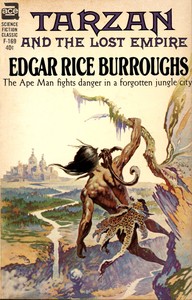
Tarzan and the lost empire — Reading Notes
(0 User reviews)
540
Project Gutenberg
2023
Not confirmed
Tarzan (Fictitious character) -- Fiction; Fantasy fiction; Adventure stories
Readers of public-domain and historical texts
Project Gutenberg digital edition
en
Edition facts
Words
69,212
Reading time
301 min
Text sections
6
The catalog record for Tarzan and the lost empire — Reading Notes provides practical reading context through 69,212 words, 5 hr 1 min estimated reading time, and 6 detected text sections.
The text analysis averages about 18.6 words per sentence, while the detected sections provide another way to judge how the source is divided.
Project Gutenberg metadata also associates the work with “Tarzan (Fictitious character) -- Fiction,” connecting these edition facts with the source record’s subject description.
Source:
Project Gutenberg record #70589
In this 1929 novel, Tarzan searches for a missing archaeologist in the Wiramwazi Mountains and discovers twin cities of Roman soldiers who have preserved Latin and ancient culture for 1500 years. The narrative contrasts Tarzan's jungle instincts with the rigid hierarchies of Castra Sanguinarius, while his monkey Nkima provides comic relief and tension.
Editorial Edition Score
4.7/5
★★★★★
★★★★★
Calculated from edition completeness, EPUB availability, text structure and catalogue metadata. Not a user rating.
How this score is calculated
- Description quality20 pts
- Title & short description10 pts
- Source metadata20 pts
- Text length15 pts
- Chapters / structure15 pts
- EPUB file integrity20 pts
Total of 100 points, scaled to a 2.5-5.0 range. Editions with an empty description or a missing EPUB file are not scored.
Edition quality
Read the Text
What was that? Von Harben strained his ears to catch the faint suggestion of a sound that arose out of the shadowy abyss below--a faint, thin sound that barely reached his ears, but he was sure that he could not be mistaken--the sound was the voices of men.
And now from out of the valley came the scream of a beast and again a roar that rumbled upward like distant thunder. To the music of these sounds, von Harben finally succumbed to exhaustion; sleep for the moment offering him relief from cold and hunger.
When morning came he gathered wood from the stunted trees near by and built a fire to warm himself. He had no food, nor all the previous day since he had reached the summit had he seen any sign of a living creature other than the game a mile beneath him on the verdant meadows of the canyon bottom.
He knew that he must have food and have it soon and food lay but a mile away in one direction. If he sought to circle the canyon in search of an easier avenue of descent, he knew that he might not find one in the hundred miles or more that he must travel. Of course he might turn back. He was sure that he could reach the base of the outer slopes of the Wiramwazi, where he knew that game might be found before exhaustion overcame him, but he had no mind to turn back and the thought of failure was only a vague suggestion that scarcely ever rose above the threshold of his conscious mind.
Having warmed himself before the fire, he turned to examine the fissure by the full light of day. As he stood upon its brink he could see that it extended downward for several hundred feet, but there it disappeared. However, he was by no means sure that it ended, since it was not a vertical cleft, but tilted slightly from the perpendicular.
From where he stood he could see that there were places in the fissure where descent would be just possible, though it might be very difficult to reascend. He knew, therefore, that should he reach the bottom of the fissure and find that further descent was impossible he would be caught in a trap from which there might be no escape.
Although he felt as fit and strong as ever, he realized perfectly that the contrary was the fact and that his strength must be ebbing and that it would continue to ebb still more rapidly the longer that he was forced to expend it in arduous efforts to descend the cliff and without any possibility of rebuilding it with food.
Even to Erich von Harben, young, self-confident and enthusiastic, his next step seemed little better than suicidal. To another the mere idea of attempting the descent of these towering cliffs would have seemed madness, but in other mountains von Harben had always found a way, and with this thin thread upon which to hang his hopes he faced the descent into the unknown. Now he was just about to lower himself over the edge of the fissure when he heard the sounds of footsteps behind him. Wheeling quickly, he drew his Luger.
Little Nkima came racing through the tree tops, jabbering excitedly, and dropped to the knee of Tarzan of the Apes where the latter lay stretched upon the great branch of a jungle giant, his back against the rough bole, where he was lying up after making a kill and feeding.
"Gomangani! Gomangani!" shrilled Nkima. "They come! They come!"
"Peace," said Tarzan. "You are a greater nuisance than all the Gomangani in the jungle."
"They will kill little Nkima," cried the monkey. "They are strange Gomangani, and there are no Tarmangani among them."
"Nkima thinks everything wants to kill him," said Tarzan, "and yet he has lived many years and is not dead yet."
"Sabor and Sheeta and Numa, the Gomangani, and Histah the snake like to eat poor little Nkima," wailed the monkey. "That is why he is afraid."
"Do not fear, Nkima," said the ape-man. "Tarzan will let no one hurt you."
"Go and see the Gomangani," urged Nkima. "Go and kill them. Nkima does not like the Gomangani."
Tarzan arose leisurely. "I go," he said. "Nkima may come or he may hide in the upper terraces."
"Nkima is not afraid," blustered the little monkey. "He will go and fight the Gomangani with Tarzan of the Apes," and he leaped to the back of the ape-man and clung there with his arms about the bronzed throat, from which point of vantage he peered fearfully ahead, first over the top of one broad shoulder and then over the top of the other.
The novel opens with a distinctive sensory detail: Nkima, Tarzan's monkey, dances excitedly on his shoulder and chatters, alerting the ape-man to an approaching presence. Muviro, sub-chief of the Waziri, remarks that Tarzan's ears are as keen as those of Bara the antelope, a comparison that immediately establishes the protagonist's acute animal-like senses. This scene, drawn from Chapter One, sets the pattern for how Burroughs weaves animal behavior into human perception—Nkima's agitation is not mere decoration but a plot mechanism that signals danger or discovery.
The story quickly moves beyond typical jungle adventure when Tarzan enters a hidden valley containing Castra Sanguinarius, a city where Latin is spoken and Roman customs persist. The narrative thus juxtaposes two worlds: the wild, instinctual realm of Tarzan and the rigid, hierarchical society of the lost Romans. This tension between nature and civilization, between the ape-man's freedom and the constraints of imperial order, drives much of the plot.
Language as a Cultural Artifact
One of the most striking features of the excerpts is the role of language. Tarzan, who already speaks English and the language of the apes, learns Latin from Festivitas, the daughter of Maximus Praeclarus. The text notes that she “set about teaching him her own language, with the result that it was not long before Tarzan could carry on a conversation in Latin.” This detail is not merely a convenience for dialogue; it underscores how language functions as a bridge between worlds. The lost Romans have preserved classical Latin, and their library contains “original Latin translations of Homer and of hitherto unknown manuscripts of Vergil, Cicero, and Caesar.” Burroughs thus uses language to suggest cultural continuity and isolation—the Romans have kept their tongue pure while the outside world has changed.
The contrast between Tarzan's multilingualism and the Romans' linguistic insularity highlights a broader theme: adaptability versus tradition. Tarzan learns Latin quickly because he must; the Romans, by contrast, have not evolved their speech in centuries. This linguistic stasis mirrors their social stasis, as the twin cities remain locked in ancient political rivalries.
The Perils of Loose Talk
A pivotal subplot involves Mpingu, a slave who inadvertently betrays secrets through boastful chatter. The narrator observes that “a penchant for boasting is not the prerogative of any time, or race, or individual,” a wry comment that universalizes Mpingu's flaw. Mpingu means no harm, but his loose words lead to his arrest by a centurion of the palace guard. The scene in the marketplace—where a crowd gathers but dares not interfere—illustrates the absolute power of Caesar's soldiers. The line “who would dare question an officer of Caesar?” echoes the fear that permeates Roman society.
This episode serves as a cautionary tale about information control in a closed society. Mpingu's fate is sealed not by malice but by indiscretion, and his arrest sets off a chain of events that likely endanger Tarzan and his allies. Burroughs uses this minor character to show how even loyal servants can become liabilities when they talk too much, a theme that resonates in the tense atmosphere of Castra Sanguinarius.
Contrasting Captivities
Tarzan and the man he seeks, von Harben, experience captivity in very different ways. Tarzan remains in Castra Sanguinarius as a “welcome guest” of Maximus Praeclarus, free to learn Latin and wait for news. Von Harben, meanwhile, is attached to the court of the Emperor of the East, living “the life of a young patrician” but chafing at his virtual imprisonment. The excerpts show him formulating escape plans, yet also finding pleasure in the palace library, where he discovers rare manuscripts. This ambivalence—between duty and desire, between scholarly delight and the urge for freedom—creates a nuanced portrait of a prisoner who is not entirely unhappy.
The parallel is emphasized by the narrative's shift: “while Tarzan of the Apes waited in Castra Sanguinarius for word that von Harben had been seen in the valley, the man he sought was living the life of a young patrician.” The juxtaposition highlights the irony that both men are trapped, but one is a guest and the other a courtier. Their different responses to confinement—Tarzan's patient observation versus von Harben's restless planning—reveal contrasting temperaments.
Readers should pay attention to the role of Nkima, whose appearances often signal shifts in tension or provide comic relief. The monkey's fear and scolding are not mere embellishments; they reflect the emotional undercurrents of scenes. Also note how Burroughs uses Latin phrases and Roman titles to create verisimilitude without overwhelming the narrative. The twin cities of Castra Sanguinarius and its eastern counterpart are not fully explored in the excerpts, leaving their political dynamics and ultimate fate open. Approach the novel as a blend of adventure and speculative history, where the lost empire serves as both a setting and a mirror for Tarzan's own dual nature.
Years of shelving have taught me that some books whisper to each other across the decades. Tarzan and the Lost Empire finds its lost Roman legion clinging to ancient order amid wild chaos, and I often think of that tension when I revisit Fortune — Edition Insights. Both understand how we build fragile worlds against the wilderness, then wonder what we’ve kept or lost. Quiet companions, those two.
There are no reviews for this eBook.
There are no comments for this eBook.
Reader reflection
How will you remember this book?
Save your reaction, strongest insight, and memorable passage.
Your progress
0
/
10
2
How did the book work for you overall?
3
Is this a title you would suggest to others?
4
Did the language feel accessible?
5
Did the book deliver what you hoped for?
6
How valuable was this book for your own interests?
7
Did you relate to its people, ideas, or situations?
8
Is this a title worth rereading?
9
Which lesson or insight stayed with you?
10