1

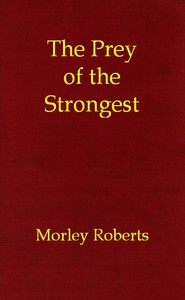
The prey of the strongest — Themes and Context
(0 User reviews)
394
Project Gutenberg
2022
Not confirmed
Revenge -- Fiction; Man-woman relationships -- Fiction; British Columbia -- Fiction; Sawmills -- Fiction
Readers of public-domain and historical texts
Project Gutenberg digital edition
en
Edition facts
Words
73,329
Reading time
319 min
Text sections
7
For The prey of the strongest — Themes and Context, the stored edition analysis reports 73,329 words, 5 hr 19 min estimated reading time, and 7 detected text sections.
The text analysis averages about 14.1 words per sentence, while the detected sections provide another way to judge how the source is divided.
Project Gutenberg metadata also associates the work with “Revenge -- Fiction,” connecting these edition facts with the source record’s subject description.
Source:
Project Gutenberg record #69014
Morley Roberts's novel follows a wandering laborer through British Columbia's sawmills and railroad camps, using a restless episodic structure and recurring images of movement along the Fraser River to explore cycles of work, revenge, and transience.
Editorial Edition Score
4.7/5
★★★★★
★★★★★
Calculated from edition completeness, EPUB availability, text structure and catalogue metadata. Not a user rating.
How this score is calculated
- Description quality20 pts
- Title & short description10 pts
- Source metadata20 pts
- Text length15 pts
- Chapters / structure15 pts
- EPUB file integrity20 pts
Total of 100 points, scaled to a 2.5-5.0 range. Editions with an empty description or a missing EPUB file are not scored.
Edition quality
Read the Text
Saw had its note, its natural song, just as naturally as a bird has: each could be told by the skilled hearer. Pete listened as he stepped inside and put his back against the studs of the wall-plates, out of the way of the hive of man, he only being a drone that hour. And the Big Hoes, Father and Mother of the Mill, droned in the cut of logs and said (or sang) that what they cut was Douglas Fir, and that it was tough. But the Pony Saw said that the last big log had been Spruce. The smell of spruce said "spruce" just as the Saw sang it. And the Trimmers screamed opposing notes, for they cut across the grain. Beneath the floor where the chorus of the Saws worked was the clatter of the lath-mill and the insistent squeal of the Shingle Saw, with its recurrent shriek of pride, "I cut a shingle, phit, I cut a shingle, phit!"
The whole Mill was a tuned instrument, a huge sounding board. There was no discord, for any discord played its part: it was one organic harmony, pleasing, fatiguing, satisfying; any dropped note was missed: if the Lath Mill stayed in silence, something was wanting, when the Shingler said nothing, the last fine addition to the music fell away. And yet the one harmony of the Mill was a background for the soloes of the Saws, for the great diapason of the Hoes, for the swifter speech of the Pony, for the sharp cross note of the Trimmers. The saws sang according to the log, to its nature, to its growth: either for the butt or the cleaner wood. In a long log the saws intoned a recitative: a solemn service. And beneath them all was the mingled song of the belts, which drove the saws, hidden in darkness, and between floors. Against the song of the Mill the voice of man prevailed nothing.
When any man desired to speak to another he went close to him and shouted. They had a silent speech for measurements in feet; the hand, the fingers, the rubbed thumb and finger, the clenched hand with thumb up, with thumb down, called numbers for the length of boards, of scantling, what not.
"Eleven feet!" said the rubbing thumb and forefinger.
If any spoke it was about the business of the Mill.
"Fine cedar this," said Mac to Jack, "fine cedar--special order--for----" a lost word.
But for the most part no one spoke but the saws. Men whistled with pursed lips and whistled dumbly: they sang too, but the songs were swallowed in the song of the Saws. They began at six and ran till noon unless a breakdown happened and some belt gave way. But none had given this day and it was ten o'clock. The men were warm and willing with work, their muscles worked warm and easy. It was grand to handle the lever and to beat in the iron dogs: to use the maul upon the wedges as the Saws squealed. They worked easy in their minds. They looked up and smiled unenvious of idle Pitt River Pete. They knew work was good, their breath felt clean: their hearts beat to the rhythm of the Mill.
As mills go it was a small one. It could not compete with the giants of the Inlet and the Sound who served Australia, which grows no good working wood, or South America. It sent no lumber to Brisbane, no boards to Callao or Valparaiso. It served the town of New Westminster and the neighbouring ranches: the little growth of townships on the River up to Hope and Yale. Sometimes it sent a cargo to Victoria or 'Squimault. A schooner even now lay alongside the wharf, piled high with new sawed stuff, that the saws had eaten as logs and spewed as lumber.
As logs! Aye, in the pool below, in the Boom, which is a chained log corral for swimming logs, a hundred great logs swam. Paul (from nowhere, but a tall thin man) was the keeper and their herder. He chose them for the slaughter, and went out upon them as they wallowed, and with a long pike stood upon the one to be sacrificed and drove it to the spot whence it should climb to the altar: a long slope with an endless cable working above and below it. He made it fast with heavy dogs, with chains may be, and then spoke to one above who clapped the Friction on the Bull-Wheel and hove the log out of the water, as if it were a whale for flensing. It went up into the Mill and was rolled upon the skids, and waited. It trembled and the Mill trembled.
From its opening pages, The Prey of the Strongest establishes a world defined by constant motion. The narrative moves with its protagonist Pete along the Fraser River, through the Fraser Cañon, and across the dry and wet belts of British Columbia. Roberts builds the novel around a series of encounters at way stations, saloons, and camps, where men drift in and out of Pete's life. The structure mirrors the itinerant labor of railroad and sawmill workers, with scenes linked less by causal plot than by the geography of the road itself. The preface, addressed to a railroad manager, frames the book as a sketch of obscure aspects of life on the Pacific Slope, and the text bears out that claim through its attention to the rhythms of wandering and the physical landscape that shapes them.
The Road as Narrative Spine
The novel’s structure is geographical rather than chronological. Roberts describes the Pacific Slope as “only one Main Street,” and the narrative follows that street from the Rocky Mountains down to the Inlet. Pete’s movements are not driven by a single goal but by seasonal shifts and personal restlessness: when the lower Fraser’s frost and rain sicken him, he climbs higher; when the dry plateau dries him out, he thinks of the wet belt. This pattern of swapping “climate for climate in a few hours” gives the book a cyclical feel, with each new location offering a variation on the same basic conditions of labor and transience. The reader encounters characters not through sustained development but through repeated meetings—a man Pete quarreled with at Savona, a partner from Kamloops—so that the road itself becomes the organizing principle.
Recurring Images of Containment and Flow
Roberts returns to images that suggest both confinement and release. The Fraser Cañon is called “the gate of the lower country and the gate of the upper country,” a narrow passage that funnels movement. Men wander “like damned souls or migratory salmon or caribou,” caught in a tideway or a whirlpool. The simile of the herring—British Columbia as “all one gut”—reduces the vast province to a single digestive tract, implying that everything passes through the same channels. These images reinforce the sense that the landscape dictates human behavior, channeling people into predictable routes and encounters. Pete himself is described as a log in the tideway, going up and down or round and round, never truly settling.
Voice and Vernacular in Dialogue
The dialogue is thick with the slang of railroad and sawmill workers. Greetings like “Klahya,” “What ho!,” and “Hell, it ain’t you?” mark the casual intimacy of a world where everyone knows everyone by sight. Pete’s speech mixes Chinook jargon with colloquial English: “She bad klootchman, yah.” The narrator adopts a similarly vernacular tone, referring to the protagonist as “Pete” and using phrases like “son of a gun” and “goldarned drifting son of a gun.” This voice is consistent with the preface’s claim that the book is a “rough and incomplete sketch,” and it gives the prose a documentary quality. The effect is to immerse the reader in the social texture of the camps without romanticizing them.
The Elusive Figure of Jenny
Jenny appears only in memory and oblique reference, yet she functions as a gravitational point in Pete’s interior life. When he thinks of her, “his face looked devilish,” but he thinks of her seldom. The Chinook phrase “She bad klootchman” reduces her to a type, but the emotional charge is clear. Roberts does not develop Jenny as a character; she exists as a wound that Pete carries from one camp to the next. Her absence is part of the novel’s larger pattern of unresolved relationships. Pete’s revenge motive, suggested by the catalog subject, remains in the excerpts a matter of inference rather than explicit action. The reader is left to piece together how this past injury might drive the narrative forward, even as the surface of the text focuses on the daily routines of work and travel.
Readers should attend to the way Roberts uses place names and physical details—the Kicking Horse Pass, the Shushwap, Eagle Pass—as anchors in a story that otherwise resists linear progression. The novel rewards attention to its recurring motifs of gates, tides, and roads, and to the vernacular that gives each encounter its particular flavor. Because the excerpts are incomplete, the precise arc of Pete’s revenge remains uncertain, but the book’s strength lies in its evocation of a world where movement is both freedom and trap.
Reading about the wanderer along the Fraser, I remembered the worn boots I left in a Calgary hostel, never claimed. There’s a strange peace in that kind of emptiness, a rhythm of moving on that feels almost like a heartbeat. That same quiet ache came back with The cobbler of Nîmes — Story, Setting & Ideas, where a fixed place, not the road, held the drifting. Both felt like the same long exhale.
There are no reviews for this eBook.
There are no comments for this eBook.
Reader reflection
Your personal reading reflection
Build a private reading journal entry for this title.
Your progress
0
/
10
2
How did the book work for you overall?
3
Would you encourage someone else to read it?
4
Did the language feel accessible?
5
What did you think about the pace?
6
Would you start a conversation about this book?
7
Would a second reading be valuable?
8
Did the book meet your expectations?
9
What changed or sharpened your thinking?
10