1

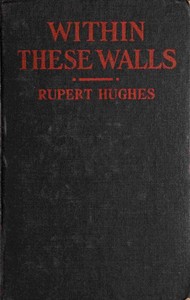
Within these walls — Reading Companion
(0 User reviews)
120
Project Gutenberg
2024
Not confirmed
Man-woman relationships -- Fiction; New York (N.Y.) -- History -- 19th century -- Fiction; Families -- Fiction
Readers of public-domain and historical texts
Project Gutenberg digital edition
en
Edition facts
Words
121,626
Reading time
529 min
Text sections
61
The source record for Within these walls — Reading Companion measures this digital text at 121,626 words, 8 hr 49 min estimated reading time, and 61 detected text sections.
The text analysis averages about 17.9 words per sentence, while the detected sections provide another way to judge how the source is divided.
Project Gutenberg metadata also associates the work with “Man-woman relationships -- Fiction,” connecting these edition facts with the source record’s subject description.
Source:
Project Gutenberg record #72904
Rupert Hughes's 1923 novel opens with a cholera-stricken New York and a tulip tree described as 'the bouquet of God,' then moves into a dinner party where Daniel Webster appears. The excerpts trace David RoBards's jealousy and the social pressures of 19th-century Manhattan.
Editorial Edition Score
4.9/5
★★★★★
★★★★★
Calculated from edition completeness, EPUB availability, text structure and catalogue metadata. Not a user rating.
How this score is calculated
- Description quality20 pts
- Title & short description10 pts
- Source metadata20 pts
- Text length15 pts
- Chapters / structure15 pts
- EPUB file integrity20 pts
Total of 100 points, scaled to a 2.5-5.0 range. Editions with an empty description or a missing EPUB file are not scored.
Edition quality
Read the Text
omes. But the cholera was faster and fiercer than commerce. It had turned Broadway into a channel of escape. It was all fugitive with citizens fleeing from this new Pompeii whose fires were from within, whose lava seethed in the loins of its people. Half the people—a hundred thousand fled.
The swine that had kept the roadway clean were frightened into the byways by the frightened men and women. The cattle droves that had gone lowing along Broadway in hundreds were thrust aside by the human herds; and their dusty wardens cursed the plague.
The street was full of funerals, lone paupers in carts, merchants with retinues of mourners on foot, moving slowly up to the burial ground for plague victims in Washington Square. Only men, of course, went to the funerals, but women joined the flight. The quick crowded the dead into the flushed gutters, and the hackney coaches, the heavy busses, the light wagons from Ford, the four-horse stages, the Tilburys, chairs, gigs, and phaetons were hurried north in a jumble of wagons and drays filled with baggage and household effects, as well as wives and children.
The city was moving once more out to Chelsea and other rural retreats. A hotel of pine boards had been run up in a Greenwich wheatfield in two days, and it held already five hundred exiles. But Greenwich was not far enough for RoBards and his precious bride. She had been too hardly won to be lightly risked.
He had bought the two bays and the Godwin carriage for the escape, and when he checked his horses under the tree before her home in Park Place, she was waiting on the step.
He had sent ahead his man, Cuff, and her woman, Teen—both of them manumitted only five years before by the New York emancipation law of 1827, both still and forever slaves at heart. They were to prepare his house in the country for the honeymoon. It was up in Westchester, beyond White Plains, near Robbin’s Mills. The stage could have carried the bride and groom, but it was booked for days ahead.
So now he helped her in and bestowed her packages. For all his fear, it was wonderful to feel the exquisite elbow of pretty Patty Jessamine in his palm, and to know that henceforth she was Mistress David RoBards.
He wished that the crowd of young and old bucks who had besought her in marriage since she was fifteen, might have been drawn up in review along Broadway to see him carry her off. Most of all he wished that Harry Chalender might have witnessed his triumph, for he had dreaded Chalender so much among his rivals that he was still surprised at his success. He wondered a little that Chalender had made no resistance to his conquest.
He whirled the steeds, and turning his back on the Columbia College Building looming through the grove behind him, sent them galloping towards City Hall placid in its marble serenity just ahead, its flower beds and grasses protected from cattle and pigs by a new picket fence.
Patty squealed and clutched RoBards’ arm, as a decently cowardly young lady ought, when the carriage spun to the left, and RoBards snapped his whip to warn away a foolish girl who swept the crossing, and one of the pestiferous boys who thrust loco-foco matches under every nose.
He almost overran the pretty girl who sold hot corn, and a shriek ended her sweet sing-song, “Lily white corn! Buy my lily white corn!”
Progress was slow among the lumbering busses and stages. Besides, the horses must be dealt with sparingly. They had twenty-seven miles ahead of them before they should reach White Plains, and five or more beyond that. And the paved streets would end at the newly opened Madison Square.
There was much to terrify the eyes in their progress. Dear friends were seen among the funeral followers, and among the fugitives many who had mocked at the prophets of the plague. But Harry Chalender was not to be seen, though RoBards did not mention him, of course. The foreign critics were ridiculing the Yankee passion for questions, but even here bridegrooms did not ask their brides about their bitterest rivals.
The thin and wretched poplar trees along Broadway were drooping under the hot midsummer sun, and the grass was yellow in the yards; for water, the greatest need of New York, was more than usually sparse. It was so expensive that sailing vessels from Europe brought with them casks enough to take them back again.
The novel begins not with a character but with a tulip tree—'the bouquet of God,' a hundred and fifty feet high, its bole so wide that a man and a girl can barely touch hands around it. This tree stands as a torch of welcome above a house that 'cuddled in its shadow,' and it introduces David RoBards returning home with his bride, fleeing a cholera epidemic that has turned New York into a city of panic, where the dead lie 'thickly strewn' in Bellevue Hospital and nurses drink and fight across the dying. The opening is dense with sensory detail: the saffron petals, the stripped sheaths, the 'grisly pilgrimages' of disease.
From this apocalyptic start, the narrative shifts to a drawing room where RoBards watches his wife Patty interact with other men, including Harry Chalender, who once saved his life. The tension is immediate and personal, framed by the larger social world of 19th-century New York.
A Tree as a Character
The tulip tree is not mere backdrop; it is the first presence the reader encounters, described with a reverence that borders on the religious. Hughes devotes a full paragraph to its height, its trunk 'deep-fluted as a Corinthian column,' and the way it 'meant a torch of welcome.' This is not a generic pastoral opening. The tree anchors the house and the homecoming, but it also introduces a pattern of lavish, almost baroque description that recurs throughout the excerpts. Later, a dinner table is 'a lake of mahogany' with a 'flotilla of heavily laden silver.' The prose is consistently ornate, piling up similes and metaphors that give the physical world a mythic weight. Readers should note how objects—a tree, a table, a glass of champagne—are never merely functional; they are charged with emotional and symbolic meaning.
The Cholera and the City
The epidemic is not a distant threat but a vivid, gruesome presence. Hughes describes 'invisible devils of pestilence' darting through the city, flinging the rich and poor to the cobblestones 'in such foul and twisted anguishes that the scavengers recoiled.' The detail is clinical and visceral: the dead in Bellevue lie so thick that physicians can barely move, and nurses from the prison 'took to drink and fought across the beds of the dying.' This is not a sanitized historical novel. The cholera functions as a force that strips away pretense, exposing the fragility of social order. Yet the excerpts show that the narrative quickly moves indoors, to the drawing room and the dinner party. The contrast between the chaos outside and the controlled rituals of society is a structural tension that readers can watch for: how does the threat of death shape the interactions of those who are, for the moment, safe?
Jealousy and the Gaze
David RoBards's interior life is dominated by jealousy, and Hughes renders it with a specificity that avoids melodrama. When Harry Chalender lifts Patty's hand to his lips, RoBards recalls having seen 'those lips on his wife’s mouth' and feels he 'ought in common decency to crush them both to death.' But he does not even frown. The gap between feeling and action is a key note. RoBards also reflects on the impossibility of monogamy in a society where women have 'rights to their own souls,' a thought that leads him to imagine the collapse of home, family, and nation. His own heart, he admits, is 'a seething chaos in little.' The excerpts offer no resolution to this conflict, but they establish a pattern: RoBards is a man who observes himself with a kind of helpless clarity, and his observations are often couched in the language of property and control.
Daniel Webster and the Performance of Society
The dinner party scene introduces Daniel Webster as a character, not a historical cameo. Patty 'almost swoons' when she learns she will go out on his arm. Webster himself is rendered with a mixture of awe and comedy: his 'mastiff jaws wagged,' his 'huge eyes saddened in a distress of homage,' and his voice, famous for eloquence, produces only 'a groan of contentment.' The scene is a set piece of social performance, complete with a detailed inventory of the food—'soup and fish and ham and turkey, venison and mutton'—and Patty's careful manners: she removes her gloves 'with caressing upward strokes' and sips her soup 'with a birdlike mincing.' Hughes is interested in the rituals that govern this world, and in the way that even a giant like Webster is reduced to awkwardness by a pretty woman. Readers should watch for how these performances reveal or conceal the characters' true feelings.
The excerpts from Within These Walls offer a world of heightened surfaces and roiling interiors. Hughes's prose is dense with simile and sensory detail, from the tulip tree to the champagne bubbles that 'tumbled and foamed to the brim.' The narrative moves between the public and the private, the historical and the intimate, without settling into any single mode. Readers attuned to the way objects and gestures carry emotional weight will find a rich text. The incomplete excerpts leave many questions open—about the fate of the marriage, the role of the epidemic, the trajectory of the plot—but they establish a distinctive voice and a specific, textured setting.
That rainy afternoon, I kept returning to the tulip tree’s quiet defiance against the cholera, and then to Webster’s blunt honesty at that tense dinner. It made me think of other men holding boundaries against chaos. Later, almost without deciding, I pulled down The Three Just Men — Reading Companion, and the same grey light seemed to fall across its pages.
There are no reviews for this eBook.
There are no comments for this eBook.
Reader reflection
Before you leave, reflect on the book
Use these questions to collect your thoughts before moving on.
Your progress
0
/
10
2
Did this book hold your interest?
3
Would you encourage someone else to read it?
4
Did the language feel accessible?
5
What was its emotional impact?
6
Would this book work well in a reading group?
7
What was the strongest part of the book?
8
Did the story or argument move comfortably?
9
What is the main idea you are taking away?
10