1

Black Canaan — Reading Notes
(0 User reviews)
255
Project Gutenberg
2023
Not confirmed
Fantasy fiction; Horror tales; Louisiana -- Fiction; Race relations -- Fiction
Readers of public-domain and historical texts
Project Gutenberg digital edition
en
Edition facts
Words
16,317
Reading time
71 min
Text sections
2
Black Canaan — Reading Notes can be approached with a clearer sense of reading commitment from its source measurements: 16,317 words, 1 hr 11 min estimated reading time, and 2 detected text sections.
The text analysis averages about 14.6 words per sentence, while the detected sections provide another way to judge how the source is divided.
Project Gutenberg metadata also associates the work with “Fantasy fiction,” connecting these edition facts with the source record’s subject description.
Source:
Project Gutenberg record #71168
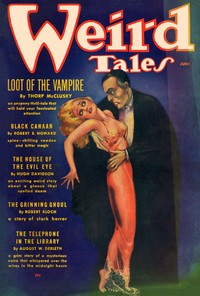
Robert E. Howard's 'Black Canaan' uses a first-person narrator racing through Louisiana swamps, with recurring images of blood-red moons, black waters, and invisible drums to build tension between the civilized world and the voodoo-haunted wilderness.
Editorial Edition Score
4.5/5
★★★★★
★★★★★
Calculated from edition completeness, EPUB availability, text structure and catalogue metadata. Not a user rating.
How this score is calculated
- Description quality20 pts
- Title & short description10 pts
- Source metadata20 pts
- Text length15 pts
- Chapters / structure15 pts
- EPUB file integrity20 pts
Total of 100 points, scaled to a 2.5-5.0 range. Editions with an empty description or a missing EPUB file are not scored.
Edition quality
Read the Text
There was no answer. A primitive silence hovered over the tiny clearing. I dismounted, tied my horse and approached the crude, heavy door. Perhaps this cabin held a clue to the mystery of Saul Stark; at least it doubtless contained the implements and paraphernalia of his noisome craft. The faint breeze dropped suddenly. The stillness became so intense it was like a physical impact. I paused, startled; it was as if some inner instinct had shouted urgent warning.
As I stood there every fiber of me quivered in response to that subconscious warning; some obscure, deep-hidden instinct sensed peril, as a man senses the presence of the rattlesnake in the darkness, or the swamp-panther crouching in the bushes. I drew a pistol, sweeping the trees and bushes, but saw no shadow or movement to betray the ambush I feared. But my instinct was unerring; what I sensed was not lurking in the woods about me; it was inside the cabin--_waiting_. Trying to shake off the feeling, and irked by a vague half-memory that kept twitching at the back of my brain, I again advanced. And again I stopped short, with one foot on the tiny stoop, and a hand half advanced to pull open the door. A chill shivering swept over me, a sensation like that which shakes a man to whom a flicker of lightning has revealed the black abyss into which another blind step would have hurled him. For the first time in my life I knew the meaning of fear; I knew that black horror lurked in that sullen cabin under the moss-bearded cypresses--a horror against which every primitive instinct that was my heritage cried out in panic.
And that insistent half-memory woke suddenly. It was the memory of a story of how voodoo men leave their huts guarded in their absence by a powerful ju-ju spirit to deal madness and death to the intruder. White men ascribed such deaths to superstitious fright and hypnotic suggestion. But in that instant I understood my sense of lurking peril; I comprehended the horror that breathed like an invisible mist from that accursed hut. I sensed the reality of the ju-ju, of which the grotesque wooden images which voodoo men place in their huts are only a symbol.
Saul Stark was gone; but he had left a Presence to guard his hut.
I backed away, sweat beading the backs of my hands. Not for a bag of gold would I have peered into the shuttered windows or touched that unbolted door. My pistol hung in my hand, useless I knew against the _Thing_ in that cabin. What it was I could not know, but I knew it was some brutish, soulless entity drawn from the black swamps by the spells of voodoo. Man and the natural animals are not the only sentient beings that haunt this planet. There are invisible _Things_--black spirits of the deep swamps and the slimes of the river beds--the negroes know of them....
My horse was trembling like a leaf and he shouldered close to me as if seeking security in bodily contact. I mounted and reined away, fighting a panicky urge to strike in the spurs and bolt madly down the trail.
I breathed an involuntary sigh of relief as the somber clearing fell away behind me and was lost from sight. I did not, as soon as I was out of sight of the cabin, revile myself for a silly fool. My experience was too vivid in my mind. It was not cowardice that prompted my retreat from that empty hut; it was the natural instinct of self-preservation, such as keeps a squirrel from entering the lair of a rattlesnake.
My horse snorted and shied violently. A gun was in my hand before I saw what had startled me. Again a rich musical laugh taunted me.
She was leaning against a bent tree-trunk, her hands clasped behind her sleek head, insolently posing her sensuous figure. The barbaric fascination of her was not dispelled by daylight; if anything, the glow of the low-hanging sun enhanced it.
"Why did you not go into the ju-ju cabin, Kirby Buckner?" she mocked, lowering her arms and moving insolently out from the tree.
Robert E. Howard's 'Black Canaan' opens with a whispered warning—'Trouble on Tularoosa Creek!'—that immediately establishes the story's central tension: the pull of a homeland menaced by an ancient, swamp-born threat. The first-person narrator, Kirby Buckner, is a Black River man who cannot ignore the call, and his journey from New Orleans back to the isolated Canaan region is marked by a series of vivid, sensory details: the 'moon set red through the black pines,' the 'shining black' creek, and the 'shuffling black crone' who delivers the message. These details root the story in a specific, atmospheric landscape.
A Landscape of Threat
The setting in 'Black Canaan' is not merely a backdrop but an active force. Howard repeatedly describes the swampland in terms of darkness, water, and hidden menace. The narrator crosses 'Nigger Head Creek,' a 'streak of shining black fringed by walls of solid shadows,' and later hears 'drums beating in Goshen' that no one else can hear. The environment is saturated with color—red moons, black branches, and 'sullen Tularoosa'—creating a visual palette that mirrors the racial and supernatural tensions. The journey is a series of thresholds: from the city to the river, from the landing to the stable, from the pike to the trail. Each step deeper into Canaan strips away the safety of the known world.
The Unseen and the Unheard
Howard builds suspense through sensory gaps. The narrator perceives things his companion cannot: the drums, the figure of a woman in the dusk, the 'black tide' that sweeps him toward Goshen. When Kirby fires his pistol at the apparition, Braxton sees nothing. This disparity between what the protagonist experiences and what others confirm creates a vertiginous uncertainty. The reader is trapped inside Kirby's consciousness, feeling the 'black rivers of Africa surging and foaming' within him. The story's horror lies not in explicit monsters but in the erosion of reliable perception—the sense that the swamp itself is alive and pulling the narrator toward an unknown fate.
Movement as Compulsion
The narrative is driven by relentless motion. From the opening line, Kirby is in transit: racing upriver, galloping on horseback, spurring down trails. This movement is rarely voluntary. He is 'drawn' by an 'invisible tie,' then 'swept' by a 'black tide,' and finally 'compelled' by a beckoning finger. Even when he tries to resist, he finds himself 'unable to help myself.' The journey is structured as a series of accelerations—from the slow boat to the frantic ride—each stage marked by a loss of control. The destination, Goshen, is a name that echoes biblical exile, but here it is a place of voodoo and massacre, a terminus that promises no redemption.
Echoes of the Ju-Ju Hut
Though the excerpts are incomplete, they hint at a central confrontation with a 'beautiful quadroon girl' who wields 'bitter magic.' The narrator's memory of a 'glade of the ju-ju hut' suggests a prior encounter that has left him vulnerable. The woman's power is not overt violence but psychological manipulation: she appears and disappears, smiles mockingly, and beckons. Kirby's reaction—sweating, shaking, firing blindly—indicates a struggle between his conscious will and an overwhelming compulsion. The story seems to pivot on whether he can resist this pull or whether he will be drawn into the 'ocean of doom' that the swamp represents. The incomplete text leaves this question open, but the trajectory is clear.
Readers should attend to the way Howard uses the first-person perspective to blur the line between internal and external threat. The narrator's unreliability is not a flaw but a feature: the story's power comes from our inability to know whether the horrors are real or the product of a mind already half-lost to the swamp. Pay attention to the moments when the landscape seems to act—the moon 'setting red,' the creek 'shining black'—as these details accumulate into a world that is both familiar and deeply alien.
That drumbeat in Howard’s swamp—it reminded me of lying in bed as a kid, hearing the river’s pulse through the window, wondering what the dark held. I had that same held-breath feeling with The sea mystery — Edition Insights, where the water’s silence felt just as loud. Both left me staring at the ceiling, half-listening for something just beyond the lamplight.
There are no reviews for this eBook.
There are no comments for this eBook.
Reader reflection
What did you think of this book?
Answer a few questions and save a private reflection on this device.
Your progress
0
/
10
2
Did this book hold your interest?
3
Would you recommend this book to another reader?
4
What was the reading difficulty like?
5
How useful did the reading feel?
6
What did you appreciate most?
7
How personally connected did you feel to the book?
8
How did the pace of the book feel?
9
What is the main idea you are taking away?
10