1

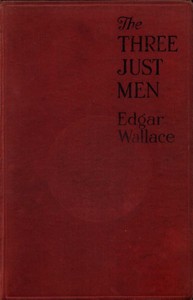
The Three Just Men — Reading Companion
(0 User reviews)
2093
Project Gutenberg
2023
Not confirmed
Detective and mystery stories; Vigilantes -- Fiction; Thrillers (Fiction)
Readers of public-domain and historical texts
Project Gutenberg digital edition
en
Edition facts
Words
97,954
Reading time
426 min
Text sections
12
The catalog record for The Three Just Men — Reading Companion provides practical reading context through 97,954 words, 7 hr 6 min estimated reading time, and 12 detected text sections.
The text analysis averages about 14.1 words per sentence, while the detected sections provide another way to judge how the source is divided.
Project Gutenberg metadata also associates the work with “Detective and mystery stories,” connecting these edition facts with the source record’s subject description.
Source:
Project Gutenberg record #69790
Edgar Wallace's 1926 thriller follows the vigilante trio as they protect a young woman from a sinister chemical firm. The narrative shifts between domestic calm and violent action, with clipped dialogue and abrupt scene changes.
Editorial Edition Score
4.8/5
★★★★★
★★★★★
Calculated from edition completeness, EPUB availability, text structure and catalogue metadata. Not a user rating.
How this score is calculated
- Description quality20 pts
- Title & short description10 pts
- Source metadata20 pts
- Text length15 pts
- Chapters / structure15 pts
- EPUB file integrity20 pts
Total of 100 points, scaled to a 2.5-5.0 range. Editions with an empty description or a missing EPUB file are not scored.
Edition quality
Read the Text
oosing a humble victim, though by no means a blameless one. An ex-convict named Sirk, a homeless down-and-out, was seen to fall by a park-keeper near the Achilles statue in Hyde Park. By the time the keeper reached him he was dead. There was no sign of a snake—nobody was near him. This time the snake had made his mark on the wrist—two little punctured wounds near together.
A month later the third man fell a victim. He was a clerk of the Bank of England, a reputable man who was seen to fall forward in a subway train, and, on being removed to hospital, was discovered to have died—again from snake-bite.
So that the snake became a daily figure of fear, and its sinister fame spread even so far afield as Heavytree Farm.
“Stuff!” said Mirabelle, yet with a shiver. “Alma, I wish you wouldn’t keep these horrors in your scrap-book.”
“They are Life,” said Alma soberly, and then: “When will you take up your appointment?” she asked, and the girl laughed.
“We will make a beginning right away—by applying for the job,” she said practically. “And you needn’t start packing your boxes for a very long time!”
An hour later she intercepted the village postman and handed him a letter.
And that was the beginning of the adventure which involved so many lives and fortunes, which brought the Three Just Men to the verge of dissolution, and one day was to turn the heart of London into a battle-field.
Two days after the letter was dispatched came the answer, typewritten, surprisingly personal, and in places curiously worded. There was an excuse for that, for the heading on the note-paper was
On the third day Mirabelle Leicester stepped down from a ’bus in the City Road and entered the unimposing door of Romance, and an inquisitive chauffeur who saw her enter followed and overtook her in the lobby.
“Excuse me, madame—are you Mrs. Carter?”
Mirabelle did not look like Mrs. Anybody.
“No,” she said, and gave her name.
“But you’re the lady from Hereford . . . you live with your mother at Telford Park . . . ?”
The man was so agitated that she was not annoyed by his insistence. Evidently he had instructions to meet a stranger and was fearful of missing her.
“You have made a mistake—I live at Heavytree Farm, Daynham—with my aunt.”
“Is she called Carter?”
“Miss Alma Goddard—now are you satisfied?”
“Then you’re not the lady, miss; I’m waiting to pick her up.”
The chauffeur withdrew apologetically.
The girl waited in the ornate ante-room for ten minutes before the pale youth with the stiff, upstanding hair and the huge rimless spectacles returned. His face was large, expressionless, unhealthy. Mirabelle had noted as a curious circumstance that every man she had seen in the office was of the same type. Big heavy men who gave the impression that they had been called away from some very urgent work to deal with the triviality of her inquiries. They were speechless men who glared solemnly at her through thick lenses and nodded or shook their heads according to the requirements of the moment. She expected to meet foreigners in the offices of Oberzohn & Smitts; Germans, she imagined, and was surprised later to discover that both principals and staff were in the main Swedish.
The pale youth, true to the traditions of the house, said nothing: he beckoned her with a little jerk of his head, and she went into a larger room, where half a dozen men were sitting at half a dozen desks and writing furiously, their noses glued short-sightedly to the books and papers which engaged their attention. Nobody looked up as she passed through the waist-high gate which separated the caller from the staff. Hanging upon the wall between two windows was a map of Africa with great green patches. In one corner of the room were stacked a dozen massive ivory tusks, each bearing a hanging label. There was the model of a steamship in a case on a window-ledge, and on another a crudely carved wooden idol of native origin.
The novel opens with an advertisement for a laboratory secretary that draws Mirabelle Leicester into the orbit of the Oberzohn firm. Wallace establishes a contrast between the mundane—a newspaper clipping circled in blue pencil—and the menace that follows. The early chapters alternate between Heavytree Farm's pastoral routines and the lurking threat, a pattern that recurs throughout. The prose is brisk, favoring short sentences and rapid shifts in focus, as when a morning scene of mist and hollyhocks is interrupted by Digby's bandaged head at a window. This oscillation between calm and crisis defines the narrative rhythm.
Voice and Dialogue as Characterization
Wallace uses dialogue to reveal character with economy. Aunt Alma's sharp retorts—"It must have been a pretty small class"—establish her as pragmatic and unsparing. Digby's speech mixes deference with pride in his police pensioner status, while his casual mention of distributing recovered loot as bonuses hints at the trio's moral ambiguity. The clipped exchanges between characters often carry subtext: when Mirabelle points out a spider, Digby's relief that no attacker came is understated. The author avoids lengthy introspection; instead, attitudes emerge through what is said and left unsaid.
Pacing Through Scene Structure
The narrative moves in short, episodic chapters with titles like "The Snake Strikes" and "When the Lights Went Out." Each chapter typically opens with a new setting or development, then builds tension through incremental details. For instance, the introduction of Heavytree Farm's staff—the departing maid with a "weak heart," the replacement thrilled by danger—creates a microcosm of normalcy under siege. Wallace often cuts from a quiet moment to sudden violence, as when Digby's sleep is broken by an attack. The pace accelerates through these abrupt transitions, with action sequences rendered in terse prose that mirrors the characters' urgency.
Recurring Details and Their Functions
Certain motifs recur to anchor the reader. The advertisement that sets events in motion is circled in blue pencil—a small, deliberate detail that emphasizes the role of chance. Heavytree Farm itself becomes a repeated setting, its chintz curtains, hollyhocks, and misty hollows providing a visual baseline against which danger is measured. The trio's wealth is mentioned twice in the excerpt: Digby notes Gonsalez was "worth a million even before the war" and describes bonuses from recovered loot. These details, while not fully explained, suggest the vigilantes operate outside conventional morality, funding their hobby with illicit gains.
Readers should attend to how Wallace withholds information. The trio's motives remain opaque; Digby calls their work "a hobby." The novel's structure rewards attention to small cues—a circled advertisement, a maid's weak heart—that later prove significant. The brisk pacing means that setting and dialogue carry the weight of exposition, making each scene a compressed unit of action and implication.
Some evenings I think back on the Wallace tale’s quiet domestic stretches, how safe rooms hold more tension than any chase. That same hush lingers when I open Within these walls — Reading Companion. The walls themselves seem to breathe, reminding me that the hardest battles are fought in rooms we once called home.
There are no reviews for this eBook.
There are no comments for this eBook.
Reader reflection
Take a moment to reflect on this book
Create a short personal record of your experience with this book.
Your progress
0
/
10
2
How did the book work for you overall?
3
How likely are you to recommend this book?
4
How much effort did this book require?
5
Was the book what you thought it would be?
6
Could you follow the author’s main argument?
7
How original did the book feel?
8
Did any part of the book feel personally relevant?
9
What is the main idea you are taking away?
10