1

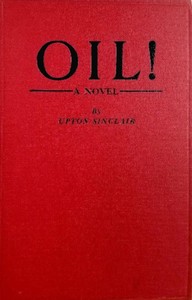
Oil! — Context and Discussion
(0 User reviews)
2722
Project Gutenberg
2023
Not confirmed
Political fiction; Motion picture industry -- Fiction; Petroleum industry and trade -- Fiction; California, Southern -- Fiction
Readers of public-domain and historical texts
Project Gutenberg digital edition
en
Edition facts
Words
230,548
Reading time
1003 min
Text sections
22
The catalog record for Oil! — Context and Discussion provides practical reading context through 230,548 words, 16 hr 43 min estimated reading time, and 22 detected text sections.
The text analysis averages about 23.0 words per sentence, while the detected sections provide another way to judge how the source is divided.
Project Gutenberg metadata also associates the work with “Political fiction,” connecting these edition facts with the source record’s subject description.
Source:
Project Gutenberg record #70379
Upton Sinclair's Oil! follows young Bunny Ross as he navigates the oil industry and radical politics in Southern California. The novel's structure alternates between intimate father-son drives and sprawling industrial landscapes, using recurring images of machinery, speed, and transformation to critique capitalism.
Editorial Edition Score
4.9/5
★★★★★
★★★★★
Calculated from edition completeness, EPUB availability, text structure and catalogue metadata. Not a user rating.
How this score is calculated
- Description quality20 pts
- Title & short description10 pts
- Source metadata20 pts
- Text length15 pts
- Chapters / structure15 pts
- EPUB file integrity20 pts
Total of 100 points, scaled to a 2.5-5.0 range. Editions with an empty description or a missing EPUB file are not scored.
Edition quality
Read the Text
usand, swarming Mexicans and Indians, bronze of skin, armed with picks and shovels; and great steam shovels with long hanging lobster-claws of steel; derricks with wide swinging arms, scrapers and grading machines, steel drills and blasting men with dynamite, rock-crushers, and concrete mixers that ate sacks of cement by the thousand, and drank water from a flour-stained hose, and had round steel bellies that turned all day with a grinding noise. All these had come, and for a year or two they had toiled, and yard by yard they had unrolled the magic ribbon.
Never since the world began had there been men of power equal to this. And Dad was one of them; he could do things like that, he was on his way to do something like that now. At seven o’clock this evening, in the lobby of the Imperial Hotel at Beach City, a man would be waiting, Ben Skutt, the oil-scout, whom Dad described as his “lease-hound”; he would have a big “proposition” all lined up, and the papers ready for signature. So it was that Dad had a right to have the road clear; that was the meaning of the sharp military voice of the horn, speaking through its nose: “Whanhnh! Whanhnh! Dad is coming! Get out of the way! Whanhnh! Whanhnh!”
The boy sat, eager-eyed, alert; he was seeing the world, in a fashion men had dreamed in the days of Haroun al Raschid—from a magic horse that galloped on top of the clouds, from a magic carpet that went sailing through the air. It was a giant’s panorama unrolling itself; new vistas opening at every turn, valleys curving below you, hilltops rising above you, processions of ranges, far as your eye could reach. Now that you were in the heart of the range, you saw that there were trees in the deep gorges, towering old pine trees, gnarled by storms and split by lightning; or clumps of live oaks that made pleasant spaces like English parks. But up on the tops there was only brush, now fresh with the brief spring green; mesquite and sage and other desert plants, that had learned to bloom quickly, while there was water, and then stand the long baking drought. They were spotted with orange-colored patches of dodder, a plant that grew in long threads like corn-silk, weaving a garment on top of the other plants; it killed them—but there were plenty more.
Other hills were all rock, of an endless variety of color. You saw surfaces mottled and spotted like the skins of beasts—tawny leopards, and creatures red and grey or black and white, whose names you did not know. There were hills made of boulders, scattered as if giants had been throwing them in battle; there were blocks piled up, as if the children of giants had grown tired of play. Rocks towered like cathedral arches over the road; through such an arch you swung out into view of a gorge, yawning below, with a stout white barrier to protect you as you made the turn. Out of the clouds overhead a great bird came sailing; his wings collapsed as if he had been shot, and he dived into the abyss. “Was that an eagle?” asked the boy. “Buzzard,” answered Dad, who had no romance in him.
Higher and higher they climbed, the engine purring softly, one unvarying note. Underneath the wind-shield were dials and gauges in complicated array: a speedometer with a little red line showing exactly how fast you were going; a clock, and an oil gauge, a gas gauge, an ammeter, and a thermometer that mounted slowly on a long grade like this. All these things were in Dad’s consciousness—a still more complicated machine. For, after all, what was ninety horsepower compared with a million dollar power? An engine might break down, but Dad’s mind had the efficiency of an eclipse of the sun. They were due at the top of the grade by ten o’clock; and the boy’s attitude was that of the old farmer with a new gold watch, who stood on his front-porch in the early morning, remarking, “If that sun don’t get over the hill in three minutes, she’s late.”
But something went wrong and spoiled the schedule. You had got up into the fog, and cold white veils were sweeping your face. You could see all right, but the fog had wet the road, and there was clay on it, a combination that left the most skilful driver helpless. Dad’s quick eye noted it, and he slowed down; a fortunate thing, for the car began to slide, and almost touched the white wooden barrier that guarded the outer edge.
From its first sentence, Oil! establishes a distinctive rhythm of motion. The opening chapter, “The Ride,” describes a road as “a ribbon of grey concrete, rolled out over the valley by a giant hand,” and the prose itself moves with the same smooth, relentless pace. Sinclair repeatedly contrasts the polished surfaces of the automobile—the wind-shield, the tan overcoat, the horn-rimmed spectacles—with the raw, often violent processes of oil extraction and social upheaval. This tension between polished appearance and gritty reality structures the entire novel.
The narrative shifts between Bunny’s sheltered perspective and broader social panoramas, a technique Sinclair signals in his preface: “Shuffle the cards, and deal a new round of poker hands.” The reader is never allowed to settle into a single viewpoint, just as the characters are never allowed to settle into a single moral position.
The Ribbon and the Refinery
The novel’s opening image of the road—precise, fourteen feet wide, “unmarred by bump or scar”—immediately establishes a world of engineered perfection. But this perfection is fragile. The road exists for the passage of “inflated rubber wheels revolving seven times a second,” a mechanical rhythm that recurs throughout the book. Later, when Bunny visits the refinery, the machinery takes on a life of its own: a building made of “enormous baking-pans set one inside another,” steam that “had a faint violet tinge,” and forty-four exhaust pipes puffing in unison “like an orchestra.” Sinclair’s descriptions of industrial processes are precise and almost musical, turning the refinery into a kind of performance. Yet the beauty is always undercut by the sickish sweet odors that “frightened the quail away.” The landscape itself is transformed, and the novel repeatedly returns to the cost of this transformation.
Bunny’s Education Through Contrast
Bunny Ross is defined by his relationship to his father, “Dad,” whose way “constituted the ethics of motoring.” The boy’s coat, gloves, and spectacles are exact copies of his father’s, signaling a world where identity is inherited and uniform. But the novel quickly introduces a counterforce: the radical Paul, whose stories of Bolshevik Russia “transvaluated all his values.” Sinclair structures Bunny’s education as a series of shocks. Paul’s account of women teachers in a cattle-car, “without a single blanket,” and his claim that “the only Bolshevik atrocity … was the fundamental one of teaching the workers they had a right to rule the world,” directly challenges the comfortable certainties of Bunny’s upbringing. The narrative does not endorse either position; instead, it places them in unresolved tension, mirroring the larger conflicts of the era.
The Shuffled Deck of Characters
Sinclair’s preface warns that “names, places, dates, details of character, episodes—everything has been dealt over again.” This deliberate shuffling means that characters often feel like placeholders in a larger argument. The oil magnates, the movie stars, the politicians—they appear and disappear, their stories fragmentary. Even Bunny, the closest thing to a protagonist, is less a fully realized individual than a consciousness through which the novel’s ideas pass. The only figures who remain fixed are the three presidents mentioned by name, anchoring the fiction to a recognizable historical reality. This technique gives the novel a documentary quality, but it also means that emotional engagement is often displaced onto the machinery, the landscapes, and the abstract forces of capital and labor.
Movement as Method
The novel’s structure is fundamentally kinetic. Scenes shift rapidly from the car to the oil field to the refinery to the radical meeting. Sinclair uses movement not just as a setting but as a narrative principle. The ride in the opening chapter is a microcosm of the entire book: a smooth, controlled journey that nevertheless contains the potential for sudden dips and turns. Bunny’s intellectual journey mirrors this physical motion—he is “like a man lost in a tangled forest” until Paul takes him “up in a balloon” to show him the way out. But the balloon ride is also a deception; the view from above simplifies what remains tangled on the ground. The novel never resolves this tension, leaving the reader, like Bunny, suspended between the ribbon of concrete and the chaotic landscape it traverses.
Oil! rewards attention to its recurring images: the road, the refinery, the automobile, the steam. Sinclair’s prose is at its best when describing physical processes—the puff of exhaust pipes, the violet tinge of steam, the feel of wind against a hand. These details ground the novel’s political arguments in sensory experience. Readers should watch for the way Sinclair uses the car as a framing device: it is both a symbol of wealth and a vehicle for escape, a sealed environment that nevertheless lets the world rush past. The novel’s power lies not in its conclusions but in its restless, searching motion.
Years after first closing Oil!, I still think of Bunny and his father in that rattling car, the machinery humming beneath their talk. There is a certain companionship in that ride—the shared silence, the road unspooling. I found that same unhurried intimacy again in "To let" — Reading Companion, almost as if the pages remembered each other's company.
There are no reviews for this eBook.
There are no comments for this eBook.
Reader reflection
Your personal reading reflection
Build a private reading journal entry for this title.
Your progress
0
/
10
2
Was reading this book enjoyable?
3
Would you pass this book on to a friend?
4
How demanding did the text feel?
5
Did the book give you something worth debating?
6
How distinctive were its ideas or approach?
7
Could you follow the author’s main argument?
8
Which aspect of the book did you value most?
9
What did this book teach you most?
10