1

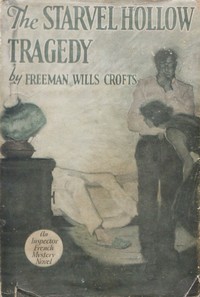
The Starvel Hollow tragedy — Text and Context
(0 User reviews)
686
Project Gutenberg
2023
Not confirmed
Detective and mystery stories; Police -- Great Britain -- Fiction; French, Joseph (Fictitious character) -- Fiction
Readers of public-domain and historical texts
Project Gutenberg digital edition
en
Edition facts
Words
93,409
Reading time
407 min
Text sections
23
The source record for The Starvel Hollow tragedy — Text and Context measures this digital text at 93,409 words, 6 hr 47 min estimated reading time, and 23 detected text sections.
The text analysis averages about 16.0 words per sentence, while the detected sections provide another way to judge how the source is divided.
Project Gutenberg metadata also associates the work with “Detective and mystery stories,” connecting these edition facts with the source record’s subject description.
Source:
Project Gutenberg record #71073
An Inspector French case set on the Yorkshire moors, where a miser's death by fire leads to a complex investigation involving blackmail, a missing brother, and a trip to Talloires. The excerpts reveal a focus on character testimony and financial motives.
Editorial Edition Score
4.9/5
★★★★★
★★★★★
Calculated from edition completeness, EPUB availability, text structure and catalogue metadata. Not a user rating.
How this score is calculated
- Description quality20 pts
- Title & short description10 pts
- Source metadata20 pts
- Text length15 pts
- Chapters / structure15 pts
- EPUB file integrity20 pts
Total of 100 points, scaled to a 2.5-5.0 range. Editions with an empty description or a missing EPUB file are not scored.
Edition quality
Read the Text
th was born in Southern France, and she had dim recollections of a land of sun and warmth, of jolly people and bright colours. But since she had come to this gloomy old house in the wilds of the Yorkshire moors the joy had gone out of her life. Her companions during childhood had been the two not very prepossessing servants and the still less attractive gardener and out-door man. With her uncle Simon she had nothing in common. Even at the time of her arrival he was elderly and morose, and every day he seemed to grow more self-centred and less approachable.
After some years a break had come in her life; she had been sent to a boarding school. But she had not been happy there, so that when she was “finished” she was almost glad to return to the dullness and loneliness of Starvel.
There she had found changes. Her uncle Simon was now an invalid, querulous and solitary, and living only for the accumulation of money. His passion took the form of collecting actual coins and notes and hoarding them in his safe. He made no attempt to cultivate the friendship of his niece, and had it not been that he required her to read to him once a day, she would have seen him but seldom.
At this time also the two old women servants and the gardener had gone, and their places had been taken by a comparatively young married couple called Roper. Though more efficient than their predecessors, Ruth did not take to either of the newcomers, with the result that the fourteen months which had passed since her return from school were lonelier than ever.
Had it not been that Ruth had developed an interest in flowers and gardening, she would have found herself hard put to it to fill her life. Gardening and her friendship with a semi-invalid entomologist who lived close by, together with occasional excursions to the neighbouring market town of Thirsby, were the only distractions she could count on.
But recently another factor had come into her life. She had met on a number of occasions a young man named Pierce Whymper, the junior assistant of an ecclesiastical architect in Leeds. Whymper was acting as clerk of works during some renovations to the parish church at Thirsby, and when Ruth had gone with one or two of the local ladies to inspect the work he had been particularly attentive. He had begged her to come again to see how the job progressed, and she had done so on more than one occasion. Then one day she had met him walking near Starvel, and she had invited him to come in and have tea. This visit had been followed by others and they had made excursions together on the moor. Though no word of love had been spoken during any of these interviews, she knew that he was attracted to her, and though she would hardly admit it to herself, she knew also that she would marry him if he should ask her.
Such was the general condition of affairs in the old house of Starvel on this gloomy September afternoon, an afternoon which was to be remembered by Ruth as the end of her old life and the prelude to a new existence in a different world.
As she was standing, staring mournfully out of the window, the attendant, Roper, entered the room. She did not know then, though she realised it afterwards, that the message he was bringing her was to be the herald of a series of terrible and tragic happenings, so dark and sinister and awful that had she foreseen them she might well have cried out in horror and dismay. But she did not foresee them, and she turned with her instinctive courtesy to hear what the man had to say.
The message, though almost unprecedented, was in itself the reverse of alarming. Roper explained that Mr. Averill had instructed him to hand this note, which he had received in a letter to himself, to Miss Ruth, and to say that he hoped Miss Ruth would accept the invitation it contained. Further, that as there would be expenses in connection with the visit, he wished Miss Ruth to have the ten pounds enclosed in this other envelope. She could go in to Thirsby in the morning, get any little thing she might want, and go on to York in the afternoon.
With rapidly beating heart Ruth unfolded the dog-eared corner of the note, which was addressed simply “Ruth,” and read as follows:—
“Oakdene,” Ashton Drive, York. _September_ 10_th_.
The opening chapter of The Starvel Hollow Tragedy introduces Ruth Averill in a single, sustained tableau: she stands at a window, watching rain lash the moor while the narrator inventories her worn dress, darned stockings, and the "brooding look of melancholy" on her face. The prose lingers on material details—the grass-grown drive, the broken-down paling, the threadbare fabric—before revealing that Ruth is an orphan dependent on her miserly uncle, Simon Averill. This slow, almost static beginning is unusual for a detective novel; it prioritizes atmosphere and economic vulnerability over immediate action.
A Detective Story That Delays Its Detective
Inspector French does not appear until Chapter IV, after the tragedy (a fire at Starvel Hollow), an inquest, and a lengthy exposition of a theory by a character named Mr. Tarkington. The early chapters are given over to establishing the household and the suspicious circumstances through the eyes of Ruth and the local community. French’s late entry suggests that Crofts is less interested in a puzzle-box plot than in the social and psychological context of the crime. When French finally arrives, he works methodically, interviewing witnesses and scrutinizing bank notes. The excerpts show him weighing a young man’s statement—not for its drama, but for its internal consistency and fit with known facts.
The Mechanics of a Confession Scene
A long passage in the excerpts presents a character named Whymper recounting, under French’s questioning, a secret errand to Talloires. The speech is rendered in direct, unadorned prose: “I swear to you that what I have told you is the literal truth.” French’s reaction is equally procedural: he notes that Whymper’s manner “borne the almost unmistakable impress of truth,” but he also identifies two minor points that remain unexplained—why Roper asked for a three-week delay, and why Whymper did not propose to Ruth. The scene is less about emotional revelation than about the accumulation of verifiable detail: sums of money, addresses, a monthly payment scheme. Crofts builds credibility through specificity, not suspense.
The Miser’s House as a Character
The setting of Starvel Hollow is drawn with a precision that borders on the documentary. The house is “dilapidated,” the lawn “untidy,” the moor “wild and lonely and forbidding.” Ruth’s clothing is described as “in the fashion of three years earlier,” and her shoes are “cracked.” These details are not decorative; they signal the economic straits that drive the plot. Simon Averill is a miser, but the text shows his miserliness through objects—the threadbare dress, the broken paling—rather than through direct characterization. The moor itself, with its “dun-coloured sedgy grass” and rock outcroppings, becomes a barrier and a boundary, isolating the household and concentrating the narrative’s attention on the few people who inhabit it.
Readers approaching The Starvel Hollow Tragedy should expect a deliberate, almost unhurried narrative that values procedure over surprise. Crofts devotes considerable space to the texture of daily life in a constrained household, and the mystery unfolds through patient interviews and the weighing of testimony. The excerpts suggest that the novel’s satisfactions lie less in a shocking reveal than in the gradual assembly of a coherent account from partial, sometimes contradictory statements.
The arson in The Starvel Hollow Tragedy brought back a grey Yorkshire afternoon, rain against my window, the smell of old paper. I remembered, then, the quiet menace of stranger’s motives in The Three Just Men — Reading Companion, where every confession felt like a clue. Both books share that hushed feeling—of being alone with other people’s secrets.
There are no reviews for this eBook.
There are no comments for this eBook.
Reader reflection
How will you remember this book?
Save your reaction, strongest insight, and memorable passage.
Your progress
0
/
10
2
Was reading this book enjoyable?
3
Would you encourage someone else to read it?
4
How much effort did this book require?
5
Was the book what you thought it would be?
6
Would you read this book again?
7
Did it raise ideas you would like to talk about?
8
How clearly were the main ideas presented?
9
Which lesson or insight stayed with you?
10