1

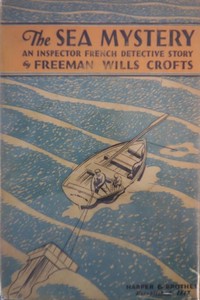
The sea mystery — Edition Insights
(0 User reviews)
2694
Project Gutenberg
2024
Not confirmed
Detective and mystery stories; Police -- Great Britain -- Fiction; French, Joseph (Fictitious character) -- Fiction
Readers of public-domain and historical texts
Project Gutenberg digital edition
en
Edition facts
Words
80,397
Reading time
350 min
Text sections
23
This digital edition of The sea mystery — Edition Insights is described by source-level measurements including 80,397 words, 5 hr 50 min estimated reading time, and 23 detected text sections.
The text analysis averages about 13.4 words per sentence, while the detected sections provide another way to judge how the source is divided.
Project Gutenberg metadata also associates the work with “Detective and mystery stories,” connecting these edition facts with the source record’s subject description.
Source:
Project Gutenberg record #72771
Crofts opens with a serene Welsh estuary scene before a crate containing a corpse is dragged up in a fishing net. Inspector French's methodical investigation, including timing experiments and analysis of a drugged watchman's tea, drives a plot that hinges on railway timetables and industrial routines.
Editorial Edition Score
4.9/5
★★★★★
★★★★★
Calculated from edition completeness, EPUB availability, text structure and catalogue metadata. Not a user rating.
How this score is calculated
- Description quality20 pts
- Title & short description10 pts
- Source metadata20 pts
- Text length15 pts
- Chapters / structure15 pts
- EPUB file integrity20 pts
Total of 100 points, scaled to a 2.5-5.0 range. Editions with an empty description or a missing EPUB file are not scored.
Edition quality
Read the Text
d through his mind when the line he was holding tightened suddenly and began to run out through his fingers. At the same moment the next line, which was made fast round the after thwart, also grew taut, strained for a second, then with a jerk slackened and lay dead. Evan leaped to his feet and screamed out in excitement:
“Hold, daddy, hold! Back water quick! I’ve got something big!”
The line continued to run out until Mr. Morgan, by rowing against the tide, brought the boat relatively to a standstill. Then the line stopped as if anchored to something below, twitching indeed from the current, but not giving the thrilling chucks and snatches for which the boy was hoping.
“Oh, blow!” he cried, disgustedly. “It’s not a fish. We’ve got a stone or some seaweed. See, this one caught it, too.”
He dropped the line he was holding and pulled in the other. Its hooks were missing.
“See,” he repeated. “What did I tell you? We shall probably lose the hooks of this one, too. It’s caught fast.”
“Steady, old man. Take the oars and let me feel it.”
Mr. Morgan moved into the stern and pulled the resisting line, but without effect.
“Rather curious this,” he said. “All this stretch is sand. I once saw it uncovered at very low springs. Keep rowing till I feel round the thing with the grappling and see if I can find out what it is.”
Evan passed the small three-pronged anchor aft and his father let it down beside the line. Soon it touched bottom.
“About three and a half fathoms—say twenty feet,” Mr. Morgan remarked. “Keep her steady while I feel about.”
He raised the grappling and, moving it a few inches to one side, lowered it again. Four times it went down to the same depth; on the fifth trial it stopped three feet short.
“By Jove!” he exclaimed, “there’s something there right enough.” He danced the grappling up and down. “And it’s certainly not seaweed. Treasure trove, Evan, eh?”
“Try round a bit and see how big it is,” Evan suggested, now thoroughly interested.
Mr. Morgan “tried round.” Had he been by himself he would have dismissed the incident with a muttered imprecation at the loss of his hooks. But for the sake of the boy he wished to make it as much of an adventure as possible.
“Curious,” he therefore commented again. “I’m afraid we shall not be able to save our hooks. But let’s take bearings so that we may be able to ask about it ashore.” He looked round. “See, there’s a good nor’west bearing. That signal post on the railway is just in line with the west gable of the large white house on the hill. See it? Now for a cross bearing. Suppose we take that tall mill chimney, the tallest of that bunch. It’s just in line with the pier-head beacon. What about those?”
“Fine, I think. What can the thing be, dad?”
“I don’t know. Perhaps something drifted in from a wreck. We’ll ask Coastguard Manners. Now I’ll pull in the grappling, and then the line, and if the hooks go I can’t help it.”
The little anchor had been lying on the bottom while they talked. Mr. Morgan now seized the rope and began to pull. But he had not drawn in more than two feet when it tightened and remained immovable.
“By Jove! The grappling’s caught now!” he exclaimed. “A nuisance, that. We don’t want to lose our grappling.”
“Let’s pull up. Perhaps it will come clear.”
Evan put down the oars and joined his father in the stern. Both pulled steadily with all their strength. For a time nothing happened, then suddenly the rope began to yield. It did not come away clear, but gave slowly as if the object to which it was attached was lifting also.
“By Jove!” Mr. Morgan exclaimed again. “We shall get our hooks, after all! The whole thing’s coming up.”
Slowly the rope came in foot after foot. The object, whatever it was, was heavy, and it was all they could do to raise it. Mr. Morgan pulled in sudden heaves, while Evan took a turn with the line round a thwart, so as to hold the weight while his father rested.
At last the end of the rope was reached and the shank of the grappling appeared. Then dimly beneath the surface Mr. Morgan was able to see the object hooked. It was a large wooden packing case or crate.
The first chapter of The Sea Mystery establishes a deceptively tranquil setting: Mr. Morgan and his son Evan fish in the Burry Inlet on a late September evening, the landscape described with precise topographical detail—Carmarthen to the north, Gower Peninsula to the south, Llanelly's chimneys and harbor visible. The calm is shattered when their net brings up a heavy crate containing a dead body. Crofts devotes careful attention to the Morgans' reactions and the subsequent police procedures, grounding the mystery in the physical particulars of the Welsh coast.
A Landscape of Clues
The opening pages do more than set a mood; they map the terrain that will later yield evidence. Crofts names specific locations—Salthouse Point, Penclawdd, Burry Port—and notes the tide's behavior, the visibility of landmarks, and the sounds of distant mills. This geographical precision is not decorative. When Inspector French later reconstructs events, he will rely on such details: the distance a car could travel, the timing of a boat's movement, the line of sight from a particular point. A first-time reader should note these place names and physical descriptions, as they become reference points in the investigation.
The Detective's Experimental Method
French's approach, as shown in the excerpts, is notably hands-on. He does not merely interview witnesses; he reenacts their actions. In the boiler-house scene, he borrows the night watchman's key, locks himself out, rings the office bell, then times how long it takes Gurney to respond. He opens the tea can, counts to ten, and calculates whether someone could have drugged it unseen. This experimental detection—testing the feasibility of a crime—is a hallmark of Crofts' style. Readers should watch for similar practical tests throughout the narrative, as they often yield the crucial breakthrough.
The Watchman's Testimony and Its Gaps
John Gurney, the night watchman, provides a detailed account of his routine: he brings a can of tea and a basket of food, leaving them on the boiler's warm brickwork. He admits to sleeping through his second meal, and French seizes on the leftover tea and food. The old man's puzzled reaction—"we 'ad it for breakfast, my wife an' I"—and his admission that they felt no drowsiness afterward, initially seems to undermine French's drugging theory. But French's reasoning shows how a criminal could have poured away the doped tea and replaced it with fresh. This moment illustrates Crofts' method: presenting an apparent obstacle, then showing how methodical thinking overcomes it.
Timetables and Alibis
A key complication emerges when French's theory of Berlyn's guilt collides with the timing of the office-door ring. The ring came shortly before ten, but Berlyn was at Tavistock at that hour. French must therefore posit either a second murderer or an accomplice. The narrative here hinges on railway schedules and travel times—a recurring feature in Crofts' work. Readers should pay close attention to any mention of train arrivals, departures, or distances, as these are not incidental color but the scaffolding of the plot. The car's availability and the possibility of a quick return journey become central to French's revised hypothesis.
Crofts builds his mystery not on psychological complexity but on the patient assembly of physical evidence and temporal logic. A first reading benefits from tracking each piece of information as French encounters it: the crate's dimensions, the tide tables, the watchman's routine, the railway timetables. The author rarely wastes a detail, and what seems like a minor observation in one chapter often becomes the linchpin of a later deduction. Approach the text as French would—with a notebook and a willingness to question every assumption.
That rainy afternoon, Crofts’ Welsh estuary felt damp on my skin—the crate’s weight, the drugged tea, French’s patient clock-watching. Afterwards, I drifted to Oil! — Context and Discussion, and noticed how both authors treat industry as a quiet, grinding character. Timetables, pump jacks, men’s routines unhurriedly burying their secrets. I closed the lamp then, rain still tapping, thinking how patience reveals what greed hides.
There are no reviews for this eBook.
There are no comments for this eBook.
Reader reflection
Take a moment to reflect on this book
Create a short personal record of your experience with this book.
Your progress
0
/
10
2
How much did you enjoy the reading experience?
3
Would you pass this book on to a friend?
4
How demanding did the text feel?
5
How strongly did the book affect you emotionally?
6
How useful did the reading feel?
7
Did any part of the book feel personally relevant?
8
Did the book offer a fresh perspective?
9
Which lesson or insight stayed with you?
10