1

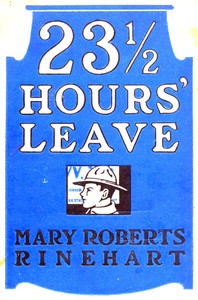
Twenty-three and a half hours' leave — Text and Context
(0 User reviews)
412
Project Gutenberg
2022
Not confirmed
World War, 1914-1918 -- Fiction; Soldiers -- Fiction; Man-woman relationships -- Fiction
Readers of public-domain and historical texts
Project Gutenberg digital edition
en
Edition facts
Words
18,808
Reading time
82 min
Text sections
8
This digital edition of Twenty-three and a half hours' leave — Text and Context is described by source-level measurements including 18,808 words, 1 hr 22 min estimated reading time, and 8 detected text sections.
The text analysis averages about 13.0 words per sentence, while the detected sections provide another way to judge how the source is divided.
Project Gutenberg metadata also associates the work with “World War, 1914-1918 -- Fiction,” connecting these edition facts with the source record’s subject description.
Source:
Project Gutenberg record #68950
A World War I story following Sergeant Gray during a 23.5-hour leave, where a chance encounter with a mysterious woman leads to a covert mission involving a suspicious photographer, told through tight dialogue and shifting scenes.
Editorial Edition Score
4.6/5
★★★★★
★★★★★
Calculated from edition completeness, EPUB availability, text structure and catalogue metadata. Not a user rating.
How this score is calculated
- Description quality20 pts
- Title & short description10 pts
- Source metadata20 pts
- Text length15 pts
- Chapters / structure15 pts
- EPUB file integrity20 pts
Total of 100 points, scaled to a 2.5-5.0 range. Editions with an empty description or a missing EPUB file are not scored.
Edition quality
Read the Text
es me,” went on Sergeant Gray meditatively. “It’s about a week now since he told me I was a disgrace to the uniform. How’d I know I was going to sneeze in his horse’s ear just as he was climbing on?”
“Suffering snakes!” cried the second mess sergeant. “Go to bed! You’re delirious.”
Sergeant Gray put a dimple in the girl’s cheek and surveyed it critically.
“Yep. The old boy’s crazy about me,” he ruminated aloud. “Asked me the other day if I thought I’d fight the Germans as hard as I fought work.”
“Probably be asking you to breakfast,” observed the second mess sergeant, beginning on a new sheet. “He’s in the habit of having noncoms to eat with him.”
The subtlety of this passed over Sergeant Gray’s head. He was carefully adding a small ear to his drawing, an ear which resembled an interrogation point. But a seed had been dropped on the fertile soil of his mind. He finished, yawned again and grinned.
“All right,” he said. “_C’est la guerre_, as the old boy says. I’ll lay you two dollars to one I eat breakfast with him within a month.” His imagination grew with the thought. “Wait! I’ll eat bran muffins with him at breakfast within a month. How’s that?”
“It’s simple damn foolishness,” observed the second mess sergeant. “I’ll take you if you’ll go to bed and lemme alone.”
“‘Lemme,’” observed Sergeant Gray, “is probably Princeton. In Harvard we——”
But the second mess sergeant had picked up the inkwell and was fingering it purposefully.
“All right, dear old thing,” said Sergeant Gray.
And he rose, stretching his more than six feet to the uttermost. Then he made his way through the rows of beds to the sergeant’s corner, and removing his blouse, his breeches, his shoes and his puttees was ready for sleep. His last waking thought was of his wager.
“A bran muffin with the Old Man!” he chuckled. “A bran muffin! A——”
Something heavy landed on his chest with a great thump, and after turning round once or twice settled itself there for the remainder of the night. Lying on his back, so as to give his dog the only possible berth on the tiny bed, Sergeant Gray, all-American athlete and prime young devil of the Headquarters Troop, went fast asleep.
Reveille the next morning, however, found him grouchy. He kicked the dog off his legs, to which the animal had retired, and reaching under his pillow brought out his whistle. He blew a shrill blast on it. The lower squad room groaned, turned over, closed its eyes. He blew again.
“Roll out!” he yelled in stentorian tones. “R-r-roll out, you dirty horsemen!”
Then he closed his eyes again and went peacefully to sleep. He dreamed that the general was carrying a plate of bran muffins to his bedside, and behind him was a pretty girl with coffee and an ear like an interrogation point. He wakened to find breakfast over and the cook in a bad temper.
“Be a sport, Watt,” he pleaded. “Just a cup of coffee, anyhow.”
“I fed your dog for you. That’s all you get.”
“I can’t eat the dog.”
“Go on out,” said the cook. “This ain’t the Waldorf-Astoria. Nor Childs’ neither.”
“Some day, on the field of honor,” said Sergeant Gray, “you will lie wounded, Watt. You will beg for a cup of water, and I shall refuse it, saying——”
“Give him something to get rid of him,” the cook instructed his helper.
And Sergeant Gray was fed. As he drank his coffee he reflected as to his wager of the night before. It appealed to his sporting instinct but not to his reason. He had exactly as much chance to eat a bran muffin with the general as he had to sign peace terms with the Kaiser.
He drank his tepid coffee and surveyed his finger nails disconsolately. The faces had only partially disappeared during his morning’s ablution.
“This is the life, Watt!” he said to the cook. “Wine, women and song, eh?”
But the cook was cutting his finger nails, preparatory to morning inspection.
Now the ink pictures on Sergeant Gray’s finger nails had a certain significance. They bore, to be exact, a certain faint resemblance to a young lady whose photograph was now concealed against inspection in the sergeant’s condiment can. The young lady in question had three days before wired the sergeant to this effect:
“Married Bud Palmer yesterday. Please wish me happiness.”
To which, concealing a deep hurt, the sergeant had replied: “Praying earnestly for you both.”
The story opens in a barracks humming with preparation for deployment, where Sergeant Gray records his own disciplinary infraction—absent without leave—on a pay roll. The narrative immediately establishes a tone of bureaucratic absurdity: a stable sergeant is chosen for his motorcycle racing, a chief mechanic once ran a livery stable. This ironic mismatch between military roles and civilian skills recurs throughout.
Gray’s leave begins at two in the morning, and the first scene outside the barracks hinges on a single object: a raincoat he insists on wearing despite clear, hot weather. The raincoat becomes a visual cue for concealment and unease, setting up a pattern of objects that carry hidden meanings.
The Raincoat as a Recurring Motif
The raincoat appears in the opening illustration caption and the first dialogue: “You’ll have to take that raincoat off, of course.” Gray’s refusal to remove it, despite the heat, creates an impasse with the girl. He mutters about having a cold; she counters that dressing too warmly will make him sicker. The slicker is not just clothing—it is a prop that signals Gray’s discomfort and his attempt to hide something. Later, when he puts on the slicker before leaving the barracks, the narrator notes “the absence of wind, he felt, was in his favour,” implying the coat serves a purpose beyond weather. The object recurs as a point of tension, a visual shorthand for secrets not yet revealed.
Movement Between Confined and Open Spaces
The story shifts between cramped interiors—the tiny office cut off from the squad room, the barracks humming day and night—and open, mobile spaces: the car ride, the road, the city. Gray’s leave begins at two A.M. in a “tiny office” where he surveys his own arrest record. The next scene moves to the outdoors, where the sun gleams and he hesitates. The car journey takes them past the end of the trolley line, into unknown territory. This movement from confinement to openness mirrors Gray’s transition from military routine to a civilian adventure that quickly becomes a detective-like mission. The girl’s car becomes a mobile stage for their conversation, and the road a threshold between the known camp and the uncertain city.
Dialogue as a Vehicle for Suspense
The exchanges between Gray and the girl are clipped, loaded with implication. She speaks in commands and flat statements: “You are late,” “You’d better take that raincoat back,” “I want you to get your picture taken.” Gray responds with muttered excuses, guilt, and surprise. The dialogue reveals character through what is left unsaid. When she hands him a card for a photographer, he reads it carefully, turns it over, and admits, “I don’t get it, I guess.” Her reply—“The more I see of army men the less imagination I find”—is both a critique and a challenge. The conversation builds tension through small revelations: the photographer was once court photographer at Vienna. Each line advances the mystery without explaining it fully.
The Photographer’s Card as a Plot Device
A small boy flings a card into the car; the girl already has one in her pocket. The card—advertising J. M. Booth, cheap photographs, rush orders for soldiers—is initially dismissed as trivia. But Gray’s careful reading and the girl’s revelation that the man was once the court photographer at Vienna transform it into evidence of espionage. The card is a tangible link between the mundane (a soldier’s souvenir photo) and the covert (a spy network). The girl’s dressmaker, who works in the same building, becomes an informant. This chain of ordinary connections—dressmaker, photographer, soldier—illustrates how the story builds a wartime thriller from everyday details.
Readers should attend to how objects—the raincoat, the card, the slicker—accumulate meaning across scenes. The story’s structure, moving from barracks to car to city, mirrors Gray’s shift from soldier to amateur detective. The incomplete excerpts leave the mission’s outcome unclear, but the pattern of concealment and revelation is already established. Watch for how the girl’s authority and Gray’s unease drive the plot forward, and how small details from earlier scenes resurface as clues.
That rainy afternoon, I finished Twenty-three and a half hours' leave and sat with its quiet tension—how much can shift in a single day, how chance meetings linger. The fog outside felt like Gray’s own. Later, idly, I picked up Divots — Story, Setting & Ideas, and found the same unhurried attention to small moments, the weight of a familiar field, the pause before a shot.
There are no reviews for this eBook.
There are no comments for this eBook.
Reader reflection
What did you think of this book?
Answer a few questions and save a private reflection on this device.
Your progress
0
/
10
2
Did this book hold your interest?
3
Would you encourage someone else to read it?
4
How easy was the book to follow?
5
Did any part of the book feel personally relevant?
6
How valuable was this book for your own interests?
7
How much did the book move you?
8
Did the story or argument move comfortably?
9
What is the main idea you are taking away?
10