1

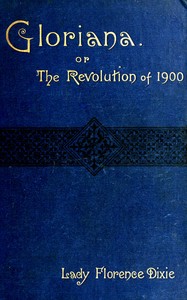
Gloriana; or, the revolution of 1900 — Edition Insights
(0 User reviews)
1364
Project Gutenberg
2023
Not confirmed
Utopias -- Fiction; Women's rights -- Fiction; Speculative fiction
Readers of public-domain and historical texts
Project Gutenberg digital edition
en
Edition facts
Words
88,468
Reading time
385 min
Text sections
15
The catalog record for Gloriana; or, the revolution of 1900 — Edition Insights provides practical reading context through 88,468 words, 6 hr 25 min estimated reading time, and 15 detected text sections.
The text analysis averages about 16.5 words per sentence, while the detected sections provide another way to judge how the source is divided.
Project Gutenberg metadata also associates the work with “Utopias -- Fiction,” connecting these edition facts with the source record’s subject description.
Source:
Project Gutenberg record #69843
Lady Florence Dixie's 1890 speculative novel follows a woman who disguises herself as a man, rises to political power, and reveals her identity to advance women's rights, blending utopian ideals with revolutionary action.
Editorial Edition Score
4.9/5
★★★★★
★★★★★
Calculated from edition completeness, EPUB availability, text structure and catalogue metadata. Not a user rating.
How this score is calculated
- Description quality20 pts
- Title & short description10 pts
- Source metadata20 pts
- Text length15 pts
- Chapters / structure15 pts
- EPUB file integrity20 pts
Total of 100 points, scaled to a 2.5-5.0 range. Editions with an empty description or a missing EPUB file are not scored.
Edition quality
Read the Text
merrily. We have seen two of the women before, and their names are Mrs. de Lacy Trevor and Lady Manderton. Close in attendance upon them are two smart good-looking men, whom we must introduce to the reader as Lord Charles Dartrey and the Earl of Westray. The former appears to be entirely taken up with the first-named lady, the latter—already introduced to the reader in a former chapter as Lord Altai—with the last-named one.
There is yet another pair in that cheery group that we must particularly notice. They are a man and woman, both young, both good-looking, and both unmistakably at home in the saddle. If one can judge from appearances, the woman must be about twenty-two years of age, the man perhaps five or six years her senior. Both are mounted on grey horses, and both look every inch what they are, splendid equestrians. The woman is well known in Society’s world, as also in the tiny hunting world of Melton. She is Lady Flora Desmond, and the man is handsome Captain “Jack” Delamere.
They trot through the streets at a merry pace, down past the Harborough Hotel, over the railway, away on by Wicklow Lodge, towards Burton Lazarus. It is a beautiful morning, and the sun is shining brightly on the flats that lie below. Dalby Hall, nestling amidst its woods on the far hillside, stands out distinct and clear, with the same bright sun gleaming on its gables and windows.
“What a glorious morning, Jack!” exclaims Lady Flora enthusiastically. “Why, it’s like summer, is it not?”
The others are a little on ahead, and these two have fallen in the rear. Jack looks at the speaker with a smile.
“It is a grand day, Florrie, and it suits you, too. I never saw you looking better in my life.”
She flushes up. Florrie Desmond does not care about compliments,—she values them at their worth,—but she and Jack are fast friends, and she is not quite averse to them from him. She answers, however.
“Shut up, you goose, and don’t talk nonsense.”
She is a clever woman is Flora Desmond, cleverer far than some people take her to be. Her bringing up has not been exactly like other women’s, and she has always kicked against the restraints and restrictions put upon her sex. She is the daughter of the Marquis and Marchioness of Douglasdale, and an orphan, having lost her father at an early age. Lady Douglasdale was, in her day, a very beautiful woman, a _persona grata_ at Court, where her husband exercised the duties of Comptroller of the Household, and was a favourite with his sovereign; but after the marquis’s death she took greatly to travelling, and thus it was that Flora Ruglen, in conjunction with her twin brother Archie, saw most of the great world of Europe before she was ten years of age.
Travelling expands the mind, and brightens the senses. It had this effect upon the girl, forming much of her character before its time. At that early age she exhibited peculiar characteristics. No one could get her to settle down to study under a governess; she loathed the sight of school books, and led her unfortunate preceptors a sad life; yet, in strange contradiction to so much wilfulness and apparent indolence, she was seldom without the companionship of a book in her play hours, and when not otherwise engaged with her brother, would invariably be found poring over these books, thirstily seeking knowledge, or committing to paper, in powerful language for one so young, the impressions of her youthful brain.
Lady Florence Dixie’s Gloriana; or, the revolution of 1900 (1890) presents a woman who, after living as the male politician Hector D’Estrange, publicly declares herself to be Gloria de Lara. The excerpts show a narrative that moves between political maneuvering and direct confrontation, as when the protagonist is surrounded by a crowd and defended by the “White Guards.” The author’s preface insists the book is “inextricably interwoven with truth” and aims to expose “evils which do exist.”
Cataloged as both utopian fiction and a women’s rights novel, the work is more concerned with the mechanics of revolution than with depicting an ideal society. The excerpts depict a tense standoff between the White Guards and Horse Guards Blue, with Colonel Jack Delamere torn between duty and love for Flora Desmond. This suggests the story uses romantic and military subplots to advance its political argument.
The Dedication and Its Program
The book opens with a dedication “To all women and such honourable, upright, and courageous men” who will “bravely assert and uphold the Laws of Justice, of Nature, and of Right.” This directly frames the novel as a polemical work. The preface reinforces this by stating that “there is but one object in ‘Gloriana’”—to discuss existing evils and an “artificial position” created by laws “false to Nature.” The author anticipates criticism, warning that critics may “attempt to wreck it by ridicule.” This defensive posture suggests Dixie expected resistance to her arguments.
The preface also includes a poem that speaks of truths “men could not bear” and prophets who will teach what “school-men fail to reach.” This positions the novel as a vehicle for ideas that conventional institutions suppress. The dedication and preface together establish that the book is not a neutral story but a deliberate intervention in debates about women’s rights and social reform.
The Revelation Scene and Its Aftermath
The central excerpt shows Gloria de Lara revealing her identity: “I am a woman! Henceforth I am no longer Hector D’Estrange, but Gloria de Lara.” This moment is public, occurring on horseback before a crowd. The reaction is mixed: “Poor men are more generous than rich ones,” and the people rally to her, while her enemies have “got the upper hand.” The narrative emphasizes that “it is the people’s voice that generally forces on all great reforms.”
This scene ties the personal revelation to a political crisis. The crowd’s loyalty is based on her having “understood their wants” while in power. The excerpt then shifts to a military confrontation, with Flora Desmond commanding the White Guards to “close round her, and defend her with your lives.” The author invokes the poet Whyte-Melville, suggesting that disciplined Amazons “could conquer the world.” This indicates that the novel uses the revelation as a catalyst for armed conflict, blending feminist advocacy with adventure.
Military Duty Versus Personal Loyalty
The standoff between the White Guards and the Horse Guards Blue introduces a moral dilemma. Colonel Jack Delamere, who loves Flora Desmond, must order his men to disperse the crowd and recapture Gloria. The text notes that “duty is a strange thing” and that Delamere obeys an order he “loathes.” The narrator quotes Tennyson’s “The Charge of the Light Brigade”—“His not to reason why, His but to do and die”—to underscore the conflict between personal feeling and professional obligation.
This subplot complicates the novel’s political message. While the book advocates for women’s rights, it also presents a sympathetic male character torn by his role in suppressing the revolt. The excerpt does not resolve the standoff, leaving the outcome uncertain. This suggests that Dixie uses the military confrontation to explore the costs of revolution, rather than presenting a simple triumph of justice.
Readers should note that the excerpts cover only the preface and a climactic scene, not the full arc of Gloria’s political career or the revolution’s outcome. The novel’s catalog subjects—utopia, women’s rights, speculative fiction—are all present, but the excerpts emphasize conflict and sacrifice over idealistic description. Pay attention to how Dixie balances polemical argument with narrative tension, and how the military and romantic elements serve her reformist agenda.
The rain kept me indoors with Gloriana, watching her navigate a world that refused her a voice until she borrowed a man’s. Afterwards, restless, I stumbled into Tedious brief tales of Granta and Gramarye — Reading Companion, and found a quieter kind of disguise—stories wearing old skins, whispering the same ache for belonging, for recognition that never quite arrives.
There are no reviews for this eBook.
There are no comments for this eBook.
Reader reflection
Take a moment to reflect on this book
Create a short personal record of your experience with this book.
Your progress
0
/
10
2
How did the book work for you overall?
3
Is this a title you would suggest to others?
4
How demanding did the text feel?
5
How valuable was this book for your own interests?
6
Was the book moving at the right speed?
7
Did you relate to its people, ideas, or situations?
8
How distinctive were its ideas or approach?
9
Which lesson or insight stayed with you?
10