1

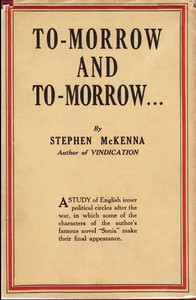
To-morrow and to-morrow ... a novel — A Closer Reading
(0 User reviews)
365
Project Gutenberg
2022
Not confirmed
Man-woman relationships -- Fiction; Spouses -- Fiction; Great Britain -- History -- George V, 1910-1936 -- Fiction
Readers of public-domain and historical texts
Project Gutenberg digital edition
en
Edition facts
Words
108,513
Reading time
472 min
Text sections
12
For To-morrow and to-morrow ... a novel — A Closer Reading, the stored edition analysis reports 108,513 words, 7 hr 52 min estimated reading time, and 12 detected text sections.
The text analysis averages about 18.3 words per sentence, while the detected sections provide another way to judge how the source is divided.
Project Gutenberg metadata also associates the work with “Man-woman relationships -- Fiction,” connecting these edition facts with the source record’s subject description.
Source:
Project Gutenberg record #69589
A first-person narrative set in post-WWI England, following a husband observing his wife's social circle. The author uses ironic, detached diction and detailed descriptions of parties to critique the era's shifting social mores and the narrator's own anachronistic sensibilities.
Editorial Edition Score
4.8/5
★★★★★
★★★★★
Calculated from edition completeness, EPUB availability, text structure and catalogue metadata. Not a user rating.
How this score is calculated
- Description quality20 pts
- Title & short description10 pts
- Source metadata20 pts
- Text length15 pts
- Chapters / structure15 pts
- EPUB file integrity20 pts
Total of 100 points, scaled to a 2.5-5.0 range. Editions with an empty description or a missing EPUB file are not scored.
Edition quality
Read the Text
come that night, or he would not have granted me leave of absence. The Admiralty, meanwhile, could not have been more silent if the old world had died in giving birth to the new.
“You got my chit?,” Hornbeck asked in an undertone, when I went to report. “Unless you _want_ to hang about here . . .”
“My taste for bureaucracy,” I answered, with a glance of loathing at his “IN”, “OUT” and “PENDING” trays, “has been cured.” How long did Barbara say the war had lasted? Since 1914? Yes, four years and three months had passed since I began to masquerade unconvincingly as an officer of the Royal Naval Volunteer Reserve. With the actors, artists, barristers and stockbrokers who combined to make up my section of the intelligence department, I had talked a hundred times of the day when we should have taken our last undeserved salute and laid aside the latest of our comic-opera uniforms. Now it was come. “As I’m here, I may as well lend a hand. I suppose they’re bound to sign?”
Hornbeck unlocked a row of japanned boxes and glanced perfunctorily at his secret files before plunging them in the fire.
“It won’t come through in time for the morning papers, so I’m getting rid of the evidence before I’m told not to,” he chuckled. “‘_The eleventh hour . . . of the_ _eleventh day . . . of the eleventh month._’ Sounds as if a journalist had had something to do with that!” One file slipped to the floor; and I read on the faded docket “_Goeben and Breslau, 1914_”. It had been a very long war. “Lord! These papers are a satire on the vanity of human wishes!,” he drawled. “You can give all your people leave for the day. They won’t be in a fit state to work . . . even if you had any work to give them. And I suppose you won’t have. It . . . takes you some time to grasp that it’s all over,” he added, checking half way to the fire and staring bemusedly at the papers in his hands. Looking at him, I needed time to recall that he had been a young man when war broke out. “What are you and Lady Barbara going to do with yourselves?,” he asked after a pause.
“Get away to the sun,” I answered with the grim determination of a man whose vitality was spent for lack of rest and good food.
“Wonder . . . what will happen . . . to _us_,” Hornbeck pondered, punctuating his words with abrupt shrieks of rending paper. “No more wars; . . . no more navies . . . or armies.”
“Well, you of all men are entitled to a holiday,” I said. Four years of Whitehall had made him short-sighted and round-shouldered; his square, wooden face was pallid; and his slow speech argued a tired brain.
“Everything will seem a bit flat now,” muttered one of the most powerful men in England, who within the next few days or hours would be as inconsequential as myself. Beyond a narrow circle described round the Treasury Exchange, the name of Captain Hornbeck was unknown; the weight and cunning of his hand, however, had been felt for more than four years in Mexican revolutions, Greek _coups d’état_ and Russian counter-revolutions. The papers which he was destroying ranged from reports on South American credit-transfers to track-charts of North Atlantic commerce-raiders. “This is what the N.O. has been training for, ever since the old Britannia days,” he went on. “Now that we’ve finished it . . .”
Wiping the sweat from his forehead, he threw open the window. From force of habit, he switched off the lights before pulling up the blind; then, as the last night of the war engulfed him in a grey eddy of fog, he laughed at his own forgetfulness.
“There’s still a fair-sized mess to clean up,” I reminded him, as he raked with irresolute fingers the memoranda that constituted the Admiralty’s suggestions for the peace conference.
“Ah, I must leave that to you politicians,” he laughed. “And I don’t envy you the job. A world without war . . . It’s a thing we’ve never seen, George. And when you consider that we’re all of us demoralized and most of us bankrupt . . . I suppose friend Woodrow knows what he wants, but I don’t believe any one else does. . . . Doctor feller once told me that, when a baby’s born, it comes into the world with its fists clenched. I sometimes wonder if war isn’t a natural instinct.”
“Self-preservation is the first natural instinct,” I answered; “but it’s not consistent with modern methods of fighting.”
“Oh, I know. This war will be a friendly scrap by comparison with the next.”
The narrator of Stephen McKenna's To-morrow and to-morrow ... establishes himself from the first as a man out of step with his time. He was 'bred in an age of strict formality,' when country-house weekends meant smoking-suits and negus; now, in 1920, he finds himself adrift at a 'gigantic beanfeast' thrown by his wife Barbara. His voice is wry, self-deprecating, and laced with a nostalgia that he himself half-mocks. The novel's opening pages are less a plot launch than a social diagnosis, delivered in the measured, ironic cadences of a man who would rather 'look on, listen' than dance or play bridge.
The Narrator's Ironic Distance
The narrator's first-person voice is the novel's central instrument. He reports conversations and scenes with a detached, almost anthropological precision, yet his own judgments keep breaking through. When Lady Dainton condemns the party's tone, he notes that she was 'criticizing it with her eyes' even before speaking. He agrees with her but will not say so directly: 'Mentally, I acquiesced in her condemnation.' This habit of mental reservation—thinking one thing, saying another—creates a persistent gap between the reader and the narrator's inner life. He is a participant who refuses to participate fully, a husband who watches his wife's world with a mixture of affection and bemusement. The effect is a narrative voice that feels both intimate and withheld, as if the story is being told from behind a veil of politeness.
Social Rituals as Stagecraft
McKenna lavishes descriptive attention on the mechanics of a 1920s party: the endless supper, the musicians 'imprisoned on a landing,' the butler Robson who acts as 'generalissimo.' The narrator observes that the party's success, like that of 'the late war, lay in unity of command.' This comparison is telling—it reduces social life to a military operation, with Robson directing traffic, supplying powder, and even playing waltzes when the band stops. The narrator's eye for such details turns the evening into a piece of theatre, complete with stage managers and unwitting actors. Barbara, meanwhile, murmurs that she would marry Robson if anything happened to her husband—a joke that underscores how much the household's order depends on servants. The scene is comic, but the comedy is edged with unease: these rituals are all that remain of a vanished world.
The Weight of a Vanished Generation
Throughout the excerpts, the narrator measures the present against a remembered past. He recalls his first London dinner-parties, which had 'the ceremony and pomp of a levée,' and contrasts them with the improvised informality of 1920. The opera and ballet are trying to revive pre-war gaiety, but 'there was no public for both.' Even the architecture of memory is precise: Loring House still bore its hatchment when he first stayed there; old Lord Loring hunted guests into smoking-suits at eleven o'clock. These details are not mere decoration—they establish a baseline of lost formality against which the present falls short. The narrator does not simply say that things have changed; he shows the change through specific, sensory recollections. The result is a portrait of a generation that feels itself to be living in the aftermath of something irrecoverable, even as it tries to dance.
Conversation as a Failed Bridge
The narrator's attempts to engage with Barbara's literary friends reveal a deeper disconnection. He hopes to discover 'what inspiration they had won from the war,' but finds the quest more dangerous than delightful. The young writers welcome him at first, then make it 'abundantly plain' that his curiosity is unwelcome. McKenna does not dramatize the confrontation; he lets the narrator's understatement carry the sting. The war, which ended in the novel's first line, is a subject that cannot be discussed—or can only be discussed on certain terms. The narrator, who gave up dancing on the outbreak of war, is left to 'look on, listen' while others fill the silence with jazz and bridge. Conversation, meant to connect, only underscores how far apart these people are. The novel's title, borrowed from Macbeth, hints at a creeping futility: tomorrow and tomorrow and tomorrow, but no real progress.
McKenna's novel is best approached as a character study in the key of social observation. The narrator's voice—ironic, nostalgic, and deliberately limited—shapes every scene. Readers should attend to what he chooses to report and what he leaves unsaid, to the gap between his inner judgments and his spoken words. The party scenes are not digressions; they are the novel's method. The war is present only as an absence, a rupture that has reshaped every relationship and ritual. This is a book about the difficulty of living in the aftermath, told by a man who would rather watch than join.
That rainy afternoon, his brittle laughter at the party rang false enough that I half-remembered the quiet ache behind my own summer glories, and before I knew it, I’d pulled down Daisy of "Old Meadow." — where that same wistfulness whispers through every page, softer, more forgiving, like remembering a garden after the storm. Daisy of "Old Meadow." — Themes and Context
There are no reviews for this eBook.
There are no comments for this eBook.
Reader reflection
Record your reading impressions
A brief reflection can help important ideas stay with you longer.
Your progress
0
/
10
2
Did this book hold your interest?
3
Would you recommend this book to another reader?
4
Did the language feel accessible?
5
How strongly did the book affect you emotionally?
6
Did the story or argument move comfortably?
7
Did it raise ideas you would like to talk about?
8
How well did it match your expectations?
9
What changed or sharpened your thinking?
10