1

Divots — Story, Setting & Ideas
(0 User reviews)
362
Project Gutenberg
2023
Not confirmed
Humorous stories, English; Golfers -- Fiction; Golf stories, English
Readers of public-domain and historical texts
Project Gutenberg digital edition
en
Edition facts
Words
71,352
Reading time
311 min
Text sections
14
The catalog record for Divots — Story, Setting & Ideas provides practical reading context through 71,352 words, 5 hr 11 min estimated reading time, and 14 detected text sections.
The text analysis averages about 13.9 words per sentence, while the detected sections provide another way to judge how the source is divided.
Project Gutenberg metadata also associates the work with “Humorous stories, English,” connecting these edition facts with the source record’s subject description.
Source:
Project Gutenberg record #72227
In this preface and opening story, Wodehouse defends golf as a literary theme with mock-scholarly citations, then traces how a once-humble golfer's improvement breeds arrogance, costing him his fiancée. The excerpts reveal a narrator who observes social dynamics through golf's etiquette and psychology.
Editorial Edition Score
4.8/5
★★★★★
★★★★★
Calculated from edition completeness, EPUB availability, text structure and catalogue metadata. Not a user rating.
How this score is calculated
- Description quality20 pts
- Title & short description10 pts
- Source metadata20 pts
- Text length15 pts
- Chapters / structure15 pts
- EPUB file integrity20 pts
Total of 100 points, scaled to a 2.5-5.0 range. Editions with an empty description or a missing EPUB file are not scored.
Edition quality
Read the Text
point at issue with bent brows.
“Ninety-four?” said the Scooper, incredulously. “Do you mean counting every stroke?”
“Counting every stroke.”
“Not conceding himself any putts?”
“Wire him to come at once,” said the meeting with one voice.
That night the Cat-Stroker approached Ferdinand, smooth, subtle, lawyer-like.
“Oh, Dibble,” he said, “just the man I wanted to see. Dibble, there’s a young friend of mine coming down here who goes in for golf a little. George Parsloe is his name. I was wondering if you could spare time to give him a game. He is just a novice, you know.”
“I shall be delighted to play a round with him,” said Ferdinand, kindly.
“He might pick up a pointer or two from watching you,” said the Cat-Stroker.
“True, true,” said Ferdinand.
“Then I’ll introduce you when he shows up.”
“Delighted,” said Ferdinand.
He was in excellent humour that night, for he had had a letter from Barbara saying that she was arriving on the next day but one.
It was Ferdinand’s healthy custom of a morning to get up in good time and take a dip in the sea before breakfast. On the morning of the day of Barbara’s arrival, he arose, as usual, donned his flannels, took a good look at the cup, and started out. It was a fine, fresh morning, and he glowed both externally and internally. As he crossed the links, for the nearest route to the water was through the fairway of the seventh, he was whistling happily and rehearsing in his mind the opening sentences of his proposal. For it was his firm resolve that night after dinner to ask Barbara to marry him. He was proceeding over the smooth turf without a care in the world, when there was a sudden cry of “Fore!” and the next moment a golf ball, missing him by inches, sailed up the fairway and came to a rest fifty yards from where he stood. He looked round and observed a figure coming towards him from the tee.
The distance from the tee was fully a hundred and thirty yards. Add fifty to that, and you have a hundred and eighty yards. No such drive had been made on the Marvis Bay links since their foundation, and such is the generous spirit of the true golfer that Ferdinand’s first emotion, after the not inexcusable spasm of panic caused by the hum of the ball past his ear, was one of cordial admiration. By some kindly miracle, he supposed, one of his hotel acquaintances had been permitted for once in his life to time a drive right. It was only when the other man came up that there began to steal over him a sickening apprehension. The faces of all those who hewed divots on the hotel course were familiar to him, and the fact that this fellow was a stranger seemed to point with dreadful certainty to his being the man he had agreed to play.
“Sorry,” said the man. He was a tall, strikingly handsome youth, with brown eyes and a dark moustache.
“Oh, that’s all right,” said Ferdinand. “Er--do you always drive like that?”
“Well, I generally get a bit longer ball, but I’m off my drive this morning. It’s lucky I came out and got this practice. I’m playing a match to-morrow with a fellow named Dibble, who’s a local champion, or something.”
“Me,” said Ferdinand, humbly.
“Eh? Oh, you?” Mr. Parsloe eyed him appraisingly. “Well, may the best man win.”
As this was precisely what Ferdinand was afraid was going to happen, he nodded in a sickly manner and tottered off to his bathe. The magic had gone out of the morning. The sun still shone, but in a silly, feeble way; and a cold and depressing wind had sprung up. For Ferdinand’s inferiority complex, which had seemed cured for ever, was back again, doing business at the old stand.
How sad it is in this life that the moment to which we have looked forward with the most glowing anticipation so often turns out on arrival, flat, cold, and disappointing. For ten days Barbara Medway had been living for that meeting with Ferdinand, when, getting out of the train, she would see him popping about on the horizon with the love-light sparkling in his eyes and words of devotion trembling on his lips. The poor girl never doubted for an instant that he would unleash his pent-up emotions inside the first five minutes, and her only worry was lest he should give an embarrassing publicity to the sacred scene by falling on his knees on the station platform.
“Well, here I am at last,” she cried gaily.
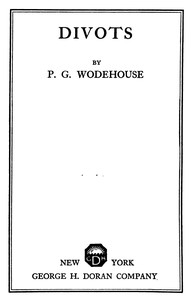
The preface to Divots immediately establishes the book's tone: a mock-scholarly defense of golf as a fit subject for literature. Wodehouse cites Publius Syrius on the back-swing, Diogenes at the water-hole, and Shakespeare's Falstaff as a slow player, all with a straight-faced absurdity that signals the collection's blend of erudition and farce. The narrator then introduces himself as a returning traveler who learns of Wallace Chesney's transformation from a genial duffer into an insufferable golf snob—a shift that has alienated his friends and ended his engagement. The excerpts show a story built not on tournament drama but on the social consequences of a swelled head, with golf serving as both setting and metaphor.
A Preface That Parodies Literary Criticism
Wodehouse opens with a mock grievance against critics who dismissed his earlier golf stories as trivial. He counters by inventing a tradition of golf wisdom from classical and literary figures: Publius Syrius on timing, Diogenes on water hazards, and Chaucer on the long spoon. The joke relies on the reader recognizing the absurdity of retrofitting golf advice onto ancient texts. The preface also demands that future critics append their handicaps to their reviews, so that a (36) would diminish a negative notice and a (scr.) would amplify praise. This playful framing establishes the author's voice as both self-deprecating and slyly competitive, and it signals that the stories to follow will treat golf with mock solemnity.
The Social Physics of Golf Etiquette
The opening story centers not on a match but on a breach of golf's unwritten code. Wallace Chesney, once a duffer, has improved so much that he now criticizes opponents' mashie-play, offers unsolicited foot-position advice, and boasts of playing for his medal score while partnered with a weaker player. The narrator's friend Raymond Gandle reports this behavior with bitterness, and the fiancée Charlotte Dix breaks the engagement because Wally is no longer his old self. The excerpts show that the story's conflict is entirely social: the game itself is merely the arena where character is revealed. The narrator's role as a concerned intermediary—interviewing Gandle, then Charlotte—mirrors the structure of a domestic comedy more than a sports story.
Narrative Voice and the Observer's Role
The first-person narrator is a returning traveler who has been away on business, positioning him as an outsider who can assess changes in the community. His language is courteous and slightly formal: he replies to Gandle with 'courteously' and describes his own speech as 'I replied, courteously.' He is shocked by Chesney's transformation, exclaiming 'You horrify me!' and 'I can hardly credit it.' This narrator does not play golf in the excerpts; he listens and reports. His voice mediates between the reader and the golf-world jargon, explaining that a 'niblick' is a club and that a 'dud' is a weak player. The effect is to make the story accessible to non-golfers while still satisfying those who know the game—a balancing act that defines the collection's appeal.
Readers coming to Divots from Wodehouse's Jeeves stories will recognize the comic structure: a well-meaning narrator intervenes in a lovers' quarrel caused by a man's foolish behavior. But here the foolishness is specifically golf-bred arrogance, and the cure likely involves humility on the links. The excerpts offer no resolution, only the setup. The preface, however, promises that the stories will treat golf with the same mock-heroic seriousness that Wodehouse brought to country-house life.
Years shelving Wodehouse, I’ve watched his golfers strut and stumble, their vanity a soft, familiar ache. The sign of the prophet — Edition Insights sits nearby, and I find it keeps that same company—a patient hand turning over pride’s quiet cost, though its fairway is prophecy, not grass. Both whisper that character, not circumstance, writes the ending we deserve.
There are no reviews for this eBook.
There are no comments for this eBook.
Reader reflection
Before you leave, reflect on the book
Use these questions to collect your thoughts before moving on.
Your progress
0
/
10
2
How much did you enjoy the reading experience?
3
Would you recommend this book to another reader?
4
What was the reading difficulty like?
5
How original did the book feel?
6
Could you follow the author’s main argument?
7
What did you appreciate most?
8
Could you see yourself revisiting this book?
9
What changed or sharpened your thinking?
10