1

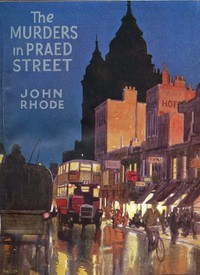
The murders in Praed Street — Themes and Context
(0 User reviews)
2171
Project Gutenberg
2024
Not confirmed
Detective and mystery stories; Murder -- Investigation -- Fiction; Priestley, Lancelot, (Fictitious character) -- Fiction
Readers of public-domain and historical texts
Project Gutenberg digital edition
en
Edition facts
Words
84,825
Reading time
369 min
Text sections
26
For The murders in Praed Street — Themes and Context, the stored edition analysis reports 84,825 words, 6 hr 9 min estimated reading time, and 26 detected text sections.
The text analysis averages about 15.2 words per sentence, while the detected sections provide another way to judge how the source is divided.
Project Gutenberg metadata also associates the work with “Detective and mystery stories,” connecting these edition facts with the source record’s subject description.
Source:
Project Gutenberg record #72926
John Rhode's 1928 mystery, set in a grimy London street, follows Inspector Whyland as a series of murders unfolds, with clues like a poisoned pipe-stem and a bone counter marked VII. The eccentric Dr. Priestley enters the case, but the excerpts focus on setting and initial investigation rather than resolution.
Editorial Edition Score
4.9/5
★★★★★
★★★★★
Calculated from edition completeness, EPUB availability, text structure and catalogue metadata. Not a user rating.
How this score is calculated
- Description quality20 pts
- Title & short description10 pts
- Source metadata20 pts
- Text length15 pts
- Chapters / structure15 pts
- EPUB file integrity20 pts
Total of 100 points, scaled to a 2.5-5.0 range. Editions with an empty description or a missing EPUB file are not scored.
Edition quality
Read the Text
nothing secretive about Mr. Tovey, you could see his name and occupation painted in bold letters over a shop in Lisson Grove; James Tovey, Fruit and Vegetable Merchant. He was, in fact, a greengrocer, and, years ago, when Mr. Tovey had originally employed a small legacy in the purchase of the business, the sign had read: Tovey, Greengrocer, etc. But it was Mr. Tovey’s proud boast that he always moved with the times, and since his neighbours, the butcher and the grocer, had respectively converted themselves into Meat Purveyors and Provision Dealers, he had abandoned the vulgar term of greengrocer for the more high-sounding appellation.
Sunday was a day of strict observance with Mr. Tovey, its presiding deity his own comfort. One can hardly blame him for this indulgence, since the rest of the week left him little leisure for repose. His habit was to rise before six, in order to drive the van to Covent Garden. The van, a second-hand Ford, was the subject of the ribald mirth of his acquaintances. Every non-essential part had long since fallen off, as an aged elm sheds its branches, and the essentials were held together by odd pieces of rope. But to any suggestion of the van’s imperfections, Mr. Tovey merely shrugged his shoulders. “’Tisn’t ’er looks as matters,” he would reply. “So long as she does ’er job she’ll do for me.” And perhaps this phrase, applied to things at large, was a complete summing up of Mr. Tovey’s philosophy.
He opened the shop as soon as he returned from Covent Garden, and kept it open, winter and summer, till a late hour. Lisson Grove shops late, and it was usually ten o’clock before Mr. Tovey could reckon to get his bit of supper. It was therefore natural that so strenuous a week should be rewarded by a relaxation on Sunday. It was his invariable habit to stay in bed till noon, inhaling the savoury smell of the Sunday joint roasting in the kitchen, and only to rise and put on his best suit when the clock struck that hour. The afternoon was usually devoted to the peaceful somnolence of repletion, or sometimes in summer, if Mrs. Tovey’s legs felt equal to accompanying him, to a walk in the park. And in the evening there were always the thrilling columns of the Sunday paper.
Mr. Tovey hated to be disturbed in the evening of this day of rest. Especially on such an evening as the present. The day had been an eminently satisfactory one, from his point of view. The sirloin of beef, carefully selected by Mrs. Tovey from the stock of her friend the Meat Purveyor, over the way, had been of uncommon succulence; the Yorkshire pudding crisped to that exact degree of golden delicacy that Mr. Tovey’s heart desired. True, he had had a slight difference of opinion with Mrs. Tovey, but that had merely given a zest to a day which might otherwise have been uneventful. Mr. and Mrs. Tovey never really quarrelled. For one thing they were neither of them of a quarrelsome disposition, and for another they were both too fond of their own comfort to risk its disturbance by domestic rancour. But sometimes they did not see eye to eye, as in the present case.
It had begun when Mr. Tovey had come down to the kitchen, and noticed that only two places had been laid at the table. He had raised his eyebrows and glanced towards the massive form of Mrs. Tovey, bending over the glowing range.
“Hullo! Where’s Ivy, then?” he asked, in an almost querulous tone.
“Gone out with Ted,” replied Mrs. Tovey quietly, from among the saucepans. “He’s taken her home to dinner, and they’re going on to the pictures afterwards.”
Mr. Tovey clicked his tongue, his favourite expression of annoyance. Of course, Ted and Ivy had known one another since they were children. Old Sam Copperdock, Ted’s father, was Mr. Tovey’s oldest friend, and they had been near neighbours ever since the latter, as a newly married man, had bought the greengrocery business. Still, Mr. Tovey didn’t altogether like it. Ivy was twenty now, and young Ted Copperdock only three years older. Just the sort of age when young folks get the bit between their teeth and go and get married without a thought of the future. Old Sam was a thorough good chap, and his son was a very nice lad; Mr. Tovey would not have denied either of these facts for a moment. But Ted’s only prospects lay in his father’s shop in Praed Street, and Mr. Tovey had very different views of his only child’s future, very different.
Praed Street, as John Rhode describes it in the opening chapter, is a thoroughfare that has never adapted to its role as a main artery near Paddington Station. The street's squalid shops and indifferent atmosphere set the stage for a series of murders that begin with the death of a herbalist. The narrative voice is dry and observational, noting that the street 'regarded Paddington Station as an intrusion.' This attention to place is not mere backdrop; the street's character becomes a silent participant in the crimes.
The excerpts introduce James Tovey, a greengrocer who has rebranded himself as a 'Fruit and Vegetable Merchant,' and later Inspector Whyland, who investigates alongside Mr. Ludgrove. A bone counter marked with the Roman numeral VII appears as a recurring clue, but the excerpts do not reveal its significance. The catalog lists this as a detective and mystery story featuring Lancelot Priestley, yet the excerpts show Priestley only entering in Chapter XIII, suggesting the first half of the novel proceeds without him.
Setting as a Character
Rhode devotes the entire first chapter to describing Praed Street, a narrow, 'frankly lamentable' road bordered by furtive shops and squalid upper parts. The street's history is sketched: it existed before the Great Western Railway planted its terminus there, and it has made only 'occasional grudging widening' to accommodate traffic. The canal terminus nearby is mentioned as a prior interest. This level of detail suggests that the setting is not incidental but integral to the plot. The street's indifference to the crowds passing through mirrors the detachment of its inhabitants, who may be witnesses or participants in the murders. The description of the street as 'uninviting' and 'sombre' establishes a tone of moral decay that likely permeates the crimes.
Clues and Their Presentation
The excerpts reveal two specific clues: a poisoned pipe-stem (Chapter IV) and a bone counter marked with VII (Chapter XII). The bone counter is found propped against a clock on a mantelpiece, 'conspicuously' placed to attract attention. This object appears earlier in the narrative, as a 'yarn about the black sailor' and a counter found on a bed. The recurrence of the counter suggests a pattern, but the excerpts do not explain its meaning. The pipe-stem is mentioned only in the table of contents, leaving its role unclear. Rhode presents these clues through the observations of Inspector Whyland and Mr. Ludgrove, who react with surprise but offer no immediate interpretation. This method of revealing clues without explanation is typical of the genre, but the excerpts show a deliberate withholding of context.
The Late Arrival of Dr. Priestley
Despite the catalog listing Lancelot Priestley as a character, the excerpts show him entering only in Chapter XIII, after the first twelve chapters have established the crimes and investigation. When he appears, he is absorbed in writing a book titled Some Aspects of Modern Thought, described as a work that 'shattered the majority of the pet theories of orthodox science.' His secretary, Harold Merefield, is similarly preoccupied. This introduction emphasizes Priestley's intellectual detachment and his reputation for 'incontrovertible logic.' The excerpts do not show him engaging with the case, leaving his role in the investigation unclear. Readers familiar with the series may expect him to apply his logic to the murders, but the text itself does not confirm this.
The excerpts from The Murders in Praed Street offer a detailed view of the novel's early chapters, focusing on setting, initial clues, and the delayed introduction of the series detective. Readers should note that the catalog's subject headings may overstate Priestley's prominence in the first half of the book. The narrative voice is consistently observational, with a dry humor evident in character descriptions like Tovey's self-promotion. The bone counter and the street itself are likely to remain central as the plot unfolds.
There’s something about that damp London street in The Murders in Praed Street — how the fog seems to hold secrets tighter than the people do. I found myself thinking of that quiet unease later, strangely, while rereading A man made of money — Inside the Classic. Different world entirely, yet the same soft dread of what ordinary spaces hide. It lingers without asking to be finished.
There are no reviews for this eBook.
There are no comments for this eBook.
Reader reflection
What was your reading experience?
Capture what you thought, learned, and would like to remember.
Your progress
0
/
10
2
How did the book work for you overall?
3
Would you pass this book on to a friend?
4
How demanding did the text feel?
5
Did the story or argument move comfortably?
6
Did it raise ideas you would like to talk about?
7
What was the strongest part of the book?
8
How clear did the writing feel?
9
Which lesson or insight stayed with you?
10