1

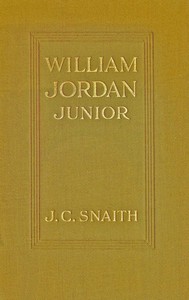
William Jordan, Junior — Edition Insights
(0 User reviews)
509
Project Gutenberg
2024
Not confirmed
London (England) -- Fiction; Fathers and sons -- Fiction; Booksellers and bookselling -- Fiction; Poets -- Fiction
Readers of public-domain and historical texts
Project Gutenberg digital edition
en
Edition facts
Words
123,451
Reading time
537 min
Text sections
68
The source record for William Jordan, Junior — Edition Insights measures this digital text at 123,451 words, 8 hr 57 min estimated reading time, and 68 detected text sections.
The text analysis averages about 18.2 words per sentence, while the detected sections provide another way to judge how the source is divided.
Project Gutenberg metadata also associates the work with “London (England) -- Fiction,” connecting these edition facts with the source record’s subject description.
Source:
Project Gutenberg record #73096
J. C. Snaith's 1907 novel follows a stammering bookseller's son navigating London's literary and social scenes, with a structure that alternates between rain-soaked streets and stifling interiors, and a recurring motif of goddess-like women deflating male pretension.
Editorial Edition Score
4.9/5
★★★★★
★★★★★
Calculated from edition completeness, EPUB availability, text structure and catalogue metadata. Not a user rating.
How this score is calculated
- Description quality20 pts
- Title & short description10 pts
- Source metadata20 pts
- Text length15 pts
- Chapters / structure15 pts
- EPUB file integrity20 pts
Total of 100 points, scaled to a 2.5-5.0 range. Editions with an empty description or a missing EPUB file are not scored.
Edition quality
Read the Text
sound in the little room except the ticking of the clock, and an occasional creak from the fire. Now and again the man would pause in his scrutiny of the old yellow page. Uplifting the finger which pursued every word of the faded and almost illegible writing, he would seem to consider it with secret thoughts shaping themselves upon his lips. Then he would smile a little and sigh faintly and turn to it again.
Presently his gaze sought the boy. Within it was a look of indescribable solitude, for as the boy crouched over the old volume printed in black letter which he held upon his knees, great tears dripped softly from his eyes. The white-haired man addressed him in a low voice that was like a caress.
“Ah, my brave one! thou dost not fear the drama.”
The boy looked up with a startled face. He gave a little shiver.
“What is that, my father,” he asked, “that you speak of as the drama?”
“What is that, beloved one,” asked his father, “that afflicts you with dismay?”
The boy pressed his palms against his thin temples.
“I think--I think it is the words, my father,” he said, “the something in the sound of the words.”
“Truly,” said his father, “the something in the sound of the words. That which is given is taken away--the something in the sound of the words.”
“Did you not say, my father,” said the boy, “that the drama was--was what you call a ‘play’?”
“Yes, a play,” said his father, “a bewildering and curious play--a haunting and strange play. It is almost terrible, and yet it is beautiful also.”
“I don’t understand,” said the boy, his eyes growing dark with perplexity.
His father was quick to read his distress, and a mournful compassion came into his face. The boy left his book and came to his father’s side. The man folded the frail and excitable form to his bosom.
“Patience, patience, agile spirit!” he exclaimed as he pressed his lips upon the gaunt cheek upon which lay the wound.
“I must understand all things, my father,” said the boy, who was composed a little by his father’s arms. “I--I must know something more about the drama, for I--I must understand it all.”
“It is that which we feel,” said his father. “It is sometimes in the air. If we listen we can hear it. I hear it now.”
The boy lifted his face with all his senses strung.
“I can only hear the ticking of the clock, my father, and the creaking of the fire.”
“There is something else.”
The boy walked to the shutters of the little room, pressed his ear against them, and listened with great intensity.
“There is only the gurgle of water,” he said, “and the little voice of the wind.”
“And,” said the man with faint eyes.
“And--and! And the mighty roar of the streets of the great city.”
“That is the drama, beloved one.”
The boy sprang away from the shutters with a little cry.
“Yes, now I know,” he said excitedly. “Now I know what it is. And it _was_ the something in the sound of the words. That which is given is taken away. It is what I am always dreaming about this little room of ours. I am always dreaming, my father, that it has been taken from us, that we have been cast out of it, that we have it no more. I have even dreamt that we wandered all day and all night in the cold and dreadful streets of the great city, among all those fierce and cruel street-persons, and that they looked upon us continually with their rude eyes. Then it is that I shiver so much in my fear that I awaken; and I could shout with joy when I find it is ours still, and that it has all been a dream.”
The look of compassion deepened in the man’s face.
“Dost thou never grow weary of this little room?” he said.
“Never, never, my father,” said the boy. “I can never grow weary of this little room. I almost wish sometimes we did not venture to leave it, lest one day we should lose our path in the great city, and not find our way back. I sometimes think I would like to stay in it every moment of my earth-life, so that I might read every one of those authors in the shop. How I wish, my father, that I understood all the hard words and all the strange tongues like you do. But at least I understand one more very difficult word now that I know what is the meaning of the drama.”
The novel opens not with its hero but with a November night in London, where rain erases the familiar shapes of streets and people. The first chapter dwells on the sound of water falling upon the city, the gurgle into sewers, and the half-seen figures of a policeman, a dog, a bedraggled walker. This atmospheric overture establishes a pattern: the narrative often pauses to observe how weather, light, and shadow transform ordinary scenes into something strange and significant. The bookseller's shop, with its faded sign and a chink of light behind shutters, becomes a talisman in this watery darkness.
Rain, Fog, and the City as Stage
The novel's opening is dominated by weather. Rain is not mere backdrop but an active force that erases the actual like a wet cloth drawn across writing in chalk. Fog and darkness turn pedestrians into vague forms and phantasmal appearances. This treatment of atmosphere recurs throughout the excerpts: interiors are often described in terms of light and shadow, and characters emerge from or recede into gloom. The city itself—London's narrow purlieus, its shuttered shops, its roaring thoroughfares—is rendered as a series of stage sets, each with its own quality of light and sound. The narrative eye moves from the wet street to the dim bookshop to the glittering room where Hermione Leigh holds court, each transition marked by a shift in sensory detail.
The Stammer and the Goddess
William Jordan's speech impediment is introduced early and used for both comedy and pathos. When he meets Hermione Leigh, his stammer becomes a source of ridicule: “He d-doesn’t t-think he s-said a-anything” is echoed mockingly. Yet the narrative also treats his awe with a kind of solemnity—he feels he has entered the presence of the white-armed Hera. This double vision, where a character is simultaneously absurd and sincere, is a recurring structural device. The goddess figure (Hermione) is described in terms of classical divinity, but her actions—putting out her tongue, calling him cocky—undercut that idealization. The juxtaposition of William's reverent inner monologue with the ladies' tittering creates a tension between how he sees the world and how it actually operates.
Movement Between Social Spheres
The excerpts trace a clear spatial and social trajectory: from the rainy street outside the second-hand bookshop to the cramped back room, then to a more fashionable interior where Chrissie and Hermione entertain. Each setting carries its own code of behavior. In the bookshop, William is at home; in the drawing room, he is an object of amusement. The narrative moves between these spheres abruptly, often via a character's entrance or exit. Mr. Davis saunters in with hands in his pockets and a nonchalant air, signaling a different social register. The structure thus mirrors William's own navigation of London's class boundaries—he is a bookseller's son who finds himself in rooms where his stammer and his courtesy mark him as an outsider.
Recurring Images: Light, Water, and the Glimpse
Certain images recur with enough frequency to suggest a deliberate pattern. Light is often frail, faint, or stealing through a chink—never full or steady. Water is cold, monotonous and heavy, but also mysterious and remote. The act of seeing is frequently partial: shapes emerge from the curtain of the shadows, a signboard is half-disclosed, a goddess is glimpsed furtively, sideways. This emphasis on the incomplete view reinforces the novel's concern with perception and illusion. William's first sight of Hermione is described as a vision that burst upon his gaze, yet the narrative immediately undercuts it with her mundane gesture of putting out her tongue. The pattern suggests that the novel is as interested in how things are seen as in what is seen.
Readers attentive to the novel's handling of space and sensory detail will find a work that uses London's weather and interiors as more than setting. The movement between the bookshop's dim back room and the glittering drawing rooms of the demi-monde is not merely scenic but structural, reflecting the hero's uncertain social position. The recurring images of partial light and half-glimpsed figures invite a reading that questions the reliability of first impressions—whether of a goddess or a bookseller.
Some evenings, when the rain taps the window, I think of Snaith’s stammering bookseller and those goddess-like women, his quiet unraveling. It is not the plot that lingers, though, but the hush between scenes. That same hush finds me in The mother's recompense — Reading Companion, a feeling of rooms holding their breath until someone finally speaks.
There are no reviews for this eBook.
There are no comments for this eBook.
Reader reflection
Before you leave, reflect on the book
Use these questions to collect your thoughts before moving on.
Your progress
0
/
10
2
Did this book hold your interest?
3
Would you recommend this book to another reader?
4
What was the reading difficulty like?
5
Did any part of the book stay with you emotionally?
6
How personally connected did you feel to the book?
7
How well did it match your expectations?
8
What was the strongest part of the book?
9
Which lesson or insight stayed with you?
10