1

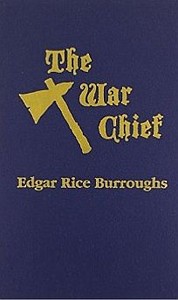
The war chief — Reading Companion
(0 User reviews)
1185
Project Gutenberg
2023
Not confirmed
Historical fiction; Western stories; Apache Indians -- Fiction
Readers of public-domain and historical texts
Project Gutenberg digital edition
en
Edition facts
Words
83,197
Reading time
362 min
Text sections
9
The catalog record for The war chief — Reading Companion provides practical reading context through 83,197 words, 6 hr 2 min estimated reading time, and 9 detected text sections.
The text analysis averages about 20.1 words per sentence, while the detected sections provide another way to judge how the source is divided.
Project Gutenberg metadata also associates the work with “Historical fiction,” connecting these edition facts with the source record’s subject description.
Source:
Project Gutenberg record #70124
Edgar Rice Burroughs opens his Apache novel with a parallel between Caledonian and Athapascan warriors, using repeated phrasing to link ancient savagery across continents. The narrative shifts between panoramic historical commentary and tight tactical scenes, as when Shoz-Dijiji holds off cavalry while Geronimo fortifies a hill. Voice oscillates from ironic asides to clipped action.
Editorial Edition Score
4.7/5
★★★★★
★★★★★
Calculated from edition completeness, EPUB availability, text structure and catalogue metadata. Not a user rating.
How this score is calculated
- Description quality20 pts
- Title & short description10 pts
- Source metadata20 pts
- Text length15 pts
- Chapters / structure15 pts
- EPUB file integrity20 pts
Total of 100 points, scaled to a 2.5-5.0 range. Editions with an empty description or a missing EPUB file are not scored.
Edition quality
Read the Text
reedom. Agricola was as yet unborn, the Wall of Antoninus unbuilt, Albion not even a name; but Agricola was to come, Antoninus was to build his wall; and they were to go their ways, taking with them the name of Albion, taking with them freedom; leaving England, civilization, inhibitions.
But ever in the seed of the savage is the germ of savagery that no veneer of civilization, no stultifying inhibitions seem able ever entirely to eradicate. Appearing sporadically in individuals it comes down the ages—the germ of savagery, the seed of freedom.
As the Caledonian savages danced through that long-gone night, a thousand years, perhaps, before the prototypes of Joseph Smith, John Alexander Dowie and Aimee Semple McPherson envisaged the Star of Bethlehem, a new sun looked down upon the distant land of the Athapascans and another scene—American Indian savages.
Naked but for a G-string, rough sandals, a bit of hide and a buffalo headdress, a savage warrior moved silently among the boles of great trees. At his heels, in single file, came others, and behind these squaws with papooses on their backs and younger children tagging at their heels.
They had no pack animals, other than the squaws, but they had little to pack. It was, perhaps, the genesis of that great trek toward the south. How many centuries it required no man knows, for there were no chroniclers to record or explain that long march of the Apaches from northwest Canada to Arizona and New Mexico, as there have been to trace the seed of the Caledonian savage from the Grampian Hills to the New World.
The ancestors of Jerry MacDuff had brought the savage germ with them to Georgia from Scotland in early colonial days, and it had manifested itself in Jerry in two ways—filled him with a distaste for civilization that urged him ever frontierward and mated him with the granddaughter of a Cherokee Indian, in whose veins pulsed analogous desires.
Jerry MacDuff and Annie Foley were, like nearly all other pioneers, ignorant, illiterate, unwashed. They had nothing of the majesty and grandeur and poise of their savage forebears; the repressive force of civilization had stifled everything but the bare, unlovely germ of savagery.
They have little to do with this chronicle, other than to bring Andy MacDuff into the world in a dilapidated wagon somewhere in Missouri in the spring of 1863, and carry him a few months and a few hundred miles upon the sea of life.
Why Jerry MacDuff was not in one army or another, or in jail, in 1863, I do not know, for he was an able-bodied man of thirty and no coward; but the bare fact is that he was headed for California along the old Santa Fe trail. His pace was slow, since dire poverty, which had always been his lot, necessitated considerable stops at the infrequent settlements where he might earn the wherewith to continue his oft-interrupted journey.
Out of Santa Fe, New Mexico, the MacDuffs turned south along the Rio Grande toward the spot where the seeds of the ancient Caledonian and Athapascan warriors were destined to meet again for the first time, perhaps, since they had set out upon opposite trails from the birthplace of humanity in the days when ferns were trees, and unsailed seas lashed the shores of continents that are no more.
Changed are the seas, changed are the continents, changed the mortal envelope that houses the germ of humanity that alone remains unchanged and unchangeable. It abode in the breast of Go-yat-thlay, the Apache and, identical, in the breast of Andy MacDuff, the infant white.
Had Andy’s forebears remained in Scotland Andy would doubtless have developed into a perfectly respectable caddie before he became a God-fearing, law-abiding farmer. Back of him were all the generations of civilization that are supposed to have exerted a refining influence upon humanity to the end that we are now inherently more godlike than our savage ancestors, or the less-favored peoples who have yet to emerge from savagery.
Back of Go-yat-thlay there was no civilization. Down through all the unthinkable ages from the beginning the savage germ that animated him had come untouched by any suggestion of refinement—Go-yat-thlay, born a Ned-ni Apache in No-doyohn Canyon, Arizona, in 1829, was stark savage. Already, at thirty-four, he was war chief of the Be-don-ko-he, the tribe of his first wife, Alope, which he had joined after his marriage to her. The great Mangas Colorado, hereditary chief of the Be-don-ko-he, thought well of him, consulted him, deferred to him upon occasion; often sent him out upon the war trail in command of parties of raiders.
The first chapter of The War Chief opens with a striking parallel: a Caledonian warrior dancing in the Grampian Hills is mirrored by an Athapascan moving silently through American forests. Burroughs repeats the phrase “Naked but for a G-string, rough sandals, a bit of hide and a buffalo headdress” to link these scenes, then breaks into a sardonic aside about “the refining influences of imperial conquest.” This double opening establishes a narrative voice that oscillates between panoramic historical commentary and close, physical description of the Apache world.
The excerpts show that Burroughs does not maintain this elevated tone throughout. Later chapters shift into tight, tactical prose: Shoz-Dijiji, alone behind a rock, “held off the United States Army” while Geronimo prepared a stand. The language becomes clipped, focused on movement and cover, as the cavalry charges and the infantry deploys under a blistering sun. The voice adapts to the scene—sometimes ironic, sometimes starkly immediate.
Parallel Openings and Ironic Asides
The novel’s first paragraph performs a deliberate structural echo. Burroughs describes a Caledonian warrior in the Grampian Hills, then immediately cuts to “another scene—American Indian savages.” The repetition of the same opening sentence (“Naked but for a G-string…”) forces a comparison between prehistoric Scotland and prehistoric America. This is not mere scene-setting; it is a rhetorical move that frames the Apache story within a larger meditation on savagery and civilization.
Burroughs then inserts a parenthetical aside: “pardon me!—that was as yet ignorant of the refining influences of imperial conquest, trained mercenaries and abhorrent disease.” The sarcastic tone breaks the immersive mood, reminding the reader that this is a constructed narrative. The voice here is knowing, even flippant, and it contrasts sharply with the earnest physicality of the warrior’s dance. This ironic register reappears only sporadically; the excerpts suggest it is most prominent in the opening chapters, where Burroughs establishes his thematic framework.
Tactical Prose and Shifts in Pace
Once the narrative moves to the Apache campaigns, the prose tightens. In the scene where Shoz-Dijiji holds off cavalry, sentences become short and action-driven: “Behind his rock, quite alone, Shoz-Dijiji held off the United States Army.” The pace accelerates through a series of rapid-fire details: the crack of a rifle, the ping of a bullet, a head ducking to safety. Burroughs uses repetition of structure (“There was not an Indian in sight”) to underscore the emptiness of the landscape after the fight.
When the infantry arrives, the rhythm shifts again. Burroughs describes their march in longer, cumulative sentences: “All day they had groused and cursed and bewailed the fate that had sent them into ‘this man’s army.’” Then, with the first shot, “fatigue slipped from them as easily as an old coat.” The change in pace mirrors the soldiers’ own shift from weary plodding to alert readiness. Burroughs controls tempo by alternating between panoramic description and close focus on individual movement.
Voice and the Germ of Savagery
Burroughs’s narrator frequently steps back to offer generalizing statements about human nature. The opening chapter introduces the idea of “the germ of savagery” that persists through civilization, appearing “sporadically in individuals.” This concept is presented as a universal law, linking the Caledonian and Apache warriors across millennia. The voice here is authoritative, almost anthropological, but it is undercut by the ironic asides that follow.
In later excerpts, the narrator’s presence recedes. The tactical scenes are rendered with minimal commentary; the reader is left to infer the characters’ thoughts from their actions. When the cavalry captain mutters “Hell!” after finding no Indians, the narrator does not explain his frustration—the single word carries the weight. This restraint contrasts with the earlier, more discursive passages. The voice of The War Chief is thus not uniform: it moves between a knowing, essayistic tone and a lean, reportorial one, depending on whether Burroughs is establishing theme or depicting action.
Readers will find that the novel’s interest lies less in plot than in the way Burroughs modulates his narrator’s distance from the events. Pay attention to when the voice becomes ironic and when it withdraws; these shifts often signal a change in the kind of attention the text demands. The tactical sequences reward close reading for their precise geography of cover and movement, while the opening chapters invite reflection on the book’s larger claims about savagery and freedom.
I remember sitting on my grandfather’s porch, reading about Shoz-Dijiji’s quiet ferocity, and thinking how distance doesn’t soften struggle. That same ache surfaced later in The mother’s recompense — Reading Companion, where a woman’s reckonings felt just as ancient, just as raw. Both books let me hold a moment without needing to fix it. Just witness.
There are no reviews for this eBook.
There are no comments for this eBook.
Reader reflection
Before you leave, reflect on the book
Use these questions to collect your thoughts before moving on.
Your progress
0
/
10
2
How did the book work for you overall?
3
Would you recommend this book to another reader?
4
How demanding did the text feel?
5
How strong was your personal connection to the text?
6
What was the strongest part of the book?
7
How valuable was this book for your own interests?
8
How would you describe its reading pace?
9
Which lesson or insight stayed with you?
10