1

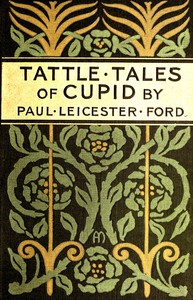
Tattle-tales of Cupid — Context and Discussion
(0 User reviews)
1217
Project Gutenberg
2023
Not confirmed
United States -- Social life and customs -- 19th century -- Fiction; American drama -- 19th century; Romance fiction, American
Readers of public-domain and historical texts
Project Gutenberg digital edition
en
Edition facts
Words
44,057
Reading time
192 min
Text sections
14
Before opening Tattle-tales of Cupid — Context and Discussion, the edition data offers a quick orientation: 44,057 words, 3 hr 12 min estimated reading time, and 14 detected text sections.
The text analysis averages about 13.2 words per sentence, while the detected sections provide another way to judge how the source is divided.
Project Gutenberg metadata also associates the work with “United States -- Social life and customs -- 19th century -- Fiction,” connecting these edition facts with the source record’s subject description.
Source:
Project Gutenberg record #71597
Paul Leicester Ford's 1898 collection of romantic stories and plays, opening with a horse's perspective on a woman's character and including a play where characters debate aristocracy over teacups. The excerpts show varied narrative voices and social comedy.
Editorial Edition Score
4.8/5
★★★★★
★★★★★
Calculated from edition completeness, EPUB availability, text structure and catalogue metadata. Not a user rating.
How this score is calculated
- Description quality20 pts
- Title & short description10 pts
- Source metadata20 pts
- Text length15 pts
- Chapters / structure15 pts
- EPUB file integrity20 pts
Total of 100 points, scaled to a 2.5-5.0 range. Editions with an empty description or a missing EPUB file are not scored.
Edition quality
Read the Text
ing his head, but this time it was exactly what I wanted. Whoop! Ride me? Neigh, neigh! If you ever saw a coward in an ague of a blue funk, that is what I was. I blessed my stars none of the Eleventh Battery were round! Lewis tried; but, do his best, I wouldn’t let him back me. When my Major interfered, I sidled up to my dear just as if I couldn’t keep away from him; but when he attempted to hold me for Lewis to mount, I went round in a circle, always keeping him between me and the brute. It was oats to me, you’d better believe, to see the puzzled, worried look on Miss Fairley’s face as she watched the whole thing.
“Well, they discussed what they called ‘the mystery,’ and finally agreed that they couldn’t ride that afternoon, so we horses were sent down to the stable, and the three went back to the verandah. Sagitta told me afterward what happened there.
‘Come here, pup,’ calls Lewis to him, the moment they were seated.
“Sagitta backed away two steps, bristling up, and growling a bit.
“‘Come here, you brute!’ ordered Lewis hotly, rising.
“Sagitta crouched a little, drew his lips away from his fangs, and pitched his growl ‘way down in his throat.
“‘Look out! That dog means mischief,’ cried my Major.
“‘Are the animals possessed?’ roared Lewis, his voice as angry as Sagitta’s snarl, yet stepping backwards, for it looked as if the dog were about to spring.
“But my Major didn’t retreat—not he! He sprang between the wolf-hound and Miss Fairley. ‘Down, sir!’ he ordered sharply; and Sagitta dropped his lips and his bristles, and came right up to him, wagging his tail, and trying to lick his hand.
“‘Isn’t it extraordinary?’ cried Miss Fairley, with a crease in her forehead. ‘Here, Sagitta!’
“‘Miss Fairley, be careful!’ pleaded my Major; but there wasn’t the slightest necessity. Sagitta was by her side like a flash, and was telling her how he loved her, in every way that dog could. And there he stayed till Lewis came forward, when he backed away again, snarling.
“Now, in all their Washington intercourse my Major had been the surly one; but in the interval he had evidently had time to realise his mistake, and to see that he must correct it. Probably, too, he wasn’t depressed by what had just taken place. Anyway, that afternoon he was as pleasant and jolly as he knew how to be. But Mr. Lewis! Well, I acknowledge he’d had enough to make any man mad, and that was what he was. Cross, sulky, blurting out disagreeable things in a disagreeable voice, with a disagreeable face: he did make an exhibition of himself, so Sagitta said.
“After as long a stay as was proper, my Major told them he must go, and I was brought round. Miss Fairley came to the stoop with him, and didn’t I prick up my ears when I heard her say:
“‘Since you were defrauded of your ride to-day, Major Moran, perhaps you will lunch here to-morrow, and afterward we will see if we can’t be more successful?’
“The next day our interference was done a little differently. When we were brought round to the door, there was Mr. Lewis with a pair of cruelly big rowelled spurs on his boots, a brutal Mexican quirt in his hand, and a look on his face to match the two. Of course the grey gave him a lot of trouble in mounting, but we had already planned a different policy; and so, after enough snorting and trembling to make Felicia look thoughtful, he finally was allowed to get on Mr. Solitaire’s back.
“Much good it did him! The filly and I paired off just as if we were having a bridle trip in double harness; but do his best, Mr. Lewis could not keep the grey abreast of us. Twenty feet in front, or thirty feet behind, that was where he was during the whole ride, and Lewis fought one long battle trying to make it otherwise. He had had the reins buckled to the lower bar of the curb, so it must have been pretty bad for the grey, but there was no flinching about him.
Paul Leicester Ford’s Tattle-tales of Cupid opens with an unusual narrative voice: a bay mare, a carriage-horse, and an old horse named Reveille discuss a woman’s character while eating apples. The horses’ dialogue—‘She’s a darling!’ and ‘She’s a thoroughbred; but she’s not the beauty her mother was’—immediately establishes a comic, animal-eye view of human romance. This framing device suggests Ford will use unconventional perspectives to examine courtship.
The collection mixes short stories and plays, as shown by the table of contents listing pieces like ‘His Version of It’ and ‘The Cortelyou Feud.’ The excerpts from the play ‘Man Proposes’ reveal a group of characters bantering about an approaching earl, with lines like ‘the talking point will be passed. We shall act!’ The tone is witty and self-aware, blending social satire with romantic tension.
Horses as Critics of Love
The opening story, ‘His Version of It,’ uses horses as commentators on human affection. The bay mare calls the woman ‘a darling,’ while the older horse Reveille offers a comparative judgment: ‘she’s not the beauty her mother was.’ This animal perspective is not merely whimsical; it establishes a pattern of indirect observation. The horses’ conversation about apples and manners mirrors human concerns about taste and breeding. Readers should note how Ford sustains this framing—whether the horses return or the narrative shifts entirely. The excerpt suggests a layered approach to romance, where even stable talk carries weight.
Teacup Politics and Social Satire
In the play ‘Man Proposes,’ characters engage in rapid-fire repartee over tea. The dialogue is dense with allusions: Talleyrand’s aphorism ‘that words were meant to conceal ideas’ is quoted, and the characters mock each other’s motives. The men fear being overshadowed by an incoming earl, while the women tease them for their insecurity. The stage directions—‘pounding on table with paper-knife,’ ‘seizing hot water pot’—emphasize physical comedy. This section reveals Ford’s skill with theatrical dialogue, where social hierarchies and romantic rivalries are debated openly. The play’s structure, with its parliamentary-style interruptions, suggests a satirical view of courtship as a game of strategy.
The Dedication as a Clue to Tone
Ford’s dedication ‘To My Playmate’ recounts a childhood partnership in reading and inventing stories. He writes that the two children ‘stopped inventing and acting and living their joint imaginings,’ and he now collects ‘the offspring of some of his earliest and some of his latest play-hours.’ This personal note frames the collection as a return to collaborative creativity. The language—‘playthings,’ ‘playmate’—suggests that the stories are meant to be playful rather than earnest. Readers may find that the dedication colors the subsequent tales, hinting at a lighthearted, even nostalgic approach to love and fiction.
Varied Forms and Voices
The table of contents lists both stories and plays, indicating formal variety. The excerpts show two distinct modes: the animal-narrated prose of ‘His Version of It’ and the dialogue-heavy play ‘Man Proposes.’ The play’s characters—Steven, Dennis, Helen, Rose—engage in a mock-parliamentary debate about an earl’s arrival, with lines like ‘the motion of expulsion is not in order.’ This contrast in form suggests Ford experiments with perspective and genre. Readers should attend to how each piece handles romantic conflict: through indirect animal commentary in one, through direct verbal sparring in another. The collection may reward attention to these shifts in narrative distance.
Ford’s Tattle-tales of Cupid invites readers to approach each piece as a distinct experiment in romantic storytelling. The horses, the teacup debates, and the dedication all point to a writer who enjoys playing with convention. Rather than expecting a unified novel, treat the collection as a series of variations on courtship, each with its own rules and tone. The excerpts suggest that Ford’s humor and social observation are best appreciated when the reader is alert to shifts in voice and form.
The rain spattered on the windowsill while I drifted through Ford’s horse’s-eye view of Cupid, caught between a whinny and a wink. That playful tangle of motives lingered, so when I shelved it, I found myself reaching for something sharper, quieter: Unnatural death — Edition Insights. Both, in their own way, are about reading people wrong, and the pleasure of being tricked into knowing better.
There are no reviews for this eBook.
There are no comments for this eBook.
Reader reflection
Record your reading impressions
A brief reflection can help important ideas stay with you longer.
Your progress
0
/
10
2
How did the book work for you overall?
3
Would you encourage someone else to read it?
4
What was the reading difficulty like?
5
Did the book give you something worth debating?
6
What did you appreciate most?
7
Did the book deliver what you hoped for?
8
How closely did the book connect with your experience?
9
What did this book teach you most?
10