1

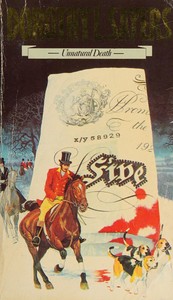
Unnatural death — Edition Insights
(0 User reviews)
351
Project Gutenberg
2023
Not confirmed
Private investigators -- England -- Fiction; Detective and mystery stories; Wimsey, Peter, Lord (Fictitious character), 1890- -- Fiction
Readers of public-domain and historical texts
Project Gutenberg digital edition
en
Edition facts
Words
89,841
Reading time
391 min
Text sections
12
This digital edition of Unnatural death — Edition Insights is described by source-level measurements including 89,841 words, 6 hr 31 min estimated reading time, and 12 detected text sections.
The text analysis averages about 14.3 words per sentence, while the detected sections provide another way to judge how the source is divided.
Project Gutenberg metadata also associates the work with “Private investigators -- England -- Fiction,” connecting these edition facts with the source record’s subject description.
Source:
Project Gutenberg record #70008
Dorothy L. Sayers' third Lord Peter Wimsey novel, where the detective investigates a suspicious death with no clear cause, navigating a web of clergy, solicitors, and family secrets. The narrative shifts between Wimsey's banter and Parker's methodical police work, with a pace that quickens as clues emerge.
Editorial Edition Score
4.8/5
★★★★★
★★★★★
Calculated from edition completeness, EPUB availability, text structure and catalogue metadata. Not a user rating.
How this score is calculated
- Description quality20 pts
- Title & short description10 pts
- Source metadata20 pts
- Text length15 pts
- Chapters / structure15 pts
- EPUB file integrity20 pts
Total of 100 points, scaled to a 2.5-5.0 range. Editions with an empty description or a missing EPUB file are not scored.
Edition quality
Read the Text
s mother was being very much worried at the time by her husband’s behaviour (Denver was always tiresome, though the big scandal did not break out till the Jubilee year), and her anxieties may have affected the boy. He was a colorless shrimp of a child, very restless and mischievous, and always much too sharp for his age. He had nothing of Gerald’s robust beauty, but he developed what I can best call a kind of bodily cleverness, more skill than strength. He had a quick eye for a ball and beautiful hands for a horse. He had the devil’s own pluck, too: the intelligent sort of pluck that sees the risk before it takes it. He suffered badly from nightmares as a child. To his father’s consternation he grew up with a passion for books and music.
His early school-days were not happy. He was a fastidious child, and I suppose it was natural that his school-fellows should call him “Flimsy” and treat him as a kind of comic turn. And he might, in sheer self-protection, have accepted the position and degenerated into a mere licensed buffoon, if some games-master at Eton had not discovered that he was a brilliant natural cricketer. After that, of course, all his eccentricities were accepted as wit, and Gerald underwent the salutary shock of seeing his despised younger brother become a bigger personality than himself. By the time he reached the Sixth Form, Peter had contrived to become the fashion—athlete, scholar, _arbiter elegantiarum—nec pluribus impar_. Cricket had a great deal to do with it—plenty of Eton men will remember the “Great Flim” and his performance against Harrow—but I take credit to myself for introducing him to a good tailor, showing him the way about Town, and teaching him to distinguish good wine from bad. Denver bothered little about him—he had too many entanglements of his own and in addition was taken up with Gerald, who by this time was making a prize fool of himself at Oxford. As a matter of fact Peter never got on with his father, he was a ruthless young critic of the paternal misdemeanours, and his sympathy for his mother had a destructive effect upon his sense of humour.
Denver, needless to say, was the last person to tolerate his own failings in his offspring. It cost him a good deal of money to extricate Gerald from the Oxford affair, and he was willing enough to turn his other son over to me. Indeed, at the age of seventeen, Peter came to me of his own accord. He was old for his age and exceedingly reasonable, and I treated him as a man of the world. I established him in trustworthy hands in Paris, instructing him to keep his affairs upon a sound business footing and to see that they terminated with goodwill on both sides and generosity on his. He fully justified my confidence. I believe that no woman has ever found cause to complain of Peter’s treatment; and two at least of them have since married royalty (rather obscure royalties, I admit, but royalty of a sort). Here again, I insist upon my due share of the credit; however good the material one has to work upon it is ridiculous to leave any young man’s social education to chance.
The Peter of this period was really charming, very frank, modest and well-mannered, with a pretty, lively wit. In 1909 he went up with a scholarship to read History at Balliol, and here, I must confess, he became rather intolerable. The world was at his feet, and he began to give himself airs. He acquired affectations, an exaggerated Oxford manner and a monocle, and aired his opinions a good deal, both in and out of the Union, though I will do him the justice to say that he never attempted to patronise his mother or me. He was in his second year when Denver broke his neck out hunting and Gerald succeeded to the title. Gerald showed more sense of responsibility than I had expected in dealing with the estate; his worst mistake was to marry his cousin Helen, a scrawny, over-bred prude, all country from head to heel. She and Peter loathed each other cordially; but he could always take refuge with his mother at the Dower House.
From its opening pages, Unnatural Death establishes a distinctive narrative voice through the fictional biographical note by Paul Austin Delagardie, who introduces Lord Peter Wimsey with a blend of family pride and sardonic commentary. Delagardie describes his nephew as 'all nerves and nose' and contrasts him with the 'beef-witted' Duke of Denver, setting a tone of witty, self-aware observation that permeates the novel. This framing device immediately signals that the story will be as much about character as about detection.
The early chapters move at a deliberate pace, with Wimsey and his friend Inspector Parker gathering information through interviews. The dialogue is crisp and often humorous, as when Wimsey quotes Ingoldsby and asks Parker if he knows 'the land where blooms the citron-flower.' These exchanges reveal Wimsey's erudition and his tendency to deflect tension with literary allusions.
The Biographical Frame and Narrative Voice
The novel opens not with a crime but with a mock-biography of Lord Peter, written by his uncle Paul Austin Delagardie. This unusual choice immediately establishes a self-conscious, almost playful narrative voice. Delagardie’s tone is arch and opinionated: he dismisses the Duke of Denver as 'nothing but a beef-witted English squire' and praises Peter for inheriting 'the Delagardie brains.' The biography includes details like Peter’s education, war service, and recreations ('Criminology; bibliophily; music; cricket'), blending fact with a hint of parody. This framing device colors the entire novel, reminding readers that Wimsey is a constructed character, observed from a knowing distance. Sayers uses this voice to control the pace, slowing down for character sketches and quickening during investigative scenes.
Pacing Through Dialogue and Detail
The investigation proceeds through a series of conversations, each revealing new information while maintaining a leisurely rhythm. When Wimsey and Parker interview the Coblings, the dialogue is filled with local color and digressions, such as Ben Cobling’s comment that the solicitor was 'uncommon sharp—ha, ha! Never gave nothing away.' These asides build atmosphere but also delay the plot, creating a sense of patient accumulation. Later, the pace shifts abruptly when Wimsey decides to visit Croftover Magna: 'we’re going straight off… to look up Messrs. Pointer & Winkin.' The contrast between the meandering interviews and the sudden decision to act highlights Sayers’ control over narrative tempo. The visit to the Tabernacle Mission introduces a comic interlude with children forming a 'ring-o’-roses' around Parker, momentarily lightening the tone before the investigation resumes.
Recurring Motifs: Clergy, Solicitors, and Family Secrets
The excerpts reveal a pattern of characters connected to the deceased: a clergyman (the Rev. Hallelujah Dawson), a solicitor (Mr. Probyn), and family members. Wimsey’s method involves tracing these connections through letters and interviews, as when he writes to Bishop Lambert for information. The motif of 'Cousin Hallelujah' and the 'disgraceful and papistical Mr. Paul' suggests a web of religious and familial tensions. Sayers uses these figures to create a sense of hidden history, with each new character adding a layer of complexity. The solicitor’s withdrawal from the case and the mention of 'Miss Dawson’s affairs' hint at financial motives, but the excerpts do not reveal the full picture. This careful layering of clues, delivered through dialogue and brief narrative summaries, maintains suspense without rushing to resolution.
Readers approaching Unnatural Death should attend to the interplay between Wimsey’s theatricality and Parker’s doggedness, as their contrasting styles drive the investigation forward. The novel rewards attention to small details—a solicitor’s address, a bishop’s secretary, a child’s game—that later prove significant. Sayers’ prose is precise and often wry, inviting the reader to share in the detective’s intellectual pleasure without losing sight of the human stakes.
Rereading Unnatural Death, I kept thinking of how carefully each clue sat hidden in plain sight, like letters waiting to be properly addressed. That patient unravelling reminded me of the quiet pleasure found in Anne Page — A Reader’s Guide, where every detail earns its place. It’s strange how two such different books can share that same unhurried trust in the reader.
There are no reviews for this eBook.
There are no comments for this eBook.
Reader reflection
What was your reading experience?
Capture what you thought, learned, and would like to remember.
Your progress
0
/
10
2
Was reading this book enjoyable?
3
How likely are you to recommend this book?
4
How easy was the book to follow?
5
Did the book meet your expectations?
6
Could you follow the author’s main argument?
7
How did the pace of the book feel?
8
Did you relate to its people, ideas, or situations?
9
In one sentence, what did you learn?
10