1

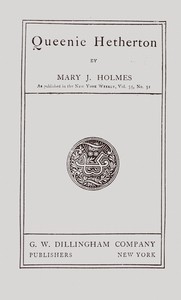
Queenie Hetherton — A Reader’s Guide
(0 User reviews)
982
Project Gutenberg
2023
Not confirmed
American fiction -- 19th century; Man-woman relationships -- Fiction; Upper class -- Fiction; Dime novels
Readers of public-domain and historical texts
Project Gutenberg digital edition
en
Edition facts
Words
159,545
Reading time
694 min
Text sections
54
The source record for Queenie Hetherton — A Reader’s Guide measures this digital text at 159,545 words, 11 hr 34 min estimated reading time, and 54 detected text sections.
The text analysis averages about 24.8 words per sentence, while the detected sections provide another way to judge how the source is divided.
Project Gutenberg metadata also associates the work with “American fiction -- 19th century,” connecting these edition facts with the source record’s subject description.
Source:
Project Gutenberg record #70474
Mary Jane Holmes's 1880 novel contrasts the proud, reserved dressmaker Margery La Rue with the wealthy Queenie Hetherton, exposing class tensions in Merrivale through precise social rituals, French heritage, and the weight of family secrets.
Editorial Edition Score
4.9/5
★★★★★
★★★★★
Calculated from edition completeness, EPUB availability, text structure and catalogue metadata. Not a user rating.
How this score is calculated
- Description quality20 pts
- Title & short description10 pts
- Source metadata20 pts
- Text length15 pts
- Chapters / structure15 pts
- EPUB file integrity20 pts
Total of 100 points, scaled to a 2.5-5.0 range. Editions with an empty description or a missing EPUB file are not scored.
Edition quality
Read the Text
CHAPTER I. INTRODUCING SOME OF THE CHARACTERS.
The morning mail for Merrivale had just arrived, and the postmaster was distributing the letters. Col. Rossiter, who lived in the large stone house on the Knoll, had two; one from his wife, who, with his two daughters, was spending the summer at Martha’s Vineyard, and one from his son Philip, a young graduate from Harvard, who had been off on a yachting excursion, and was coming home for a few days before joining his mother and sisters at the sea-side. There was also one for Mrs. Lydia Ann Ferguson, who lived on Cottage Row, and was the fashionable dressmaker of the town. Mr. Arthur Beresford, the only practicing lawyer in Merrivale, had six, five of which he read hastily, as he stood in the post-office door, and then for a moment studied the superscription of the other, which was soiled and travel-worn, and bore a foreign postmark.
“From Mr. Hetherton,” he said, to himself. “What can he want, I wonder?” and opening the letter, he read as follows:
“HOTEL MEURICE, PARIS, June 10th, 18—.
“_Dear Sir_:—You will undoubtedly be surprised to hear that I am coming home. Once I expected to live and die abroad, but recently, with my failing health, there has come over me an intense longing to see America once more.
“After an absence of nearly twenty-three years, it will seem almost as strange to me as to my daughter Reinette, who has never been in an English-speaking country. She is as anxious to come as I am, and we have engaged passage on the Russia, which sails from Liverpool the 25th. I have no idea whether the old house is habitable or not. All important changes and repairs I prefer to make myself, after Reinette has decided what she wants; but, if possible, I wish you to have a few rooms made comfortable for us. The large chamber which looks toward the town and the river I design for Reinette, and will you see that it is made pretty and attractive. If I remember rightly, there used to be in it a mahogany bedstead older than I am. Remove it, and substitute something light and airy in its place. Reinette does not like mahogany. Put simple muslin curtains at the windows, and have nothing but matting on the floors; Reinette detests carpets. And if you know of a pair of fine carriage horses and a lady’s saddle pony, have them ready for inspection, and if they suit Reinette I will take them. If you chance to hear of a trusty, middle-aged woman suitable for a housekeeper at Hetherton Place, retain her until Reinette can see her; and please have the conservatory and garden full of flowers. Reinette is passionately fond of flowers—fond, in fact, of everything bright and pretty. She has just come in, and says tell you to be sure and get her some cats and dogs, so I suppose you must do it; but, for Heaven’s sake, don’t fill the house with them—two or three will answer. I can’t abide them myself. Reinette is waiting for me to go to dinner, and I must close. Shall telegraph to you from New York as soon as the vessel arrives, and shall follow on first train.
“Truly, FREDERICK HETHERTON.
“Spare no money to make the place comfortable.”
Arthur Beresford’s face was a puzzle as he read this letter from one whose business agent and lawyer he merely was, and whom he scarcely remembered at all except as a dashing, handsome young man, whom everybody called fast, and whom some called a _scamp_.
From its first chapter, Queenie Hetherton establishes a world where social standing is measured in small, telling details: the number of letters a lawyer receives, the size of a dressmaker's bundle, and the precise hour a gown must be delivered. Mary Jane Holmes builds her narrative around the friction between Margery La Rue, a French-born dressmaker who carries her work through town without feeling "one whit degraded," and the wealthy families who employ her. The novel's opening scenes—a postmaster sorting mail, a mother bringing tea and toast to her sewing daughter—ground the story in domestic routines that carry sharp class implications. Holmes's prose moves between interior monologue and brisk dialogue, letting characters reveal their prejudices through casual asides. Mr. Beresford's thought that it is "a pity" Margery was not born into higher ranks encapsulates the novel's central tension: a society that admires beauty and skill but cannot separate them from birth.
The Dressmaker's Bundle and the Lawyer's Hat
Holmes uses material objects to mark social boundaries. When Margery trudges along Cottage Row with a bundle "almost as large as herself," the narrator specifies the dress has "many plaitings, and puffs, and bows" that must not be crushed. This is not mere description; it is a measure of labor. The bundle's size contrasts with Mr. Beresford's polite hat-lift—a gesture that acknowledges Margery's beauty while reinforcing her place. Anna Ferguson's imperious demand for the dress by twelve, and her later condescending praise ("you are a brick"), show how the wealthy consume Margery's work while dismissing her person. The novel repeatedly returns to such scenes: a cup of tea carried at noon, a dress fitted at two, a walk home in the afternoon. These small temporal markers anchor the class system in everyday life.
French Gush and Cold Americans
Margery's mixed heritage is a recurring point of tension. She reflects that she has "very little of the French gush" in her, considering herself "more like the cold Americans." This self-assessment comes after her mother's anxious questions about love and happiness—questions Margery attributes to a "naturally morbid temperament." The novel uses French identity as both a marker of exoticism and a source of instability. Mrs. La Rue's moods grow more frequent in Merrivale, and Margery resolves to "pet her more," yet the narrative keeps the mother's past obscure. The dedication to "the dear little girl who sleeps among the New England hills" hints at loss, but the excerpts do not reveal how that loss connects to the La Rues. What is clear is that French heritage carries emotional weight: it is associated with demonstrative affection, nervous health, and a past that the novel withholds.
Letters, Names, and Unspoken Knowledge
The novel's epistolary structure—chapters titled "Letters from Mentone," "Old Letters," "The Letters"—suggests that written communication drives the plot. In the opening, Col. Rossiter receives letters from his wife and son; Mr. Beresford gets six, five of which he reads hastily. These letters carry news from absent characters and create a network of information that readers must piece together. The title character, Queenie Hetherton, is introduced through others' correspondence before she appears. Meanwhile, names carry weight: "La Rue" marks Margery as French, while "Hetherton" signals landed gentry. Anna Ferguson's thought that "Queenie has just spoiled" Margery "with so much attention" hints at a cross-class friendship that the excerpts do not fully explore. The novel's fifty-four chapters and 159,545 words suggest a slow unraveling of secrets, with letters as the primary vehicle for revelation.
Readers approaching Queenie Hetherton should attend to the novel's rhythm of small social transactions—a dress delivered, a letter read, a hat raised. Holmes embeds her class critique in these gestures rather than in overt commentary. The excerpts leave many questions unanswered: What is Mrs. La Rue hiding? How will Queenie's friendship with Margery develop? What do the old letters contain? The novel rewards patience with its accumulation of detail, and its 694-minute reading time allows for the slow immersion that such a world demands.
Reading about Margery’s precise French rituals reminded me of my grandmother’s sewing drawer, each spool in its place, hiding a letter she never discussed. The quiet weight of unspoken family things—that’s what lingered. I felt it again last autumn with The unpleasantness at the Bellona Club — Themes and Context, where a club’s rigid etiquette muffles the same kind of private grief. Two different worlds, one familiar ache.
There are no reviews for this eBook.
There are no comments for this eBook.
Reader reflection
Your personal reading reflection
Build a private reading journal entry for this title.
Your progress
0
/
10
2
How did the book work for you overall?
3
Would you encourage someone else to read it?
4
Did the language feel accessible?
5
How much did the book move you?
6
Would you start a conversation about this book?
7
How original did the book feel?
8
What did you appreciate most?
9
What is the main idea you are taking away?
10