1

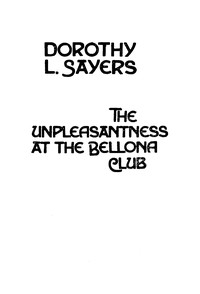
The unpleasantness at the Bellona Club — Themes and Context
(0 User reviews)
995
Project Gutenberg
2024
Not confirmed
Private investigators -- England -- Fiction; Detective and mystery stories; Wimsey, Peter, Lord (Fictitious character), 1890- -- Fiction
Readers of public-domain and historical texts
Project Gutenberg digital edition
en
Edition facts
Words
76,192
Reading time
332 min
Text sections
8
The catalog record for The unpleasantness at the Bellona Club — Themes and Context provides practical reading context through 76,192 words, 5 hr 32 min estimated reading time, and 8 detected text sections.
The text analysis averages about 11.4 words per sentence, while the detected sections provide another way to judge how the source is divided.
Project Gutenberg metadata also associates the work with “Private investigators -- England -- Fiction,” connecting these edition facts with the source record’s subject description.
Source:
Project Gutenberg record #72855
Lord Peter Wimsey investigates a suspicious death at a London club, where the timing of a general's demise becomes crucial. The novel's structure mirrors a card game, with chapter titles like 'Hearts Count More Than Diamonds' and 'Spades Are Trumps,' while recurring images of corpses and morgues underscore the club's funereal atmosphere.
Editorial Edition Score
4.7/5
★★★★★
★★★★★
Calculated from edition completeness, EPUB availability, text structure and catalogue metadata. Not a user rating.
How this score is calculated
- Description quality20 pts
- Title & short description10 pts
- Source metadata20 pts
- Text length15 pts
- Chapters / structure15 pts
- EPUB file integrity20 pts
Total of 100 points, scaled to a 2.5-5.0 range. Editions with an empty description or a missing EPUB file are not scored.
Edition quality
Read the Text
Fentiman looked round, and something in their manner made him get up and follow them over to the fire.
Wimsey bent down over General Fentiman and drew the "Morning Post" gently away from the gnarled old hands, which lay clasped over the thin chest. He touched the shoulder--put his hand under the white head huddled against the side of the chair. The Colonel watched him anxiously. Then, with a quick jerk, Wimsey lifted the quiet figure. It came up all of a piece, stiff as a wooden doll.
Fentiman laughed. Peal after hysterical peal shook his throat. All round the room, scandalized Bellonians creaked to their gouty feet, shocked by the unmannerly noise.
"Take him away!" said Fentiman, "take him away. He's been dead two days! So are you! So am I! We're all dead and we never noticed it!"
It is doubtful which occurrence was more disagreeable to the senior members of the Bellona Club--the grotesque death of General Fentiman in their midst or the indecent neurasthenia of his grandson. Only the younger men felt no sense of outrage; they knew too much. Dick Challoner--known to his intimates as Tin-Tummy Challoner, owing to the fact that he had been fitted with a spare part after the second battle of the Somme--took the gasping Fentiman away into the deserted library for a stiffener. The Club Secretary hurried in, in his dress-shirt and trousers, the half-dried lather still clinging to his jaws. After one glance he sent an agitated waiter to see if Dr. Penberthy was still in the Club. Colonel Marchbanks laid a large silk handkerchief reverently over the rigid face in the arm-chair and remained quietly standing. A little circle formed about the edge of the hearthrug, not quite certain what to do. From time to time it was swelled by fresh arrivals, whom the news had greeted in the hall as they wandered in. A little group appeared from the bar. "What? old Fentiman?" they said. "Good God, you don't say so. Poor old blighter. Heart gone at last, I suppose"; and they extinguished cigars and cigarettes, and stood by, not liking to go away again.
Dr. Penberthy was just changing for dinner. He came down hurriedly, caught just as he was going out to an Armistice dinner, his silk hat tilted to the back of his head, his coat and muffler pushed loosely open. He was a thin, dark man with the abrupt manner which distinguishes the Army Surgeon from the West-end practitioner. The group by the fire made way for him, except Wimsey, who hung rather foolishly upon the big elbow-chair, gazing in a helpless way at the body.
Penberthy ran practiced hands quickly over neck, wrists and knee-joints.
"Dead several hours," he pronounced, sharply. "Rigor well-established--beginning to pass off." He moved the dead man's left leg in illustration; it swung loose at the knee. "I've been expecting this. Heart very weak. Might happen any moment. Any one spoken to him to-day?"
He glanced around interrogatively.
"I saw him here after lunch," volunteered somebody. "I didn't speak."
"I thought he was asleep," said another.
Nobody remembered speaking to him. They were so used to old General Fentiman, slumbering by the fire.
"Ah, well," said the doctor. "What's the time? Seven?" He seemed to make a rapid calculation. "Say five hours for rigor to set in--must have taken place very rapidly--he probably came in at his usual time, sat down and died straight away."
"He always walked from Dover Street," put in an elderly man, "I told him it was too great an exertion at his age. You've heard me say so, Ormsby."
"Yes, yes, quite," said the purple-faced Ormsby. "Dear me, just so."
"Well, there's nothing to be done," said the doctor. "Died in his sleep. Is there an empty bedroom we can take him to, Culyer?"
"Yes, certainly," said the Secretary. "James, fetch the key of number sixteen from my office and tell them to put the bed in order. I suppose, eh, doctor?--when the rigor passes off we shall be able to--eh?"
"Oh, yes, you'll be able to do everything that's required. I'll send the proper people in to lay him out for you. Somebody had better let his people know--only they'd better not show up till we can get him more presentable."
"Captain Fentiman knows already," said Colonel Marchbanks. "And Major Fentiman is staying in the Club--he'll probably be in before long. Then there's a sister, I think."
"Yes, old Lady Dormer," said Penberthy, "she lives round in Portman Square. They haven't been on speaking terms for years. Still, she'll have to know."
The Bellona Club is introduced as a 'Funeral Parlor' in the opening chapter, with Lord Peter Wimsey remarking on its 'marble,' 'palms,' and 'chaste bronze nude.' Captain Fentiman, a fellow member, describes the elderly members as 'corpses' and compares the club to a morgue. This morbid imagery recurs throughout, establishing a setting where death is a constant, almost routine presence. The club's atmosphere, with its snoring old men and armchairs, becomes a key structural element, framing the investigation that follows.
Card-Game Chapter Titles as Structural Framework
The novel's twenty-three chapters are titled after bridge terms, such as 'The Queen Is Out,' 'Hearts Count More Than Diamonds,' and 'Grand Slam In Spades.' This is not mere decoration; the chapter headings mirror the investigative process. For instance, 'Lord Peter Leads A Club' and 'Lord Peter Clears Trumps' suggest strategic moves in both the card game and the mystery. The final chapter, 'Post-Mortem,' echoes the post-game analysis, reinforcing the idea that the plot unfolds like a hand of bridge, with clues as cards and suspects as players. This structure gives the narrative a deliberate, almost mathematical progression.
Movement Between London and Paris
The investigation shifts between the Bellona Club in London and Paris, creating a contrast between the club's static, indoor world and the fluid, international chase. Wimsey travels to Paris after a detective's letter mentions a possible sighting of the supposedly deceased Oliver. The journey is described in practical terms—Wimsey takes the train, instructs Bunter to pack a suitcase, and stays at the Hôtel Meurice. This movement underscores the tension between the club's confined space and the broader, uncertain world outside, where identities can be mistaken and trails go cold.
Recurring Images of Death and Stagnation
From the opening line—'What in the world, Wimsey, are you doing in this Morgue?'—the club is persistently associated with death. Members are described as 'corpses,' and the elderly General Fentiman becomes 'part of the furniture' until his death. The club's decor, with its 'marble' and 'palms,' evokes a funeral parlor. This imagery extends to the characters' attitudes: Captain Fentiman laments his gassed stomach and lost job, feeling 'rotten' and purposeless. The club becomes a symbol of post-war stagnation, where survivors are merely waiting, like the old men in their armchairs.
The Role of Letters and Telegrams in Advancing the Plot
Key plot developments are conveyed through written correspondence, such as the detective's letter from Paris, which Wimsey reads aloud. The letter's cautious phrasing—'I believe that I have myself come upon the track of O.'—and its physical details ('bad paper and worse ink, and a small stain of vin ordinaire') ground the narrative in tangible evidence. Similarly, Wimsey sends a card from a P.L.M. express train. These documents serve as structural pivots, moving the investigation forward and introducing new complications, such as the need to stop an exhumation.
Readers should pay attention to how the card-game chapter titles relate to the unfolding mystery, as they often hint at the next move in the investigation. The contrast between the club's static interior and the journeys to Paris highlights the tension between confinement and escape. The recurring imagery of death and decay is not just atmospheric but central to the novel's themes of post-war disillusionment and the fragility of life.
I keep thinking about that club, how death lingers in its armchairs like a held breath. It reminded me of a summer I spent rereading an old favorite, feeling the same quiet dread settle over me. The trumpet in the dust — A Reader’s Guide brought that back, a gentler echo of endings and the spaces we leave empty.
There are no reviews for this eBook.
There are no comments for this eBook.
Reader reflection
What was your reading experience?
Capture what you thought, learned, and would like to remember.
Your progress
0
/
10
2
How much did you enjoy the reading experience?
3
Would you pass this book on to a friend?
4
How demanding did the text feel?
5
Which element worked best for you?
6
Did the book offer a fresh perspective?
7
How did the reading compare with what you expected?
8
Did any part of the book feel personally relevant?
9
What is the main idea you are taking away?
10