1

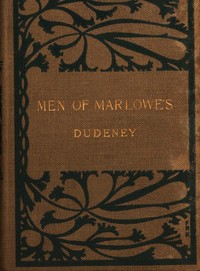
Men of Marlowe's — Edition Insights
(0 User reviews)
219
Project Gutenberg
2023
Not confirmed
City and town life -- Fiction; England -- Fiction; Short stories, English; Death -- Fiction
Readers of public-domain and historical texts
Project Gutenberg digital edition
en
Edition facts
Words
57,193
Reading time
249 min
Text sections
16
For Men of Marlowe's — Edition Insights, the stored edition analysis reports 57,193 words, 4 hr 9 min estimated reading time, and 16 detected text sections.
The text analysis averages about 13.2 words per sentence, while the detected sections provide another way to judge how the source is divided.
Project Gutenberg metadata also associates the work with “City and town life -- Fiction,” connecting these edition facts with the source record’s subject description.
Source:
Project Gutenberg record #70426
A linked story collection set in a London Inn of Court, where the men of Marlowe's—barristers, clerks, and their associates—navigate humor, scandal, and sudden death. The excerpts reveal a narrative voice that undercuts sensationalism, a focus on domestic tension and class dynamics, and a framing device that promises tales of 'buoyancy' and 'feudal' intrigue.
Editorial Edition Score
4.8/5
★★★★★
★★★★★
Calculated from edition completeness, EPUB availability, text structure and catalogue metadata. Not a user rating.
How this score is calculated
- Description quality20 pts
- Title & short description10 pts
- Source metadata20 pts
- Text length15 pts
- Chapters / structure15 pts
- EPUB file integrity20 pts
Total of 100 points, scaled to a 2.5-5.0 range. Editions with an empty description or a missing EPUB file are not scored.
Edition quality
Read the Text
k. Orion never spoke to Pearson afterward.
“A fellow who will come into one’s rooms and do a thing like that is a dirty cad,” he would say in his thin, piping voice.
He was always saying it. He never said more than three things at the same period. He had attacks of sentences and worked them off. He said it every time you went to his set. He said it to all new acquaintances. He took them in to look at the sideboard, and while they looked he enlarged on the rank villainy of Pearson. I actually waited for him to say it on that Saturday night. But he didn’t. He only lifted the old woman’s leg of mutton from the center table where she had set it. It was foreign meat and the blood had run out freely, pulping the newspaper and making a patch on the tablecloth. He carried it, with an air of reproof, to the cupboard and set it carefully on a dish.
The woman looked at him and then she looked at me. There was defiance and self-vindication and a lurking terror on her face. It was a long, horselike face, I remember. People of her class always look like that when anything suspicious occurs. She seemed to be saying in a terrified, insolent way:
“Don’t you think I did it, because I didn’t.”
It is pathetic; this perpetual assertion of innocence--before they are accused--of such people.
“It give me such a orful turn!” she burst out at last, addressing herself to me, as Orion remained half in the cupboard, carefully putting a wire cover over the joint. “I’ve never been mixed up in no sich thing before. I’ve never been to prison. Not me! Nor any of my relations. It’s made my ’eart that bad--I suffers with the palpitations.”
Orion remained in the cupboard, deaf to the hint.
“I come straight off to Mr. Rine,” she went on. “I didn’t even think to take the joint from under my arm. I’d only bin gone ’arf an hour down Tibbalds Row marketin’ with another lady--’er as is ’ousekeeper in Chapel Street, where Mr. Wood lives. She could tell you the same. I’ll take my Bible oath I wasn’t more’n ’arf an hour. The larst place I was in was the fish shop at the corner of Devonshire Street.”
“We’d better go to Great Ormond Street,” I said to Orion.
The servant stood up, pulling her gray and black shawl closer round her throat. She gave a critical glance round the room before she left, and paid it her feminine tribute.
“You’ll excuse me,” she said, “but what a pretty room this is. Quite a doll’s ’ouse, to be sure. I never see but one like it, and that was Mrs. Abraham’s in North Street--’er whose ’usband was in the ready-made line.”
It wouldn’t interest you to hear the rest, but I have all the newspapers put aside if you would like to read the reports some day. The murder of Mrs. Grigg was one of London’s many mysteries. There was no clew. The servant was able to clear herself conclusively of all suspicion. Scotland Yard was baffled. Ambitious journalists, with a taste for intrigue and interviewing, started wild theories, and there ended. Great Ormond Street was blocked with the crowd that gaped stolidly all day at the shabby house with the drawn blinds opposite the hospital.
Orion didn’t go to the City. He was junior partner--so he said--in a shipping-house near London Bridge. He stayed at home in the jaunty room with the pink-tinted gas globes and drank all day. Orion was in a bad way. You might guess that when he drank whisky at three and something a bottle as if it had been water.
We’ll skip the inquest and so on, and pass to the funeral.
Orion begged me to go, and I went. One couldn’t refuse a poor, invertebrate, pleading fool like that. His aunt’s death had absolutely doubled him up.
There was the uncomfortable atmosphere of death about the place when we got there. I’ll show you the particular house next time we are in Great Ormond Street. There is a narrow passage paneled to the ceiling with wood that is painted stone color. There is a sitting room to your left as you go in, and a flight of stairs ready to your feet at the end of the passage.
The opening of Men of Marlowe's immediately establishes a skeptical, conversational frame. A woman seeking sensation is told by a male narrator that his tales lack detectives and conventional love stories—they are instead about 'buoyancy' and 'the feudal period.' This self-conscious dismissal of melodrama sets the tone for a collection that often undercuts its own dramatic moments. The excerpts show a world where a murder-suicide is followed by a husband patting his wife's hair and worrying about a chess game, and where a woman's near-confession is deflected by her husband's complacent trust. The stories are linked by the setting of Marlowe's, an Inn of Court, but the catalog subjects—city and town life, death, short stories—only partially capture the wry, understated voice that emerges from the text.
A Framing Device That Promises, Then Withholds
The 'Introductory' chapter presents a woman who wants to be startled and a man who insists his stories are not sensational. He offers 'tales of buoyancy, funny from the man’s point of view' and 'quite of the feudal period.' This framing sets reader expectations for a mix of humor and historical anecdote, yet the excerpts that follow—such as the story of Mrs. Conifer—are tense, violent, and psychologically acute. The narrator’s claim that a woman 'can never appreciate the fine humor of a tipsy man' is immediately challenged by the grim events that unfold. The framing device thus functions as a kind of misdirection, inviting readers to question whose perspective is being privileged and whether the promised 'droll' tales will materialize.
Domestic Spaces and the Threat of Exposure
Several excerpts center on the home as a site of concealed crisis. Mrs. Conifer’s firelit room, with its 'open piano, the bowls of autumn flowers, and the pleasant litter of magazines,' is juxtaposed with her terror and the violent intrusion of a murder-suicide. The detail of her husband’s 'black bag, which was bloated with papers' from the City becomes a symbol of his neglect, which she blames for her 'drift.' The story 'Arnold’s Laundress' likely involves similar domestic tensions, as suggested by the title. The setting of Marlowe’s—a professional enclave for barristers—provides a backdrop where private lives are constantly at risk of public exposure, and where the line between respectability and scandal is thin.
Voice and the Unreliable Narrator
The narrative voice in the excerpts is distinctive for its dry, almost offhand tone in the face of catastrophe. When Mrs. Conifer shrieks, her husband 'pulled himself out of the depths of the chair and rushed downstairs' with a mild irritation that undercuts the horror. The narrator describes Sophia Dominy as 'a very jolly, good sort of girl' even as she lies dead from a self-inflicted gunshot. This disjunction between event and reaction creates a sense of ironic detachment, but it also raises questions about the narrator’s reliability. The framing narrator in the 'Introductory' admits he will tell 'all I know—or nearly,' hinting at omissions. Readers must navigate between what is said and what is implied, particularly in stories like 'Why?' and 'Beyond the Gray Gate,' where motives remain opaque.
Readers approaching Men of Marlowe's should attend to the gaps between the narrator’s promises and the stories’ actual content. The collection rewards attention to recurring motifs—the loaded bag, the firelit room, the threshold—and to the way violence is often reported secondhand or deflected. The catalog subject 'Death — Fiction' is accurate but reductive; death here is less a theme than a sudden punctuation in lives otherwise occupied with chess, laundry, and the rituals of the Inn. The book’s humor, when it appears, is likely to be as dry and unsettling as its tragedies.
There’s a particular ache in watching the Marlowe’s men mask their hearts with procedure—the same quiet longing that lingers between the lines of Queenie Hetherton — A Reader’s Guide. I keep thinking how both books understand that scandal rarely shouts; it mutters over cold tea, in a robe left unbelted, a door half-shut against the landing’s draft.
There are no reviews for this eBook.
There are no comments for this eBook.
Reader reflection
How did this book work for you?
Your answers remain private and are stored only in this browser.
Your progress
0
/
10
2
What was your overall reaction to the book?
3
Would you recommend this book to another reader?
4
What was the reading difficulty like?
5
How useful did the reading feel?
6
How closely did the book connect with your experience?
7
Would a second reading be valuable?
8
Did the book deliver what you hoped for?
9
What is the main idea you are taking away?
10