1

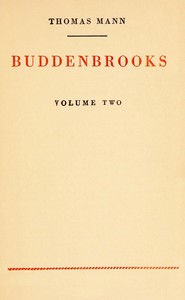
Buddenbrooks, volume 2 of 2 — Story, Setting & Ideas
(0 User reviews)
314
Project Gutenberg
2024
Not confirmed
Germany -- Fiction; Domestic fiction; Families -- Fiction
Readers of public-domain and historical texts
Project Gutenberg digital edition
en
Edition facts
Words
119,714
Reading time
521 min
Text sections
39
Buddenbrooks, volume 2 of 2 — Story, Setting & Ideas can be approached with a clearer sense of reading commitment from its source measurements: 119,714 words, 8 hr 41 min estimated reading time, and 39 detected text sections.
The text analysis averages about 19.1 words per sentence, while the detected sections provide another way to judge how the source is divided.
Project Gutenberg metadata also associates the work with “Germany -- Fiction,” connecting these edition facts with the source record’s subject description.
Source:
Project Gutenberg record #72962
This editorial note examines Thomas Mann's authorial choices in volume 2 of Buddenbrooks, focusing on the interplay between formal narration and intimate dialogue, the symbolic weight of domestic objects, and the use of free indirect style to convey characters' unspoken tensions.
Editorial Edition Score
4.9/5
★★★★★
★★★★★
Calculated from edition completeness, EPUB availability, text structure and catalogue metadata. Not a user rating.
How this score is calculated
- Description quality20 pts
- Title & short description10 pts
- Source metadata20 pts
- Text length15 pts
- Chapters / structure15 pts
- EPUB file integrity20 pts
Total of 100 points, scaled to a 2.5-5.0 range. Editions with an empty description or a missing EPUB file are not scored.
Edition quality
Read the Text
m the very first was heard the name of Thomas Buddenbrook; and as election-day approached, it grew constantly plainer that he and Hermann Hagenström were the favoured candidates.
Hermann Hagenström had his admirers and hangers-on--there was no doubt of that. His zeal in public affairs, the spectacular rise of the firm of Strunck and Hagenström, the showy house the Consul kept, the luxurious life he led, the pâtés-de-foie-gras he ate for breakfast--all these could not fail to make an impression. This large, rather over-stout man with the short, full, reddish beard and the snub nose coming down flat on his upper lip, this man whose grandfather nobody knew, not even himself, and whose father had made himself socially impossible by a rich but doubtful marriage; this man had become a brother-in-law of the Huneus’ and the Möllendorpfs, had ranged his name alongside those of the five or six reigning families in the town, and was undeniably a remarkable and a respected figure. The novel and therewith the attractive element in his personality--that which singled him out for a leading position in the eyes of many--was its liberal and tolerant strain. His light, large way of making money and spending it again differed fundamentally from the patient, persistent toil and the inherited principles of his fellow merchants. This man stood on his own feet, free from the fetters of tradition and ancestral piety; and all the old ways were foreign to him. His house was not one of the ancient patrician mansions, built with senseless waste of space, in tall white galleries mounting above a stone-paved ground floor. His home on Sand Street, the southern extension of Broad Street, was a modern dwelling, not conforming to any set style of architecture, with a simple painted façade, but furnished inside with every luxury and planned with the cleverest economy of space. Recently, on the occasion of one of his large evening parties, he had invited a prima donna from the government theatre, to sing after dinner to his guests--among them his witty, art-loving brother--and had paid her an enormous fee for her services. Hermann Hagenström was not the man to vote in the Assembly for the application of large sums of money to preserve and restore the town’s mediaeval monuments. But it was a fact that he was the first, absolutely the first man in town to light his house and his offices with gas. Yes, if Consul Hagenström could be said to represent any tradition whatever, it was the free, progressive, tolerant, unprejudiced habit of thought which he had inherited from his father, old Heinrich--and on this was based all the admiration people undoubtedly felt for him.
Thomas Buddenbrook’s prestige was of a different kind. People honoured in him not only his own personality, but the personalities of his father, grandfather, and great-grandfather as well: quite apart from his own business and public achievement, he was the representative of a hundred years of honourable tradition. And the easy, charming way, indeed, with which he carried the family standard made no small part of his success. What distinguished him, even among his professional fellow-citizens, was an unusual degree of formal culture, which, wherever he went, aroused both wonder and respect in about equal degrees.
On Thursdays at the Buddenbrooks’, the coming election received only brief and passing comment in the presence of the Consul. Whenever it was mentioned, the old Frau Consul discreetly averted her light eyes. But Frau Permaneder, now and then, could not refrain from displaying her astonishing knowledge of the Constitution. She had gone very thoroughly into the decrees touching the election of a member of the Senate, precisely as once she thoroughly informed herself on the laws governing divorce. She talked about voting chambers, ballots, and electors, she weighed all the possible eventualities, she could recite verbatim and glibly the oath taken by the voters. She spoke of the “free and frank discussion” which the Constitution ordains must be held over each name upon the list of candidates, and vivaciously wished she might be present when Hermann Hagenström’s character was being pulled to pieces! A moment later she leaned over and began to count the prune-pits on her brother’s dessert-plate: tinker, tailor, soldier, sailor--finishing triumphantly with “senator” when she came to the last pit. But after dinner she could not hold in any longer. She took her brother’s arm and drew him into the bow-window.
“Oh, Tom! _Tom!_ Suppose you are really elected--if our coat-of-arms is put up in the Senate-chamber at the Town Hall I shall just die of joy, I know I shall. I shall fall dead at the news--you’ll see!”
From the opening sentence of volume 2—'A christening —a christening in Broad Street!'—Thomas Mann establishes a narrator who oscillates between ceremonial formality and ironic intimacy. The exclamation marks and dashes mimic breathless excitement, yet the subsequent catalog of details (the 'gilded shell-shaped handles,' the 'towering layer-cake') undercuts the solemnity with domestic precision. This dual voice recurs throughout, as when the narrator asks, 'Do we really grasp the meaning of the fact?' about the birth of an heir, only to deflate the moment by noting the infant 'looks most unimposing.' Such tonal shifts are not mere decoration; they reflect the Buddenbrooks' struggle to reconcile public dignity with private reality.
The Weight of Objects
Mann invests furniture, houses, and heirlooms with emotional and economic gravity. In the excerpt, the debate over selling the family home turns on a single phrase: 'the house—Mother’s house—the family home.' The repetition and dashes convey Tony Permaneder's desperation, while Thomas Buddenbrook counters with practicalities: 'the whole back part has been going to pieces. A family of cats is living rent-free in the billiard-room.' The cats are a telling detail—they signal decay without melodrama. Later, Tony recalls the housewarming poem, 'Venus Anadyomene,' and the 'landscape-room' and 'dining-hall,' as if the rooms themselves hold memory. Mann does not explain; he lets objects speak through characters' fragmented recollections.
Dialogue as Subtext
The conversation between Tony and Thomas about selling the house is a masterclass in indirect conflict. Tony begins 'looking down into her lap,' then 'furtively wrung her hands'—gestures that betray anxiety before she speaks. Thomas 'did not answer at once' and 'went on for a while twisting his moustaches and drearily meditating.' Their words are polite, but the physical cues reveal a power imbalance: Thomas controls the decision, Tony can only plead. When she says, 'you will do whatever you think best,' the bitterness is palpable, yet Mann avoids explicit commentary. The dialogue's rhythm—pauses, repetitions, unfinished sentences—mirrors the family's inability to confront loss directly.
Free Indirect Style and Unspoken Thought
Mann frequently slips into characters' minds without quotation marks, blending their voice with the narrator's. When Tony murmurs, 'Our house. I remember the housewarming. We were no bigger than that,' the shift from third-person to first-person memory is seamless. The narrator then adds, 'They must have felt the same—the family of whom Grandfather bought the house.' This is Thomas's thought, but it is presented as objective fact. Such technique creates a layered perspective: we hear both what characters say and what they silently feel. In the christening scene, the narrator's rhetorical question—'Do we really grasp the meaning of the fact?'—could be the family's collective hope, but the ironic tone suggests the narrator's detachment. This ambiguity is central to the novel's effect.
Rhythm and Repetition
Mann uses repetition to underscore obsession and inevitability. Tony repeats 'the house' four times in a short speech, each time with increasing emotional weight. The narrator's catalog of the christening—'a christening—a christening in Broad Street!'—echoes the same pattern, linking joy and grief through verbal symmetry. Similarly, the phrase 'he has come' appears twice in the opening, first as triumphant announcement, then undercut by 'looks most unimposing.' This rhythmic pairing of expectation and deflation recurs throughout the excerpt. Mann also varies sentence length: long, flowing descriptions of the christening preparations give way to staccato dialogue. The effect is a prose that breathes with the characters' moods, quickening in anxiety and slowing in reflection.
Readers attentive to Mann's craft will notice how he builds meaning through accumulation rather than exposition. A gesture, a repeated word, a pause in dialogue—these small choices carry the novel's emotional weight. Volume 2 rewards those who read slowly, watching for the tension between what is said and what is withheld. The Buddenbrooks' decline is not narrated; it is felt in the spaces between their words.
There’s a particular ache in watching the Buddenbrooks family’s fine things slowly lose their meaning—each object weighed down by what’s left unsaid. I felt that same quiet heaviness drifting through Illustrations of political economy, Volume 4 (of 9) — Text and Context, where economic arguments carry their own buried tensions. Both books seem to know that the real story lives between the lines, in the pauses we don’t fill.
There are no reviews for this eBook.
There are no comments for this eBook.
Reader reflection
Take a moment to reflect on this book
Create a short personal record of your experience with this book.
Your progress
0
/
10
2
Was reading this book enjoyable?
3
Would you pass this book on to a friend?
4
Did the language feel accessible?
5
Did this book create an emotional response?
6
Did you gain anything practical from the text?
7
Did any part of the book feel personally relevant?
8
Could you follow the author’s main argument?
9
In one sentence, what did you learn?
10