1

Illustrations of political economy, Volume 4 (of 9) — Text and Context
(0 User reviews)
1307
Project Gutenberg
2023
Not confirmed
Social problems -- Fiction; Didactic fiction, English; Political fiction, English
Readers of public-domain and historical texts
Project Gutenberg digital edition
en
Edition facts
Words
109,863
Reading time
478 min
Text sections
14
Illustrations of political economy, Volume 4 (of 9) — Text and Context can be approached with a clearer sense of reading commitment from its source measurements: 109,863 words, 7 hr 58 min estimated reading time, and 14 detected text sections.
The text analysis averages about 23.9 words per sentence, while the detected sections provide another way to judge how the source is divided.
Project Gutenberg metadata also associates the work with “Social problems -- Fiction,” connecting these edition facts with the source record’s subject description.
Source:
Project Gutenberg record #71544
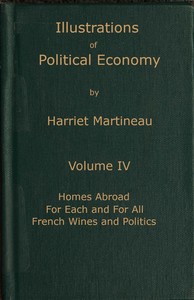
Harriet Martineau's fourth volume collects three tales—'Homes Abroad,' 'For Each and for All,' and 'French Wines and Politics'—each using dialogue and scene shifts to illustrate economic principles like wages, profits, and cooperation, set against Kentish farms, English villages, and French vineyards.
Editorial Edition Score
4.8/5
★★★★★
★★★★★
Calculated from edition completeness, EPUB availability, text structure and catalogue metadata. Not a user rating.
How this score is calculated
- Description quality20 pts
- Title & short description10 pts
- Source metadata20 pts
- Text length15 pts
- Chapters / structure15 pts
- EPUB file integrity20 pts
Total of 100 points, scaled to a 2.5-5.0 range. Editions with an empty description or a missing EPUB file are not scored.
Edition quality
Read the Text
The fair and fertile county of Kent has long suffered peculiarly from the poverty of its labouring population. To the traveller who merely passes through it, it looks like a fruitful garden, capable of affording support to as many inhabitants as can gather round its neat towns, or settle on the borders of its orchards, hop-grounds, and corn-fields; yet it is certain that nowhere,—not in the alleys of Manchester or the cellars of London,—is more abject, hopeless poverty to be found than in some of the country parishes of Kent. One class murmurs about tithes, and rages about poor-rates, while another sets law at defiance, and fills the country with news of murderous poaching expeditions, and of midnight fires;—guilty adventures, of which the first brings in only a precarious and dearly bought advantage, and the other is the most effectual method that could be devised for increasing the very evils under which the people are groaning.
Some years ago,—before the first ruffian or fool of a rick-burner had conceived the bright idea of destroying food because the people were starving,—the parish of A——, in Kent, seemed to some of its inhabitants to be sunk into the lowest depth of poverty that could be found in a country like England; though, alas! it has since been proved that more remained to be endured by its population than had yet been experienced. The parish of A—— contained at that time about two thousand persons; the number of labourers, including boys, was about 450, of whom upwards of 300 were of the agricultural class. The farmers were doing badly, and could not employ all these people; or, if they employed all, could not sufficiently pay any. They reckoned that there were between fifty and sixty able-bodied men more than were wanted. The burden on the parish of these men and their wives and families was very grievous to the poorer class of rate-payers; and in proportion as it became more difficult to them to pay, the numbers and the wants of the paupers increased; and among the whole body of the population of A—— the effects of want showed themselves more and more every day in the spread of recklessness and crime. It mattered not that in spring the orchards were gay with the delicate pink of the apple-blossom, or that flourishing young plantations put forth their early verdure as if the place had been a paradise; for there were theft in the woods, and murmurs of discontent from beneath the hedgerows. It mattered not that in autumn the hop-pickers were busy gathering in their fragrant harvest; for too many of them had fathers, or brothers, or sons, looking on idly from a distance, envious of their employed companions, and thankless that the season had been propitious to the ripening of the delicate crop. It mattered not that the sun shone on fertile valleys and snug homesteads: for many a houseless parent scowled upon comforts which he must not share; many a child shivered with disease and hunger amidst the noonday heat. It mattered not even that new dwellings for the poor were rising up here and there; for their creation was no sign of prosperity. They were reared by speculators in pauperism, who depended on the rents being paid out of the rate. From this circumstance, it was easy to guess by what class they would be occupied;—not by such cottagers as England boasted of a century and a half ago, but by reckless youths with their younger wives, who depended on the parish to help out the insufficient resources of their labour.
This volume brings together three distinct tales—'Homes Abroad,' 'For Each and for All,' and 'French Wines and Politics'—each designed to dramatize a specific economic principle through fictional narrative. The structure is notable: each tale is divided into nine chapters, and the volume itself is a collection of previously published separate works, as indicated by the repeated title pages and pagination. Martineau moves her characters between settings—from the Kentish countryside to a manufacturer's city, and later to French vineyards—using these shifts to contrast economic conditions and to stage debates about wages, profits, and cooperation. The recurring image of land as both a source of sustenance and a site of struggle appears early, with Kent described as a 'fruitful garden' yet suffering from labourer poverty, a paradox that drives the first tale's inquiry.
Dialogue as Economic Argument
The excerpts show that Martineau relies heavily on extended conversations between characters to advance her economic arguments. In 'Homes Abroad,' a lady and a farmer named Joel discuss the relationship between wages, profits, and rent. Joel explains how 'capital may be largely invested in one concern at one time, and another at another'—a point illustrated by a manufacturer and a farmer each employing ten men at £25 wages, then a new farmer hiring eleven men. The dialogue is structured as a Socratic exchange, with the lady asking clarifying questions ('But do these things actually take place?') and Joel providing concrete examples. This method allows Martineau to present complex ideas like the falling rate of profit and the Malthusian pressure of population on resources without resorting to dry exposition. The conversational tone—'Well, but the corn the farmer retains is higher in price'—makes the economic reasoning accessible, though the arguments are clearly one-sided, with Joel serving as the author's mouthpiece.
Recurring Images of Scarcity and Hunger
Across the excerpts, Martineau uses visceral imagery of hunger and want to ground her economic arguments in human suffering. Joel describes a kingdom where 'hunger does not stalk ferociously through the streets, and howl in the dark alleys' and where 'want does not wet the mother’s pillow with tears, and open untimely graves for the gentle and the manly.' This language is deliberately stark, contrasting with the earlier description of Kent as a 'fruitful garden.' The juxtaposition of natural abundance and human deprivation is a recurring motif: the land is fertile, yet the labourers are poor. In 'French Wines and Politics,' the setting shifts to vine-growing, but the same tension between productivity and poverty likely persists. Martineau does not offer sentimental relief; instead, she uses these images to underscore the urgency of the economic questions her characters debate, such as whether cooperation or laissez-faire can alleviate distress.
Movement Between Settings and Perspectives
The volume's structure emphasizes movement—both geographical and conceptual. 'Homes Abroad' begins in Kent, then moves to 'Homes on the Waste' and 'Going in search of Home,' suggesting a journey from a known landscape to marginal or foreign spaces. 'For Each and for All' includes chapters titled 'Novelty,' 'Pastime,' and 'Observing at hand' and 'Observing afar,' indicating a shift from immediate experience to broader observation. 'French Wines and Politics' moves from 'Vine-Growing' to 'Signs of the Time' and 'Mob Sovereignty,' tracing a progression from agricultural detail to political upheaval. This deliberate movement allows Martineau to compare economic conditions across regions and classes: the Kentish farmer's perspective is contrasted with the manufacturer's, and later with French vintners. The reader is thus invited to see economic principles not as abstract laws but as forces that shape lives differently depending on place and circumstance.
The Role of the Capitalist and the Labourer
Martineau's characters frequently personify economic roles. Joel, the farmer, speaks for the capitalist: he discusses borrowed capital, fluctuating profits, and the pressure of rising wages. The lady represents the landowner, concerned with rent. The labourers are largely voiceless, their suffering described by others. In the dialogue, Joel dismisses cooperation as unable to 'prevent the decline of profits' or to make 'capital grow as numbers grow.' This positions the capitalist as a rational actor constrained by market forces, while the labourer is a passive victim of those forces. The excerpts do not give the labourer a speaking part; instead, their plight is reported. This asymmetry is a structural feature of Martineau's didactic method: she uses the dialogue to explain why the system works as it does, but the emotional weight of hunger and tears is meant to provoke the reader's sympathy and, presumably, a desire for reform within the existing framework.
Readers approaching this volume should attend to how Martineau uses fictional scenes to test economic theories. The three tales are not simply stories; they are experiments in which characters embody different interests—land, capital, labour—and debate their conflicts. The movement between settings—from English farms to French vineyards—invites comparison of how similar economic pressures play out in different contexts. Because the excerpts are incomplete, the resolution of each tale remains unknown, but the pattern of argument suggests that Martineau aims to persuade through reason and example rather than through plot alone.
Leafing through Martineau’s fourth volume, I paused at the Kentish farm scenes, that quiet rhythm of wages and harvests. It brought back the hushed, almost legalistic atmosphere of The Ponson case — Text and Context—not for the stories themselves, but for how both books treat people as threads in a larger economic weave. A gentle, sobering kinship, like remembering an old conversation.
There are no reviews for this eBook.
There are no comments for this eBook.
Reader reflection
What was your reading experience?
Capture what you thought, learned, and would like to remember.
Your progress
0
/
10
2
How did the book work for you overall?
3
Would you recommend this book to another reader?
4
How much effort did this book require?
5
Is this a title worth rereading?
6
How valuable was this book for your own interests?
7
How did the pace of the book feel?
8
Did any part of the book stay with you emotionally?
9
In one sentence, what did you learn?
10