1

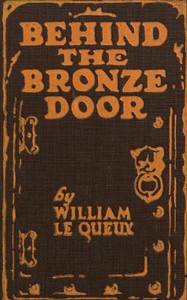
Behind the bronze door — A Reader’s Guide
(0 User reviews)
3338
Project Gutenberg
2024
Not confirmed
London (England) -- Fiction; Extortion -- Fiction; Mystery fiction
Readers of public-domain and historical texts
Project Gutenberg digital edition
en
Edition facts
Words
76,975
Reading time
335 min
Text sections
34
Before opening Behind the bronze door — A Reader’s Guide, the edition data offers a quick orientation: 76,975 words, 5 hr 35 min estimated reading time, and 34 detected text sections.
The text analysis averages about 15.9 words per sentence, while the detected sections provide another way to judge how the source is divided.
Project Gutenberg metadata also associates the work with “London (England) -- Fiction,” connecting these edition facts with the source record’s subject description.
Source:
Project Gutenberg record #73266
This editorial note examines how the opening, middle, and later excerpts of William Le Queux's 1923 mystery guide a first reading, focusing on the epidemic of society tragedies, the house-boat setting, and the servant Tom's loyalty.
Editorial Edition Score
4.8/5
★★★★★
★★★★★
Calculated from edition completeness, EPUB availability, text structure and catalogue metadata. Not a user rating.
How this score is calculated
- Description quality20 pts
- Title & short description10 pts
- Source metadata20 pts
- Text length15 pts
- Chapters / structure15 pts
- EPUB file integrity20 pts
Total of 100 points, scaled to a 2.5-5.0 range. Editions with an empty description or a missing EPUB file are not scored.
Edition quality
Read the Text
THE EPIDEMIC OF MYSTERY.
“Isn’t this terrible, Henry? Where is it going to end?”
“Isn’t what terrible?--and where is what going end?”
“Why! Haven’t you read to-night’s paper?”
“Here it is; read that!” and handing her husband the _Evening Herald_ Mrs. Hartsilver indicated with her finger a paragraph in the “stoppress” headed: “Another Society Tragedy,” and stated that a well-known baronet had been found shot in his bedroom in circumstances of great mystery.
Certainly the series of tragedies which had taken place during the past eight months in what is called “Society,” had been most puzzling.
First, Lord Hope-Cooper, the fifth peer, held in high esteem by all his friends and acquaintances, owner of Cowrie Park in Perthshire, Leveden Hall in Warwickshire, and one of the finest houses in Grosvenor Square, had drowned himself in the beautiful lake at Cowrie, apparently for no reason and without leaving even a note of farewell for Lady Hope-Cooper, with whom he was known to be on the best of terms--they had been married eight years.
Then Viscount Molesley, a rich bachelor of three-and-twenty, an owner of thoroughbreds and well-known about town and in sporting circles, had been found shot in his bedroom one morning, an automatic pistol on the floor beside him, and in the grate the ashes of some burnt papers; apparently he had shot himself after receiving his morning letters.
Following close upon these tragedies had come the sudden death of the Honorable Vera Froissart, Lord Froissart’s younger daughter, in mysterious circumstances. She had been found dead in the drawing-room in her father’s house in Queen Anne’s Gate, and at the inquest the jury had returned a verdict of “death due apparently to shock.” Then the death of a rather notorious ex-Society woman, Madame Leonora Vandervelt, who had been divorced by three husbands--she had thrown herself out of a fourth-floor window at a fashionable West End hotel. Then the death by poisoning of an extremely prosperous stockbroker of middle-age, owner of two financial journals. And after that four or five more tragedies of the same nature, the victim in nearly every case being a man or woman of high social standing and large income.
“Exactly the way Molesley made away with himself,” Henry Hartsilver observed dryly as he laid down the paper after reading the report of the discovery of Sir Stephen Lethbridge’s body in his bedroom at Abbey Hall in Cumberland.
He shrugged his shoulders.
“You may think me hard and unsympathetic, my dear,” he went on, addressing his wife, “but these people who make away with themselves leave me cold. Such tragedies don’t excite my pity--they arouse in me only a feeling of contempt.”
He paused, then continued:
“Now, look at me. _You_ know how I began life, though I sometimes try to forget it, as I hope others do. My parents were poor, and I received only a moderate education; but I had grit and determination and I won through. And look at me to-day. All who know me look up to and respect me. I’m a self-made man and not ashamed to own it, though I don’t crow about it on the housetops as some of these plebeians do. Though I come of the people, I pride myself on being one of Nature’s gentlemen, and what can you want more than that--eh? We can’t choose our parents, or I might have chosen parents like yours, my dear--blue blood through and through. And that was one reason why I married you. I think I have told you this before. I made up my mind when I was still a lad that the woman I made my wife should be a lady in the true acceptation of that often misapplied word, and the first time I met you--you remember that day, eh, my dear?--I recognized the type, and then and there I decided that you were the lady for me!”
He lay back in the big arm-chair, slipped his thumbs into the armholes of his waistcoat, and looked at his young wife with an expression of extreme self-satisfaction.
“But, Henry,” she said, wincing, “what has all that to do with this calamity? You forget that I knew poor Stephen Lethbridge. Abbey Hall is close to my old home, and Stephen and I were children together. I can’t help feeling upset.”
The novel opens with a domestic scene: Mrs. Hartsilver hands her husband Henry the Evening Herald, pointing to a paragraph headed "Another Society Tragedy." This launches a catalogue of unexplained deaths among the wealthy—a peer drowning himself, a viscount shot, a woman found dead in her drawing-room. The chapter title, "The Epidemic of Mystery," signals that the narrative will treat these events as a linked pattern rather than isolated incidents. Le Queux establishes a tone of anxious speculation through the Hartsilvers' dialogue, and the list of victims, each described with precise social coordinates (estates, titles, family connections), grounds the mystery in a specific milieu. The reader is invited to suspect that these tragedies are not suicides but something more sinister, though the excerpts do not yet reveal a unifying cause.
A Catalogue of Society Tragedies
The opening chapter enumerates four deaths in quick succession: Lord Hope-Cooper drowns himself without a note; Viscount Molesley is found shot, with burnt papers in the grate; the Honorable Vera Froissart dies of "apparent shock"; and Madame Leonora Vandervelt, a divorced ex-Society woman, throws herself from a window. Each case is presented as a puzzle—no clear motive, no farewell, no obvious connection. The Evening Herald serves as a narrative device, feeding the public's unease. Le Queux uses repetition to build a sense of epidemic: the phrase "had been found" recurs, and the details (lake, bedroom, drawing-room, window) create a geography of death within London's elite homes. The reader, like the characters, is left to wonder whether a single hand or a broader social malaise is at work.
The House-Boat as a Stage
Later excerpts shift the setting to a house-boat on the Thames, where Captain Preston and Yootha Hagerston are expected for dinner but fail to return. The servant Tom, a former soldier who served under Preston in France, waits anxiously. The house-boat becomes a confined stage: the river, the moonlit night, the absence of a telephone, and the last train gone. Tom's loyalty is emphasized through his memories of Preston's "extraordinary coolness in moments of extreme crisis" and his reluctance to open a mysterious envelope. The dialogue between Tom and Doctor Johnson (a guest) reveals that Preston and Yootha have vanished after tea. The setting isolates the characters, heightening tension. Le Queux uses the house-boat's physical separation from London to create a closed circle of suspicion.
Tom's Perspective and the Servant's Role
Tom, the ex-soldier servant, emerges as a key observer. His thoughts travel back to the war, and he reflects that if all officers were like Preston, "we should have an army, and no mistake!" This admiration is contrasted with the irritation of Tom's friends, who tire of hearing Preston's virtues extolled. When Preston and Yootha finally appear at nearly eleven, Preston speaks in a "low tone" and asks Tom to arrange for Yootha to sleep aboard, insisting "nobody must know about it." Tom's compliance, despite his curiosity about the urgent letter, underscores his trust. The servant's perspective offers a ground-level view of the mystery, distinct from the society gossip of the opening. Le Queux uses Tom's loyalty to create a moral anchor, but also to raise questions: what does Tom know, and what will he do with the envelope?
Patterns of Disappearance and Secrecy
Across the excerpts, a pattern emerges: characters vanish or die without explanation, and those left behind are forced to improvise. Mrs. Hartsilver's opening question—"Where is it going to end?"—echoes in the later scene where Preston and Yootha disappear after tea, leaving Johnson to dine alone. The house-boat lacks a telephone, cutting off communication. Preston's instruction that Yootha's presence "must not be known" introduces a layer of secrecy that mirrors the hidden scandals hinted at in the chapter titles ("The Hidden Scandal," "Hush Money"). The reader, like Tom, is given partial information: an urgent letter, a missing couple, a late-night arrival. Le Queux builds suspense by withholding explanations, forcing the reader to piece together connections between the society tragedies and the house-boat events.
Reading Behind the Bronze Door with attention to the excerpts' structure reveals a mystery built on accumulation and delay. The opening catalogue of deaths primes the reader to expect a conspiracy, while the house-boat scenes narrow the focus to a small set of characters. Tom's viewpoint offers a contrast to the society gossip, grounding the story in practical concerns. The excerpts do not resolve the central puzzle, but they establish a method: Le Queux layers unexplained events, then shifts settings to keep the reader off balance. A first-time reader may benefit from tracking the recurring motifs of newspapers, letters, and servants' knowledge.
That rainy afternoon, I lost myself in the bronze door's quiet corners—Tom's steadfast loyalty lingered longest. It reminded me, almost accidentally, of another household steeped in unspoken devotion, where a spinster's careful routines hid a similar steadfastness. I found myself reaching for Miss Devereux, spinster — Reading Companion, and the afternoon softened into that same unhurried, trusting hush.
There are no reviews for this eBook.
There are no comments for this eBook.
Reader reflection
Before you leave, reflect on the book
Use these questions to collect your thoughts before moving on.
Your progress
0
/
10
2
Was reading this book enjoyable?
3
Would you encourage someone else to read it?
4
What was the reading difficulty like?
5
How clearly were the main ideas presented?
6
Could you see yourself revisiting this book?
7
How did the pace of the book feel?
8
How useful did the reading feel?
9
What changed or sharpened your thinking?
10