1

Murder in the maze — Story, Setting & Ideas
(0 User reviews)
889
Project Gutenberg
2023
Not confirmed
Detective and mystery stories; Murder -- Investigation -- Fiction; Country homes -- England -- Fiction
Readers of public-domain and historical texts
Project Gutenberg digital edition
en
Edition facts
Words
84,834
Reading time
369 min
Text sections
21
The source record for Murder in the maze — Story, Setting & Ideas measures this digital text at 84,834 words, 6 hr 9 min estimated reading time, and 21 detected text sections.
The text analysis averages about 13.4 words per sentence, while the detected sections provide another way to judge how the source is divided.
Project Gutenberg metadata also associates the work with “Detective and mystery stories,” connecting these edition facts with the source record’s subject description.
Source:
Project Gutenberg record #71351
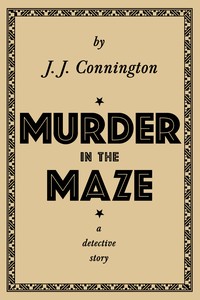
J. J. Connington's 1927 detective novel uses the Whistlefield estate's maze as a stage for murder, with a narrative that shifts between leisurely country-house description and tense forensic investigation, driven by the contrasting voices of barrister Neville Shandon and Chief Constable Sir Clinton Driffield.
Editorial Edition Score
4.9/5
★★★★★
★★★★★
Calculated from edition completeness, EPUB availability, text structure and catalogue metadata. Not a user rating.
How this score is calculated
- Description quality20 pts
- Title & short description10 pts
- Source metadata20 pts
- Text length15 pts
- Chapters / structure15 pts
- EPUB file integrity20 pts
Total of 100 points, scaled to a 2.5-5.0 range. Editions with an empty description or a missing EPUB file are not scored.
Edition quality
Read the Text
Neville Shandon stood at the window of his brother’s study gazing contentedly out over the Whistlefield grounds. This was a good place to recuperate in, he reflected, especially when one could only snatch a couple of days at a time from the grinding pressure of a barrister’s practice. His eye travelled slowly over the prospect of greenery which lay before him, lawn beyond lawn, down to where a glint of silver showed where the river cut across the estate. Beyond that came the stretches of the Low Meadows, intersected here and there by the darker green of the hedges; then the long curve of the main road; and at last, closing the horizon, the gentle slope of Longshoot Hill surmounted by its church spire. A bee hummed lazily at the open window; then, startled by a movement, it shot away, the note of its wings growing higher and fainter as it receded in the sunlight. The King’s Counsel let his attention wander for a moment to the rooks sailing, in their effortless flight around the tree-crests by the river; then, with something more than apparent reluctance, he turned away from the landscape.
“You did pretty well when you bought Whistlefield, Roger,” he commented as he moved back into the room. “It’s as restful a place as I know. If it weren’t that I can get down here from time to time, I’d be hard put to it to keep fit for my work. Think of the Law Courts on a day like this! And that Hackleton case has been a bit of a strain, a bigger business than usual.”
His twin brother nodded a general assent, but made no audible reply. There was more than the normal family resemblance between the two men. In height and build they were much alike; both were grey-haired and clean-shaven; and even the hard lines at the corners of the barrister’s mouth found their counterparts in the deeply-chiselled curves which made Roger Shandon’s face a slightly forbidding one. Whether deliberately or not, the twins accentuated their physical resemblance by a similarity in their dress.
“We have the same tailor,” Roger once explained. “When I go to him, I say: ‘Make me a suit like my brother’s last one.’ I believe Neville says the same. The fellow has our measurements, so there’s no more needed on that visit. Neville and I have much the same taste in shades, so it generally comes out all right.”
The likeness between the twins went even deeper than the surface. Both owed their success in life to a certain hardness of character coupled with an abundance of energy. Neville, going to the Bar, had made himself feared from the first as a brutal and domineering cross-examiner; and his criminal practice had done little to soften his professional manners. Roger’s rise to prosperity had been more mysterious. It was vaguely known that he had made money in South Africa and South America; but the exact methods which had led to his fortune were never discussed by him. He had come home at the age of forty-five to find his brother one of the leading lights of the Bar. The purchase of the little Whistlefield estate had followed, and Roger had apparently been content to settle down in the countryside and make a clean break with the interests of his past.
The third brother, Ernest, seemed hardly to belong to the same family as the twins. Though five years younger, he had none of the vitality and energy which were so manifest in his elders; and the contrast was accentuated by the weakness of his eyes, which gazed incuriously at the world from behind the concave lenses of his pince-nez. Left to fend for himself by the time he was twenty, and with a couple of hundred a year of his own, he had simply vegetated without even attempting to go into any business; and when his brothers had made their fortunes, he had slipped into the role of parasite without a thought, had transferred himself to Whistlefield, and had continued to live there ever since. Roger had fallen into the habit of giving him a fluctuating allowance, which he eked out as best he could by betting on a small scale.
“What’s this Hackleton case that you were talking about?” he inquired with a certain dull interest.
The novel opens with a leisurely view from a study window: barrister Neville Shandon gazes over the Whistlefield grounds, noting the river, hedges, and a church spire, while a bee hums and rooks sail. This pastoral calm is undercut by his mention of the strain of the Hackleton case, hinting at the violence to come. The twin brothers, Neville and Roger Shandon, are introduced with a precise physical resemblance—grey-haired, clean-shaven, with hard lines at the mouth—that the narrative underscores by noting they use the same tailor. This attention to detail and the measured, slightly formal voice establish a tone of controlled observation, which will later contrast with the panic and forensic scrutiny of the maze attacks.
Twin Perspectives and Narrative Distance
The story is filtered through several distinct viewpoints, each with its own register. Neville Shandon, the barrister, brings a professional detachment: his eye travels “contentedly” over the landscape, and he reflects on the “grinding pressure” of his practice. His twin Roger, by contrast, is nearly silent, nodding “a general assent” without audible reply. This asymmetry sets up a dynamic where one brother observes while the other withholds. Later, Chief Constable Sir Clinton Driffield adopts a curt, sardonic tone, dismissing Ernest Shandon’s panic with the remark “Friend Ernest raises my gorge.” The narrative voice itself shifts between these characters, offering no single authoritative perspective—a technique that keeps the reader at a distance from any one version of events.
The Maze as a Stage for Suspicion
The maze is not merely a setting but an active element in the investigation. In Chapter XI, Sir Clinton and Squire Wendover examine the maze for clues. Wendover spots a bit of black thread on the path and immediately interprets it as “Ariadne’s clue”—a thread the murderer used to navigate the maze in a hurry. Sir Clinton dismisses this with “One bit of thread’s very much like another,” but the exchange reveals how the maze itself generates suspicion: every object becomes a potential piece of evidence. The narrative lingers on physical details—the sparkle of a silver cigar-case, the tangled end of the thread—while the characters debate their significance. This tension between the mundane and the sinister drives the investigation forward.
Pace and the Shift from Calm to Crisis
The novel’s pace varies markedly between its opening and later chapters. The first chapter moves slowly, with long descriptive passages and unhurried dialogue. Neville’s gaze travels “lawn beyond lawn” and the bee’s flight is described in detail. In contrast, the maze attacks are recounted with abrupt, clipped exchanges. Sir Clinton’s interruptions—“Here’s the Maze,” “Suppose we postpone discussion”—create a staccato rhythm. The shift is also evident in the characters’ reactions: Miss Forrest, who “kept her nerves in order,” is contrasted with Ernest Shandon’s “whimpering panic.” The narrative itself seems to mirror this change, moving from expansive description to tight, action-focused scenes as the mystery deepens.
Readers should attend to the way Connington uses the maze both as a physical puzzle and as a metaphor for the narrative’s own twists. The story rewards close attention to small details—a thread, a cigar-case, a change in tone—that may later prove significant. The twin brothers’ resemblance and the shifting viewpoints also invite comparison: what one character overlooks, another may seize upon. Approach the novel not as a straightforward whodunit but as a study in how different minds interpret the same clues.
I’ve often thought the maze in Murder in the Maze keeps its own counsel—the way a house’s old corners do. Years later, reading Folly Corner — Context and Discussion, I felt that same quiet hush, where every shadow seems to hold a half-spoken secret, waiting for a patient ear.
There are no reviews for this eBook.
There are no comments for this eBook.
Reader reflection
Record your reading impressions
A brief reflection can help important ideas stay with you longer.
Your progress
0
/
10
2
How did the book work for you overall?
3
Would you encourage someone else to read it?
4
How demanding did the text feel?
5
Did the book deliver what you hoped for?
6
Was the book easy to understand?
7
Would you like to discuss this book with someone?
8
Did this book create an emotional response?
9
In one sentence, what did you learn?
10