1

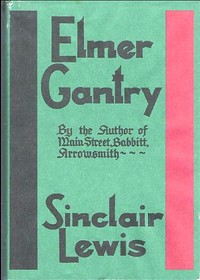
Elmer Gantry — Story, Setting & Ideas
(0 User reviews)
160
Project Gutenberg
2024
Not confirmed
Satire; Protestant churches -- Clergy -- Fiction; Evangelists -- Fiction
Readers of public-domain and historical texts
Project Gutenberg digital edition
en
Edition facts
Words
161,724
Reading time
704 min
Text sections
18
This digital edition of Elmer Gantry — Story, Setting & Ideas is described by source-level measurements including 161,724 words, 11 hr 44 min estimated reading time, and 18 detected text sections.
The text analysis averages about 17.3 words per sentence, while the detected sections provide another way to judge how the source is divided.
Project Gutenberg metadata also associates the work with “Satire,” connecting these edition facts with the source record’s subject description.
Source:
Project Gutenberg record #72609
Sinclair Lewis's satirical novel follows the rise of a charismatic, hypocritical preacher from drunken college days to evangelistic fame, exposing the gap between his pious public persona and private scheming.
Editorial Edition Score
4.8/5
★★★★★
★★★★★
Calculated from edition completeness, EPUB availability, text structure and catalogue metadata. Not a user rating.
How this score is calculated
- Description quality20 pts
- Title & short description10 pts
- Source metadata20 pts
- Text length15 pts
- Chapters / structure15 pts
- EPUB file integrity20 pts
Total of 100 points, scaled to a 2.5-5.0 range. Editions with an empty description or a missing EPUB file are not scored.
Edition quality
Read the Text
s to be allowed one charming fight, and he revived as he staggered industriously in search of it.
Oh, he exulted, it was a great party. For the first time in weeks he was relieved from the boredom of Terwillinger College.
Elmer Gantry, best known to classmates as Hell-cat, had, this autumn of 1902, been football captain and led the best team Terwillinger College had known in ten years. They had won the championship of the East-middle Kansas Conference, which consisted of ten denominational colleges, all of them with buildings and presidents and chapel services and yells and colors and a standard of scholarship equal to the best high-schools. But since the last night of the football season, with the glorious bonfire in which the young gentlemen had burned up nine tar barrels, the sign of the Jew tailor, and the president’s tabby-cat, Elmer had been tortured by boredom.
He regarded basket-ball and gymnasium antics as light-minded for a football gladiator. When he had come to college, he had supposed he would pick up learnings of cash-value to a lawyer or doctor or insurance man—he had not known which he would become, and in his senior year, aged twenty-two this November, he still was doubtful. But this belief he found fallacious. What good would it be in the courtroom, or at the operating table, to understand trigonometry, or to know (as last spring, up to the examination on European History, he remembered having known) the date of Charlemagne? How much cash would it bring in to quote all that stuff—what the dickens was it now?—all that rot about “The world is too much around us, early and soon” from that old fool Wordsworth?
Punk, that’s what it was. Better be out in business. But still, if his mother claimed she was doing so well with her millinery business and wanted him to be a college graduate, he’d stick by it. Lot easier than pitching hay or carrying two-by-fours anyway.
Despite his invaluable voice, Elmer had not gone out for debating, because of the irritating library-grinding, nor had he taken to prayer and moral eloquence in the Y. M. C. A., for with all the force of his simple and valiant nature he detested piety and admired drunkenness and profanity.
Once or twice in the class in Public Speaking, when he had repeated the splendors of other great thinkers, Dan’l Webster and Henry Ward Beecher and Chauncey M. Depew, he had known the intoxication of holding an audience with his voice as with his closed hand, holding it, shaking it, lifting it. The debating set urged him to join them, but they were rabbit-faced and spectacled young men, and he viewed as obscene the notion of digging statistics about immigration and the products of San Domingo out of dusty spotted books in the dusty spotted library.
He kept from flunking only because Jim Lefferts drove him to his books.
Jim was less bored by college. He had a relish for the flavor of scholarship. He liked to know things about people dead these thousand years, and he liked doing canned miracles in chemistry. Elmer was astounded that so capable a drinker, a man so deft at “handing a girl a swell spiel and getting her going” should find entertainment in Roman chariots and the unenterprising amours of sweet-peas. But himself—no. Not on your life. He’d get out and finish law school and never open another book—kid the juries along and hire some old coot to do the briefs.
To keep him from absolutely breaking under the burden of hearing the professors squeak, he did have the joy of loafing with Jim, illegally smoking the while; he did have researches into the lovability of co-eds and the baker’s daughter; he did revere becoming drunk and world-striding. But he could not afford liquor very often and the co-eds were mostly ugly and earnest.
It was lamentable to see this broad young man, who would have been so happy in the prize-ring, the fish-market, or the stock exchange, poking through the cobwebbed corridors of Terwillinger.
Terwillinger College, founded and preserved by the more zealous Baptists, is on the outskirts of Gritzmacher Springs, Kansas. (The springs have dried up and the Gritzmachers have gone to Los Angeles, to sell bungalows and delicatessen.) It huddles on the prairie, which is storm-racked in winter, frying and dusty in summer, lovely only in the grass-rustling spring or drowsy autumn.
You would not be likely to mistake Terwillinger College for an Old Folks’ Home, because on the campus is a large rock painted with class numerals.
Most of the faculty are ex-ministers.
The novel begins not in a church but in a saloon, with Elmer Gantry “eloquently drunk.” Sinclair Lewis immediately establishes his protagonist’s defining traits: a booming voice that makes trivial words sound profound, a bullying charm, and a talent for self-dramatization. The opening scene—Elmer weeping, boasting, and threatening a fight—sets the pattern for a career built on performance rather than conviction.
Lewis’s satire works through accumulation of detail: the bartender’s wary smile, Elmer’s mangled grammar, the sentimental song that moves him to tears. These early pages introduce a man who will later deploy religious rhetoric with the same instinctive showmanship he displays at the bar.
Voice as Weapon and Mask
From the first paragraph, Lewis foregrounds Elmer’s voice as his primary instrument. It is described as a “’cello,” capable of making “Good morning” seem as profound as Kant. This vocal power is both a tool of persuasion and a cover for emptiness. Elmer “never said anything important, and he always said it sonorously.”
The excerpts show how this voice adapts to context. In the saloon, it is slurred and belligerent; later, with the pianist Lily, it becomes soft, flattering, and manipulative. Lewis tracks the same cadences—the same “by golly” and “you bet”—across settings, revealing that Elmer’s register changes only in volume, not in sincerity. His speech is always a performance, whether he is calling for a fight or feigning spiritual admiration.
The Mechanics of Manipulation
The scene between Elmer and Lily demonstrates his method in miniature. He begins by praising her piano playing, then pivots to criticize Sharon Falconer, creating an us-against-her intimacy. His language is a paste of flattery (“flower-like beauty”), false modesty (“I’ve stood back”), and manufactured emotion. Lewis renders the dialogue with minimal narration, letting the clichés accumulate until they feel both comic and predatory.
Key tactics include: isolating the target (“just between you and I”), offering sympathy for imagined slights, and escalating physical contact. Elmer’s hand moves from squeezing to a “firmer pressure” as he tests boundaries. When Sharon interrupts, the mask drops instantly—Elmer is left “in flabby dejection,” scrambling to construct a plausible story. The scene reads as a compressed tutorial in his professional technique.
Sharon Falconer’s Authority
Sharon Falconer appears only briefly in the excerpts, but her presence is decisive. She fires both Elmer and Lily with a single sentence: “Both of you are discharged. Fired. Now!” Her voice is “level as a steel rail.” Unlike Elmer’s bluster, Sharon’s authority is quiet and absolute. She does not argue or explain; she simply commands.
This contrast is central to the satire. Sharon is a successful evangelist, yet Lewis gives her none of Elmer’s verbal excess. Her power lies in her certainty and her willingness to act. When Elmer later climbs through her window to plead his case, the imbalance is clear: he is the supplicant, she the judge. The excerpts suggest that Sharon sees through Elmer’s performance, even if she may choose to use him.
Structure and Pacing in the Excerpts
The excerpts span the novel’s opening and a later episode, but they share a structural pattern: a scene of performance, a moment of exposure, and a recovery. In the saloon, Elmer’s drunken bravado is deflated by the bartender’s calm; in the later scene, his seduction is interrupted by Sharon’s entrance. Both times, Elmer is left alone to reconstruct his persona.
Lewis uses these reversals to keep the satire dynamic. The reader sees the machinery of Elmer’s confidence—the tears, the threats, the flattery—and then sees it break down. The excerpts do not reveal whether Elmer succeeds in winning back Sharon’s favor, but the pattern suggests that he will. The novel’s rhythm, as far as these sections show, alternates between inflation and puncture, with Elmer always finding a way to reinflate.
These excerpts offer a concentrated dose of Lewis’s method: sharp dialogue, precise physical detail, and a protagonist whose voice is both his greatest asset and his most reliable giveaway. Readers should pay attention to what Elmer says when he thinks he is being charming—the flattery, the false humility, the sudden shifts in tone. The satire works not by exaggeration but by accumulation. Every gesture, every phrase, is a clue to the gap between the man and the role he plays.
I recall evenings with Elmer Gantry, watching that silver-tongued man stumble between pulpits and lies, and afterwards I’d set it down to ponder Children of destiny — Reading Notes, those quiet margins where another soul seems to whisper—not about showy hypocrites, but about the secret weight we each carry, and how grace sometimes hides in our simplest, most honest reflections.
There are no reviews for this eBook.
There are no comments for this eBook.
Reader reflection
Record your reading impressions
A brief reflection can help important ideas stay with you longer.
Your progress
0
/
10
2
How much did you enjoy the reading experience?
3
Would you pass this book on to a friend?
4
How easy was the book to follow?
5
Would you read this book again?
6
Would you like to discuss this book with someone?
7
Did the book offer a fresh perspective?
8
How did the reading compare with what you expected?
9
What changed or sharpened your thinking?
10