1

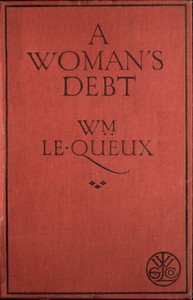
A woman's debt — Themes and Context
(0 User reviews)
1230
Project Gutenberg
2023
Not confirmed
Detective and mystery stories; England -- Social life and customs -- 20th century -- Fiction; English fiction -- 20th century
Readers of public-domain and historical texts
Project Gutenberg digital edition
en
Edition facts
Words
82,451
Reading time
359 min
Text sections
35
For A woman's debt — Themes and Context, the stored edition analysis reports 82,451 words, 5 hr 59 min estimated reading time, and 35 detected text sections.
The text analysis averages about 19.1 words per sentence, while the detected sections provide another way to judge how the source is divided.
Project Gutenberg metadata also associates the work with “Detective and mystery stories,” connecting these edition facts with the source record’s subject description.
Source:
Project Gutenberg record #72041
William Le Queux's 1924 mystery novel uses clipped dialogue and layered observation to trace a young woman's entanglement in theft, blackmail, and family loyalty. The narrative voice shifts between tense exchanges and reflective interiority, revealing character through what is left unsaid.
Editorial Edition Score
4.9/5
★★★★★
★★★★★
Calculated from edition completeness, EPUB availability, text structure and catalogue metadata. Not a user rating.
How this score is calculated
- Description quality20 pts
- Title & short description10 pts
- Source metadata20 pts
- Text length15 pts
- Chapters / structure15 pts
- EPUB file integrity20 pts
Total of 100 points, scaled to a 2.5-5.0 range. Editions with an empty description or a missing EPUB file are not scored.
Edition quality
Read the Text
ng men, although they were thrown constantly into each other’s society. Richard Croxton was the confidential secretary of Rupert Morrice, the well-known foreign banker and financier, whose firm had colossal dealings abroad. Brookes was a nephew and great favourite of the financier’s wife, the son of a dearly beloved sister who had died many years ago. In consequence of that relationship, and the partiality of his aunt, he was a frequent, almost a daily, visitor to the big house in Deanery Street, Park Lane, where the Morrices entertained largely and dispensed lavish hospitality.
Croxton’s voice was very cold, as he replied to the other’s suggestion. “Those are the sort of things one does not permit oneself to speculate about, much less to discuss.”
For a second an angry gleam showed in the light blue eyes of Brookes. Not troubled with very refined feelings himself, he thought it was rank hypocrisy on the part of Richard to refuse to talk to a man of his own age about prospects upon which he must often have meditated. But the angry gleam passed away quickly. Archie Brookes was a very self-contained young man. He seldom allowed his temper to get the better of him, and he never indulged in sarcastic remarks.
“Ah, you’ve got a very wise head upon your shoulders, Dick,” he said in a genial tone, and accentuating his air of good-fellowship by the unfamiliar use of the Christian name. “You’ll never let your tongue give you away. But I am sure it will be as I say. Uncle Rupert thinks the world of you, and he has no near relative of his own. What more natural than that you should succeed?”
To his emphatic reiteration of his previous remarks, Richard made no reply. While always perfectly civil to this elegant-mannered young man for whom he felt a vague dislike, he never encouraged intimacy. He was just a little resentful that he had been addressed as “Dick.” Nothing in the world would have induced him to accost the other as “Archie,” although they met nearly every day, and the one was the favourite nephew of the mistress of the house, and the other was as good as the adopted son of the master.
There was a certain element of romance about the introduction of Richard Croxton into the Morrice _ménage_. The great financier, hard as iron in his business dealings, was in private life a man of the greatest sentiment and sensibility. Some years before he met the lady who was now his wife, he had been desperately in love with a charming girl, who had been one of the fashionable beauties of the day.
The fate of this lovely girl had been a sad and tragic one. With the world at her feet, she had bestowed her affections upon a man utterly unworthy—a rake, a gambler—and a spendthrift, and alienated her friends and her family by marrying him. On her death-bed she had sent for her old lover and confided her only child to his care. Rupert Morrice had accepted the trust, his heart warming to the son, as he grew to know him, not only for his own qualities, but for the sake of the mother whom he had so fondly loved with the passionate ardour of a strong, intense nature.
He had taken the young fellow into his own house and made him his confidential secretary. Some women might have resented such a sudden intrusion, but Mrs. Morrice was not of a petty or jealous nature. She grew in time to be very fond of Richard Croxton, and did not in the least begrudge him his place in her husband’s affections.
There sauntered up to the two young fellows a very distinguished-looking man of about fifty years of age. Aristocrat was written all over him—in his tall, elegant figure, his aquiline features, his long, shapely, well-manicured hands, his cultivated and well-bred voice. This was Sir George Clayton-Brookes, the paternal uncle of Archie, a well-known personage in London society, a member of some of the most exclusive clubs, and, report said, the possessor of considerable wealth. He had added the name of Clayton on inheriting a fortune from a distant relative.
He greeted Croxton with an air of great cordiality. His manners were very polished, some people thought they were just a trifle too suave for perfect sincerity.
From its first lines, A Woman's Debt establishes a world of veiled antagonism and unspoken calculation. The opening exchange between Archie Brookes and Richard Croxton—'You're a lucky chap, Croxton'—carries a sidelong glance that the narrator immediately glosses: 'There was no love lost between these two young men.' Le Queux's prose favours such economical signals, letting a character's 'somewhat effeminate expression' or a 'covert' observation do the work of exposition. The setting—a financier's house in Deanery Street—is sketched with just enough detail to anchor the social stakes, while the narrative voice remains detached, almost clinical, in its reporting of motive and manner.
Diction and the Weight of Unspoken Meaning
Le Queux's dialogue often carries subtext through deliberate restraint. When Rosabelle Sheldon reflects on her aunt's changed affection, she says, 'that is only natural, and not a thing to be resented'—a line that reveals more by its careful denial than a direct complaint would. The narrator similarly withholds judgment, noting that Lane 'sat silent for some little time' after a revelation, letting the pause itself convey significance. This technique extends to the description of characters: Archie is 'very good-looking but with a somewhat effeminate expression,' a phrase that implies moral weakness without stating it. The diction is precise but not ornate, favouring verbs like 'preying,' 'shrinking,' and 'flashed' to convey psychological pressure.
Voice and the Layering of Perspective
The narrative voice shifts between omniscient commentary and close third-person focalisation. In the excerpt, we see Rosabelle's thoughts rendered directly: 'the greater tragedy of her lover lying under a horrible stigma absorbed all minor ones.' Yet the narrator also steps back to offer general observations, as when describing Lane: 'he was a man of infinite resources, but although by no means scrupulous when driven to use subterfuge, he did not employ tortuous methods if it was possible to avoid them.' This dual perspective creates a tension between the character's immediate experience and the reader's broader understanding. The effect is a story that feels both intimate and analytical, with the narrator acting as a quiet interpreter of motive.
Structure and the Rhythm of Revelation
Le Queux structures his chapters to build suspense through incremental disclosure. The table of contents reveals a pattern: 'The Rifled Safe' (Chapter II) is followed by 'Richard is Dismissed' (III), then 'Gideon Lane takes a Hand' (IV). Each chapter title functions as a mini-spoiler, guiding the reader's expectations. Within chapters, the prose alternates between action and reflection. A typical sequence moves from dialogue to interior monologue to decisive action—as when Rosabelle, after 'pondering and pondering,' suddenly decides to visit Lane's office 'early the next morning.' The rhythm of these shifts mirrors the investigative process: a clue is considered, a decision is made, a new piece of information emerges.
Recurring Details and the Texture of Suspicion
Certain details recur to create a cohesive atmosphere of unease. The 'big house in Deanery Street' is mentioned multiple times, its grandeur undercut by the financial anxieties that pervade the household. Mrs. Morrice's 'paltry income' and her husband's 'very handsome allowance' are referenced obliquely, hinting at a power imbalance that fuels the plot. The detective Gideon Lane is consistently described through his habits—'as was his custom after an important communication had been made to him, he sat silent'—making his stillness a marker of significance. Even minor characters are given telling traits: Archie's 'sidelong glance' and 'effeminate expression' reappear in different contexts, reinforcing his role as a manipulative presence.
The Function of Setting in Character Revelation
Le Queux uses setting sparingly but strategically. The financier's house is not described in lavish detail; instead, its significance emerges through the characters' movements within it. Rosabelle notices her aunt's 'anxious and preoccupied' manner at dinner and in the drawing-room, linking domestic space to emotional state. The office of Gideon Lane is similarly functional—a place for confidential conversations that advance the plot. This economy of description keeps the focus on character interaction, with the physical environment serving as a backdrop for the real drama of suspicion, loyalty, and hidden knowledge.
Readers attentive to Le Queux's craft will find a mystery built not on elaborate clues but on the nuances of human behaviour—the pause before a reply, the careful choice of words, the weight of a sidelong glance. The novel rewards close reading of its dialogue and narrative commentary, where the true debts and obligations of the title are negotiated.
I kept thinking about that young woman’s silence in A woman’s debt—how loyalty and secrets twist together so quietly. It reminded me of another old story, Where England sets her feet: a romance — Inside the Classic, where the same unspoken weight hangs between people. Some books just leave that ache behind, don’t they?
There are no reviews for this eBook.
There are no comments for this eBook.
Reader reflection
Take a moment to reflect on this book
Create a short personal record of your experience with this book.
Your progress
0
/
10
2
What was your overall reaction to the book?
3
Would you encourage someone else to read it?
4
What was the reading difficulty like?
5
Did this book create an emotional response?
6
How distinctive were its ideas or approach?
7
How well did it match your expectations?
8
Which element worked best for you?
9
What changed or sharpened your thinking?
10