
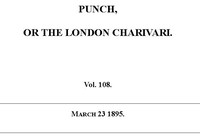
Punch or the London Charivari, Vol. 108, March 23, 1895 by Various
Let's be clear: this isn't a novel with a single plot. Punch, or the London Charivari was a weekly magazine, and this volume is a snapshot of one week in March 1895. Think of it as a historical blog or a proto-social media feed. The 'story' it tells is the story of its moment. You flip through pages of political satire, short humorous pieces, poetry, and, most famously, iconic cartoons.
The Story
The 'plot' unfolds in the topics it chooses to mock. One page might feature a cartoon about the ridiculousness of the latest hat fashions for women, while another publishes a parody of a political speech. There are jokes about train travel, observations about servants, and witty comments on new inventions. It's a mosaic of what was on people's minds. There's a recurring cast of illustrated characters, like the iconic cartoon figure of John Bull, who represent British attitudes. The narrative is the collective sigh, chuckle, and eye-roll of a nation navigating the end of the 19th century.
Why You Should Read It
I loved this because it makes history human. Textbooks tell you about the policies; Punch shows you how people felt about them. The humor is often surprisingly accessible. Yes, some references are obscure, but many jokes about bureaucratic nonsense or social pretension are timeless. It's also a reminder that satire has always been a vital tool. The artists and writers weren't just being funny; they were holding a mirror up to society, pointing out its hypocrisies and silliness with a sharp, but usually polite, wit. Reading it, you get a real sense of the personality of the age.
Final Verdict
This is perfect for history buffs who want to move beyond dry facts, for fans of satire wondering about its roots, or for anyone who enjoys people-watching. It's not a cover-to-cover read; it's a book to dip into. You might spend fifteen minutes giggling at a cartoon about bicycles and then stumble upon a piece that gives you genuine insight into the class tensions of the era. It's a conversation starter and a unique window into the past. Approach it like a museum visit for your brain—wander, observe, and be delightfully surprised.
The copyright for this book has expired, making it public property. Knowledge should be free and accessible.
Mark Miller
7 months agoTo be perfectly clear, the arguments are well-supported by credible references. A valuable addition to my collection.
Ashley Davis
1 year agoFrom the very first page, the plot twists are genuinely surprising. Worth every second.
Susan Taylor
2 years agoI stumbled upon this title and the narrative structure is incredibly compelling. One of the best books I've read this year.


Barbara Martinez
2 months agoHaving read the author's previous works, the emphasis on ethics and sustainability within the topic is commendable. A solid investment for anyone's personal development.