
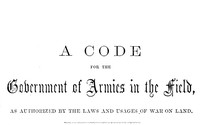
A Code for the Government of Armies in the Field, by United States. War Department et al.
Forget what you think you know about dry military manuals. "A Code for the Government of Armies in the Field" (the Lieber Code) is a document born from crisis. President Lincoln needed rules for his Union generals during the Civil War, and he turned to a German-American professor, Francis Lieber, whose own sons were fighting on opposite sides. The result was the first attempt to systematically write down the laws of war for a modern army.
The Story
There isn't a traditional plot, but there is a powerful narrative tension. The 'story' is America wrestling with itself. As the war dragged on, questions piled up with no easy answers. What do you do with captured Confederate soldiers? How do you treat civilians in occupied territory? Can you use assassination or poison? The Code is the direct response—a series of 157 articles that draw a line in the bloody sand. It says prisoners must be fed and sheltered, not murdered. It forbids torture for information. It tries to protect people who aren't fighting. In essence, it argues that even in total war, humanity must have rules.
Why You Should Read It
This isn't just history; it's a mirror. Reading the Lieber Code is a raw, sometimes shocking experience. You see the birth of ideas we now take for granted, like distinguishing between soldiers and civilians. But you also see the grim allowances—the recognition that war is brutal and some suffering is inevitable. What hit me hardest was the palpable sense of urgency. This wasn't written in a quiet lecture hall years after the fact. This was written while the cannons were firing, by a man whose family was torn apart by the very conflict he was trying to civilize. That personal stake gives every line weight.
Final Verdict
Perfect for anyone interested in the messy reality of history, the origins of modern human rights law, or the Civil War beyond the battle maps. If you like books that explore the difficult choices people make under impossible pressure, this is a foundational text. It's a short, dense read, but it will stick with you, reminding you that the rules of decency are often written in our darkest hours.
This text is dedicated to the public domain. Share knowledge freely with the world.
Nancy Brown
1 year agoGiven the current trends in this field, the objective evaluation of the pros and cons is very refreshing. A rare gem in a sea of mediocre content.
Kimberly Lee
10 months agoI started reading this with a critical mind, the footnotes provide extra depth for those who want to dig deeper. This has become my go-to guide for this specific topic.
Elizabeth Flores
5 months agoFast paced, good book.
Oliver Johnson
1 year agoI had low expectations initially, however the flow of the text seems very fluid. I learned so much from this.








Linda Brown
1 year agoI stumbled upon this title during my weekend research and it addresses the common misconceptions in a very professional manner. Definitely a five-star contribution to the field.